
Sending money across borders is no longer limited to banks and international wire transfers. Today, businesses can choose from a growing range of payment methods, including local payout networks, digital wallets, card payouts, stablecoin-enabled settlement, and modern payment infrastructure.
The right choice depends on far more than transaction fees. Finance teams must balance settlement speed, foreign exchange costs, compliance requirements, payment visibility, reconciliation, and recipient experience across every payment corridor.
This guide explains how cross-border payments work, the different payment methods businesses use, and how to evaluate each option based on cost, speed, operational efficiency, and business requirements.
A cross-border payment is any transfer of money between individuals or businesses located in different countries. These payments may involve different currencies, banking systems, regulatory frameworks, and payment networks before funds reach the recipient.
Unlike domestic payments, international payments often require foreign exchange conversion, additional compliance checks, and coordination between multiple financial institutions. Depending on the payment route, settlement can happen through correspondent banking networks, local payment rails, card networks, digital wallets, or newer payment infrastructure such as stablecoin-enabled settlement.
For businesses, cross-border payments are used for supplier invoices, payroll, contractor payments, marketplace payouts, treasury operations, intercompany transfers, and international customer collections.
Domestic payments typically move within a single country's banking infrastructure, using one currency and one regulatory framework. Cross-border payments are different. They often involve multiple financial institutions, payment networks, currencies, and compliance requirements before funds reach the recipient.
Several factors contribute to this complexity:
These additional steps make international payments more expensive and operationally complex than domestic transfers. Understanding where this complexity comes from helps businesses choose the right payment method and avoid unnecessary costs.
Although the exact process varies by payment method and provider, most cross-border payments follow a similar journey.

The sender creates the payment by entering the beneficiary details, payment amount, currency, and any required supporting information. Businesses often initiate payments through banking portals, ERP systems, treasury platforms, or payment APIs.
The payment provider verifies beneficiary information such as bank account details, routing numbers, IBANs, SWIFT/BIC codes, wallet addresses, or local payment identifiers. Additional regulatory fields or purpose codes may also be required depending on the destination country.
Before funds are released, the payment passes through compliance checks, including sanctions screening, anti-money laundering (AML) monitoring, fraud detection, and KYC/KYB verification where applicable.
If the sender and recipient use different currencies, the payment is converted using the provider's foreign exchange rate. Some businesses fund payments from existing multi-currency balances, while others convert at the time of payment.
The provider selects the most appropriate route to deliver the funds. Depending on the corridor, this could involve correspondent banking, local payment rails, card networks, digital wallets, or stablecoin-enabled settlement.
Funds move through the selected payment infrastructure until they reach the beneficiary's bank account, wallet, card, or other supported destination. Settlement time varies depending on the payment route, destination market, and compliance requirements.
Once the payment is completed, businesses receive confirmations, transaction references, and settlement records that can be reconciled with bank statements, accounting systems, or ERP platforms.
While the underlying infrastructure may differ between providers, the objective remains the same: move funds securely, comply with local regulations, and deliver payments efficiently with clear visibility throughout the process.
The exact participants vary depending on the payment method, corridor, and provider. A simple bank transfer may involve only two financial institutions, while more complex payments can pass through multiple intermediaries before reaching the recipient.
The most common parties include:
The number of participants involved directly affects cost, settlement time, and payment visibility. Payments routed through fewer intermediaries are often easier to track and may involve lower operational overhead.
There is no single payment method that works best for every international transaction. The right option depends on the destination country, payment value, recipient preference, settlement requirements, regulatory considerations, and overall operating costs.
The table below compares the most common methods businesses use for international payments.
Each payment method serves a different business need. Traditional bank wires remain common for high-value transactions, while local bank transfers can reduce costs for recurring payouts. Card payments and digital wallets improve customer and recipient experience in many markets, whereas payout platforms simplify large-scale international disbursements.
Stablecoin-enabled payment infrastructure is also becoming an option for certain cross-border business use cases, particularly where companies require faster settlement, improved treasury efficiency, or cross-border liquidity outside traditional banking hours. However, businesses should carefully evaluate regulatory requirements, on/off-ramp capabilities, liquidity, accounting treatment, and compliance obligations before adopting these models.
The best payment method is rarely determined by speed or fees alone. Businesses should evaluate each option based on the specific payment corridor, operational requirements, recipient experience, and total cost of ownership.
The transfer fee is only one part of an international payment. The total experience depends on how the payment is routed, where currencies are converted, and how much visibility both the sender and recipient have throughout the transaction.
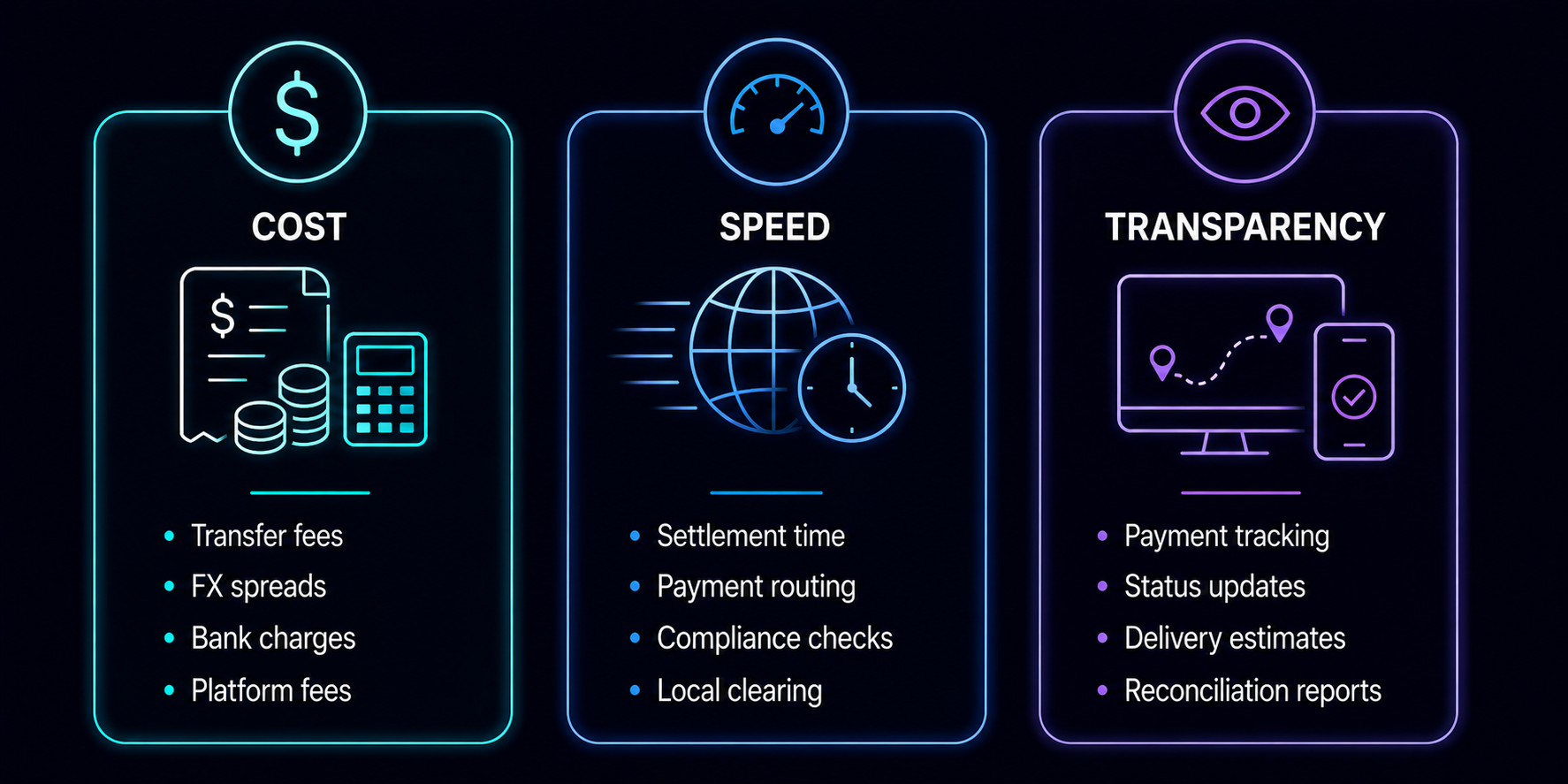
The total cost of a cross-border payment extends beyond the provider's advertised fee. Businesses should evaluate the complete cost of moving money internationally, including:
Looking only at the transfer fee can lead to inaccurate cost comparisons, particularly when FX margins or intermediary deductions make up a significant portion of the final expense.
Also read: How to Reduce Cross-Border Payment Costs Without Delays
Settlement time varies widely depending on the payment route, destination market, and compliance requirements. Factors that commonly influence delivery times include:
Faster isn't always better. Many businesses can reduce costs by choosing a lower-cost payment route when same-day settlement isn't essential.
Visibility throughout the payment journey has become just as important as speed.
Modern payment providers increasingly offer:
Greater transparency reduces support requests, simplifies reconciliation, and makes it easier to investigate delays or payment exceptions.
Rather than asking which payment method is "best," businesses should identify the payment method that best fits each use case.
Different payment types have different priorities. A supplier invoice, contractor payment, marketplace payout, and treasury transfer each have different requirements for settlement speed, cost, reporting, and operational controls.
Use the following framework when selecting a payment method.
Rather than standardizing on a single cross-border payment method, many businesses define routing policies for different payment categories. High-value supplier payments may prioritize traceability and settlement certainty, while recurring contractor payouts may focus on lower costs and local currency delivery.
Key evaluation factors include:
The most effective payment strategy often combines multiple payment methods rather than relying on a single global solution. Selecting the right route for each payment type helps improve settlement efficiency while reducing costs and operational complexity.
Businesses managing high payment volumes often rely on Cross-Border Payment APIs to automate payment initiation, beneficiary management, tracking, and reconciliation across multiple markets.
Compliance is not a separate step in a cross-border payment, it is part of the payment itself. Every international transaction must satisfy regulatory requirements before funds can move across borders.
Depending on the countries, currencies, and payment method involved, businesses may need to comply with requirements such as:
Responsibilities vary between providers. Some payment providers manage a larger share of the regulatory process under their own licensing framework, while others expect businesses to retain responsibility for customer onboarding, compliance, and regulatory reporting.
Before choosing a provider, clearly understand which compliance obligations remain with your business and which are handled by the provider.
International payments have become significantly more efficient, but businesses still encounter operational challenges that affect cost, settlement, and customer experience.
Some of the most common issues include:
Many of these challenges can be reduced by selecting providers that offer transparent pricing, local payout capabilities, real-time payment visibility, and structured reporting rather than relying solely on traditional international wire transfers.
Choosing a payment provider involves much more than comparing transaction fees. Businesses should evaluate how well a provider supports their payment corridors, operational processes, and long-term growth.
A practical evaluation framework includes the following areas:
No provider performs equally well across every corridor. Instead of relying on published averages, ask for corridor-specific pricing, settlement performance, and service-level commitments based on your actual payment flows.
Before migrating production payment volumes, run a pilot using one or two representative corridors. Compare total cost, settlement speed, payment visibility, reconciliation effort, and support responsiveness against your existing process.
Cross-border payments are evolving beyond traditional correspondent banking. Businesses now expect faster settlement, greater transparency, lower costs, and better integration with their finance systems.
Several trends are driving this shift:
While payment infrastructure continues to evolve, businesses should evaluate new technologies based on regulatory readiness, operational fit, and commercial value rather than speed alone.
Also read: Fastest Cryptocurrencies for Cross-Border Payments
Before launching a new cross-border payment process or migrating to a new provider, verify the following:
A phased rollout reduces operational risk and helps identify issues before they affect critical payment flows.
As international payments become more complex, businesses need more than a payment provider, they need infrastructure that delivers reliable settlement, transparent pricing, and operational visibility across multiple markets.
Fuze Finance helps businesses simplify cross-border payments through regulated payment infrastructure, competitive FX execution, local payout capabilities, and modern treasury workflows. Instead of managing multiple providers across different corridors, businesses can streamline international payments through a single platform designed for global operations.
Whether you're paying suppliers, contractors, marketplace sellers, or business partners, Fuze helps reduce operational complexity while improving payment visibility and settlement efficiency.


%20(1)%20(1).png)