
Cross-border payments are no longer limited to occasional supplier invoices or international wire transfers. As businesses expand globally, finance teams routinely pay overseas suppliers, contractors, marketplaces, subsidiaries, and customers while collecting funds from buyers in multiple countries.
Although these transactions all fall under the label of cross-border payments, they rarely share the same operational requirements. A supplier invoice in euros, a marketplace payout in Mexico, a contractor payment in the Philippines, and an intercompany treasury transfer each introduce different challenges around foreign exchange, compliance, settlement speed, payment visibility, and reconciliation.
Understanding those differences is often more valuable than comparing providers based solely on fees.
This guide explores the most common cross-border payment use cases and explains where modern payment infrastructure can create measurable operational value. Rather than focusing on individual products, it helps finance leaders evaluate when international payment workflows begin creating unnecessary cost, risk, delays, or administrative effort, and where improvements are likely to have the greatest impact.
Many businesses associate cross-border payments only with international wire transfers. In practice, the definition is much broader.
A cross-border payment is any movement of money where the payer, recipient, bank account, currency, payment rail, or regulatory jurisdiction crosses a national boundary.
That means a payment can still be considered cross-border even when it is denominated in US dollars. The beneficiary may be located overseas, settlement may occur through international banking infrastructure, or additional compliance requirements may apply because the transaction crosses jurisdictions.
Common business examples include:
A useful rule of thumb is simple: if your finance team manages foreign bank details, foreign exchange, international payment timing, country-specific regulations, or overseas settlement, you are operating cross-border payment workflows.
These flows can move in both directions. Outbound payments include suppliers, contractors, affiliates, subsidiaries, refunds, and claims, while inbound payments include ecommerce sales, SaaS subscriptions, tuition payments, insurance premiums, and customer deposits from overseas markets.
International payments have become a routine part of finance operations.
Companies source products from global suppliers, hire distributed teams, sell to customers in multiple countries, and operate platforms that move money across dozens of markets every day. As a result, cross-border payments have shifted from an occasional banking task to a core finance function.
At the same time, expectations have changed. Finance teams are no longer judged solely on whether payments are completed. Internal stakeholders increasingly expect predictable settlement times, transparent FX pricing, real-time payment visibility, fewer exceptions, and cleaner reconciliation at month end.
These priorities also align with broader industry initiatives. The G20's roadmap for enhancing cross-border payments focuses on making international payments faster, cheaper, more transparent, and more accessible, while the Financial Stability Board continues to monitor industry progress toward those objectives. Although policy development has advanced, businesses still experience inconsistent outcomes across payment corridors, making payment strategy an operational decision rather than simply a banking decision.
Ultimately, every organization has different requirements. A business sending a handful of international supplier payments each quarter faces very different operational challenges from a marketplace processing thousands of seller payouts every month. Understanding those differences is the first step toward selecting the right payment infrastructure.
Before comparing payment providers or technologies, finance leaders should first define where international payments are creating measurable operational friction.
The value of a better payment solution rarely comes from transfer fees alone. It often comes from eliminating inefficiencies that accumulate across payment operations.
When assessing existing workflows, consider:
These factors determine where improvements will have the greatest impact.
For some organizations, the largest opportunity is reducing FX leakage. For others, it may be eliminating failed payments, improving payment visibility, or reducing the time finance teams spend investigating payment exceptions.
Operational predictability is often just as valuable as lower costs. Payments that arrive on time, reconcile automatically, and generate fewer support requests can improve supplier relationships, reduce internal workload, and strengthen overall financial operations.
For many organizations, supplier payments are the first place where cross-border payment inefficiencies become visible.
International suppliers may invoice in foreign currencies, request payment through different banking networks, or expect funds to arrive without intermediary deductions. At the same time, accounts payable teams need reliable tracking, accurate FX reporting, and straightforward reconciliation.
Common questions include:
Traditional international wires remain widely used for high-value B2B transactions because they offer broad global coverage. However, they may also introduce correspondent-bank fees, uncertain settlement timelines, and additional reconciliation work.
Paying suppliers in their local currency can often improve the recipient experience by reducing FX uncertainty and helping vendors receive the expected invoice amount. Finance teams should still compare total landed cost, including provider fees, FX spreads, intermediary deductions, repair fees, and the operational effort required to resolve payment exceptions.
Supplier payments are frequently the best place to begin evaluating cross-border payment infrastructure because they expose many of the workflow challenges that finance teams face every day, from approvals and payment tracking to foreign exchange management and ERP reconciliation.
As companies build distributed teams, paying contractors, freelancers, consultants, creators, and other independent workers has become one of the fastest-growing cross-border payment use cases. Unlike supplier payments, these transactions sit at the intersection of finance, HR, legal, and operations, making consistency just as important as speed.
Recipients often depend on predictable payment schedules, so delays can quickly become support issues and damage trust. The operational challenge is not simply sending money internationally, it is building a repeatable process that scales across countries while maintaining compliance.
When designing these workflows, businesses should consider:
Payment infrastructure supports this process, but it does not replace legal or tax obligations. Worker classification, withholding requirements, and country-specific compliance should always be reviewed separately.
For finance teams, success comes from standardization. Accurate onboarding, structured beneficiary data, approval workflows, and payment-status visibility create a process that can scale without increasing operational overhead.
Marketplace businesses operate very differently from traditional finance teams. Instead of making occasional international payments, they often collect funds in one market while distributing thousands of payouts across many others. Recipients may include sellers, creators, publishers, affiliates, drivers, or business partners.
At this scale, even small inefficiencies become expensive. A single failed payout may be insignificant, but thousands of delayed or manually repaired payments can generate substantial operational costs across finance, customer support, and compliance teams.
Recipient experience also becomes part of the product itself. Sellers and creators increasingly expect transparent payout timing, local-currency delivery, payment tracking, and predictable fees. Poor payout experiences can directly affect retention.
Operationally, marketplaces need much more than payment execution. They require standardized onboarding, payout rules, tax-document collection, sanctions screening, account validation, payment thresholds, and reliable reconciliation.
Many platforms also need capabilities such as split payments, seller balances, refunds, chargeback allocation, and ledger-ready reporting. In these environments, payment infrastructure becomes part of the financial operating system rather than simply a way to move money.
Marketplaces, gig platforms, and fintechs often automate these high-volume payouts using a cross-border payments API that connects to multiple payout methods, currencies, and local payment rails through a single integration.
International ecommerce creates payment challenges on both sides of the transaction. Businesses must accept payments from customers across multiple markets while also managing refunds, disputes, and settlement across different currencies.
Customer trust often begins at checkout. Familiar local payment methods, transparent pricing, and the ability to pay in local currency can influence conversion rates as much as product or shipping costs.
Businesses can also use a dynamic QR code for payments to direct international customers to a payment link, digital wallet, or region-specific checkout page. Because the destination can be updated without reprinting the QR code, businesses can adapt payment options for different markets and currencies more easily.
For finance teams, however, the operational questions extend well beyond checkout. They need to understand:
Refunds deserve particular attention because they reverse the original payment flow. When foreign exchange is involved, accounting becomes more complex, especially if the refund occurs in a different reporting period than the original transaction.
Local acquiring and domestic payment methods can improve customer experience in many markets, but businesses should also evaluate settlement currency, reconciliation requirements, fraud management, and operational complexity before expanding payment options.
Cross-border payments are not only about paying external recipients. Many multinational businesses move funds between subsidiaries to support operations, centralize liquidity, fund local entities, or manage foreign-currency exposure. These transactions may involve intercompany loans, capital contributions, cash-pooling structures, or routine treasury funding.
Although the payment itself may appear straightforward, the surrounding treasury process is often far more complex. Timing, documentation, foreign exchange, approvals, and auditability usually matter more than the transaction fee itself.
Treasury teams should understand:
Visibility across bank accounts and legal entities is equally important. Better payment infrastructure can improve liquidity planning, strengthen payment controls, and simplify treasury reporting by providing a clearer view of balances, settlement status, and cash movement.
As organizations grow, they may also introduce payment factories, in-house banks, or payments-on-behalf-of (POBO) models to consolidate international payment operations. These structures can improve efficiency but require strong governance and system integration.
Certain industries place far greater emphasis on compliance, beneficiary verification, and auditability than on payment speed alone. For these organizations, cross-border payments form part of a broader regulated workflow rather than simply moving money internationally.
Examples include:
Each sector introduces its own operational priorities. In higher-risk environments, beneficiary verification, documentation, and regulatory controls frequently outweigh settlement speed.
Payment visibility also becomes increasingly important. Policyholders, patients, students, and customers often contact support teams when payments are delayed or unclear, making transparent payment tracking a customer-service requirement as much as a finance requirement.
In healthcare specifically, medical billing teams rely on this same payment visibility to reconcile reimbursements, track outstanding claims, and reduce revenue cycle delays
Organizations operating in regulated environments should therefore prioritize providers that offer strong controls, detailed audit trails, structured documentation, robust screening, and licensing that aligns with the jurisdictions in which they operate. No single payment solution is equally suited to every regulated industry.
Before comparing providers or payment technologies, it helps to understand how international payments move from sender to recipient.
Although individual payment rails differ, most cross-border transactions follow the same high-level journey:
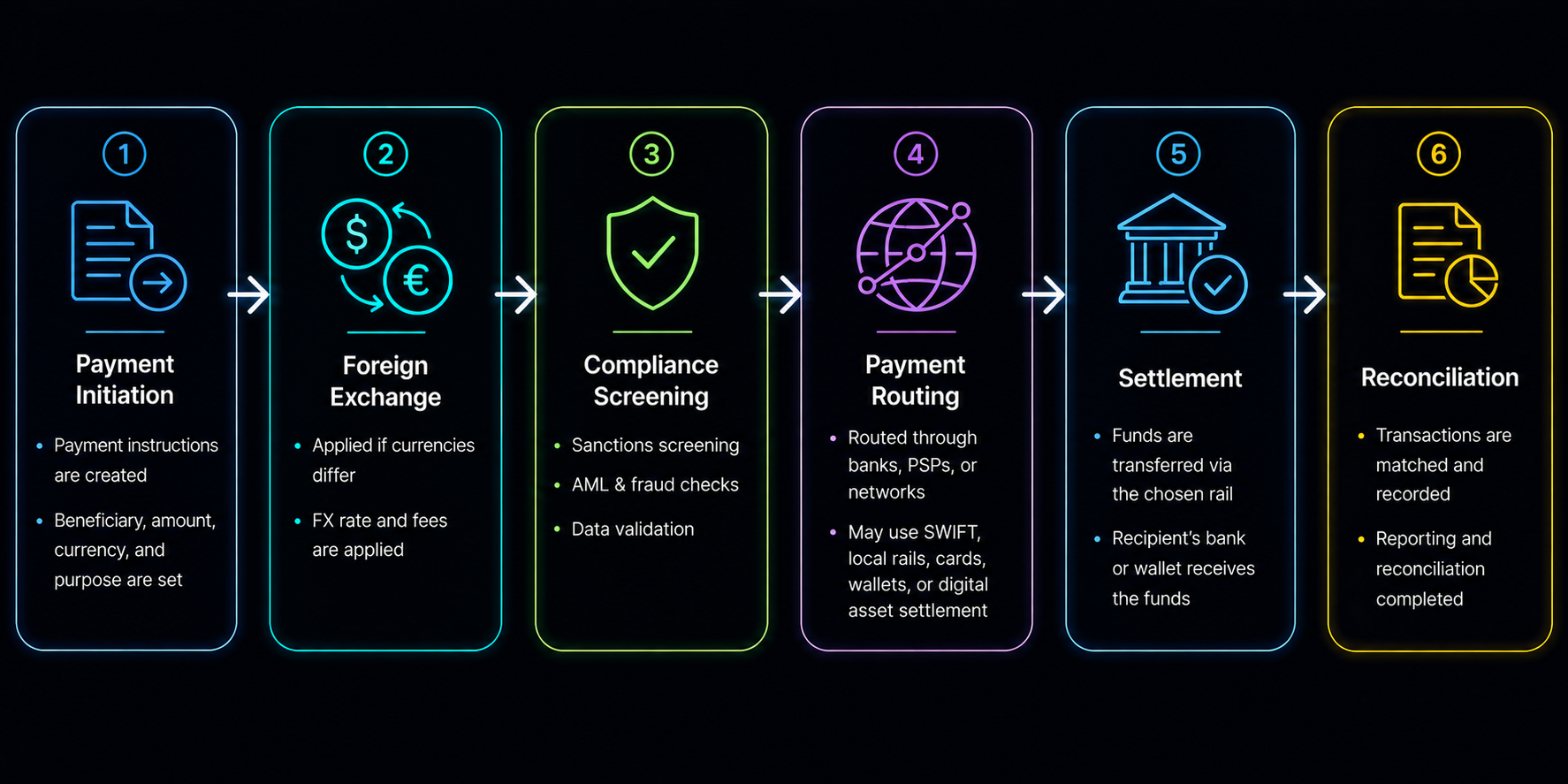
Payment initiation → Foreign exchange → Compliance screening → Payment routing → Settlement → Reconciliation
Each stage introduces different operational considerations.
The process begins when payment instructions are created, including the beneficiary, payment amount, currency, and payment purpose. If currencies differ, foreign exchange is applied before the transaction proceeds through compliance checks such as sanctions screening, AML controls, fraud monitoring, and data validation.
The payment is then routed through the appropriate infrastructure, which may include banks, SWIFT messaging, local payment systems, card networks, payment service providers, digital wallets, or, in some corridors, digital-asset settlement.
Finally, funds are settled to the recipient before finance teams receive the information required for reconciliation, including payment references, settlement amounts, FX data, fees, and accounting records.
The payment rail itself depends on the use case.
Traditional banks and SWIFT remain common for higher-value international business payments. Card networks are frequently used for ecommerce and certain payout scenarios. Local bank rails and global ACH can be effective for recurring lower-value payments, while fintech payment platforms increasingly combine payment routing, FX management, onboarding, reporting, and integrations within a single workflow.
Emerging digital-asset and stablecoin settlement models are also being explored for specific high-friction corridors, although businesses should carefully evaluate regulatory requirements, counterparty risk, accounting treatment, and compliance before adoption.
Ultimately, there is no universally superior payment rail. The right choice depends on the payment corridor, currencies involved, transaction value, settlement expectations, compliance obligations, and reconciliation requirements.
No single payment provider is the right fit for every business. The best solution depends on where you send money, how often you pay, the currencies you support, and the level of operational control your finance team requires.
Rather than comparing providers on price alone, evaluate them across the areas that have the greatest impact on day-to-day operations.
Evaluate if the provider supports the countries, currencies, payment methods, and recipient types, your business actually uses today, and those you expect to support in the future.
Understand how FX pricing is calculated. Compare quoted exchange rates against a consistent benchmark and determine whether pricing is transparent or embedded within wider spreads.
Review corridor-specific settlement expectations rather than relying on a single global SLA. Ask how providers handle cut-off times, holidays, payment delays, and failed transactions.
Good payment infrastructure should make it easy to answer a simple question: Where is my payment?
Look for real-time status updates, payment references, notifications, and reporting that reduce manual investigations.
International payments should integrate with your existing finance stack. APIs, ERP connectivity, reconciliation files, webhooks, and structured payment data reduce manual work and improve financial reporting.
Evaluate how the provider manages sanctions screening, AML controls, beneficiary verification, audit logs, approval workflows, and documentation requirements across different markets.
When payments fail, responsiveness matters. Review escalation processes, investigation timelines, local expertise, and the availability of dedicated support before making a long-term decision.
Ultimately, the best payment solution is the one that reduces operational complexity while maintaining visibility, compliance, and predictable settlement across every payment corridor.
Managing international payments becomes increasingly complex as businesses expand into new markets. Different currencies, payment methods, compliance requirements, settlement timelines, and reconciliation processes can quickly create operational overhead.
Fuze Finance helps businesses simplify these workflows through modern cross-border payment infrastructure designed for global operations. From international supplier payments and contractor payouts to marketplace disbursements and treasury transfers, businesses can access multiple payment corridors through a single platform while improving visibility across payment execution, foreign exchange, settlement, and reconciliation.
Whether your objective is reducing operational complexity, improving payment transparency, or supporting growth into new markets, the right payment infrastructure should help finance teams spend less time managing payments, and more time managing the business.


%20(1)%20(1).png)