
Finance teams often treat every international payment as the same type of transaction, with international wires becoming the default choice. While familiar, that approach can create unnecessary costs, settlement delays, intermediary deductions, and additional reconciliation work.
A more effective strategy is to choose payment methods corridor by corridor. Rather than relying on one payment rail for every transaction, treasury and finance teams should evaluate which method best fits each destination market, recipient type, payment value, urgency, and compliance requirement.
This guide explains how businesses can compare cross-border payment methods and build a repeatable routing strategy for supplier payments, contractor payouts, payroll, intercompany transfers, customer refunds, and marketplace disbursements across global markets.
Treating every overseas payment the same is one of the most common mistakes in cross-border payments.
International wires remain a reliable option for many high-value transactions because they are widely accepted and supported by banks worldwide. However, they may also involve correspondent banks, intermediary fees, operational cut-off times, payment investigations, and uncertainty around the amount ultimately received by the beneficiary.
The better question is not:
"How do we send an international payment?"
Instead, ask:
"What is the best payment method for this specific corridor, currency, recipient, and cross-border business use case?"
A payment corridor combines the sending country and currency with the receiving country and currency. For example:
Although both are international payments, they operate under completely different banking infrastructure, local payment systems, FX liquidity, compliance requirements, and recipient preferences.
Before selecting a payment method, businesses should evaluate:
Choosing the right payment method is therefore a balancing exercise. The best option minimizes cost while providing the appropriate level of settlement certainty, payment visibility, compliance, and recipient experience for that particular market.
Choosing the right payment method becomes much easier once you understand what happens after a payment is sent. Although the infrastructure varies between providers and payment rails, most cross-border payments follow the same high-level journey.
Funds are first collected from the sender, converted into the destination currency if necessary, screened against regulatory and compliance requirements, routed through one or more payment networks, delivered through the recipient's preferred payment method, and finally confirmed so both parties can reconcile the transaction.
At a simplified level, the payment journey looks like this:
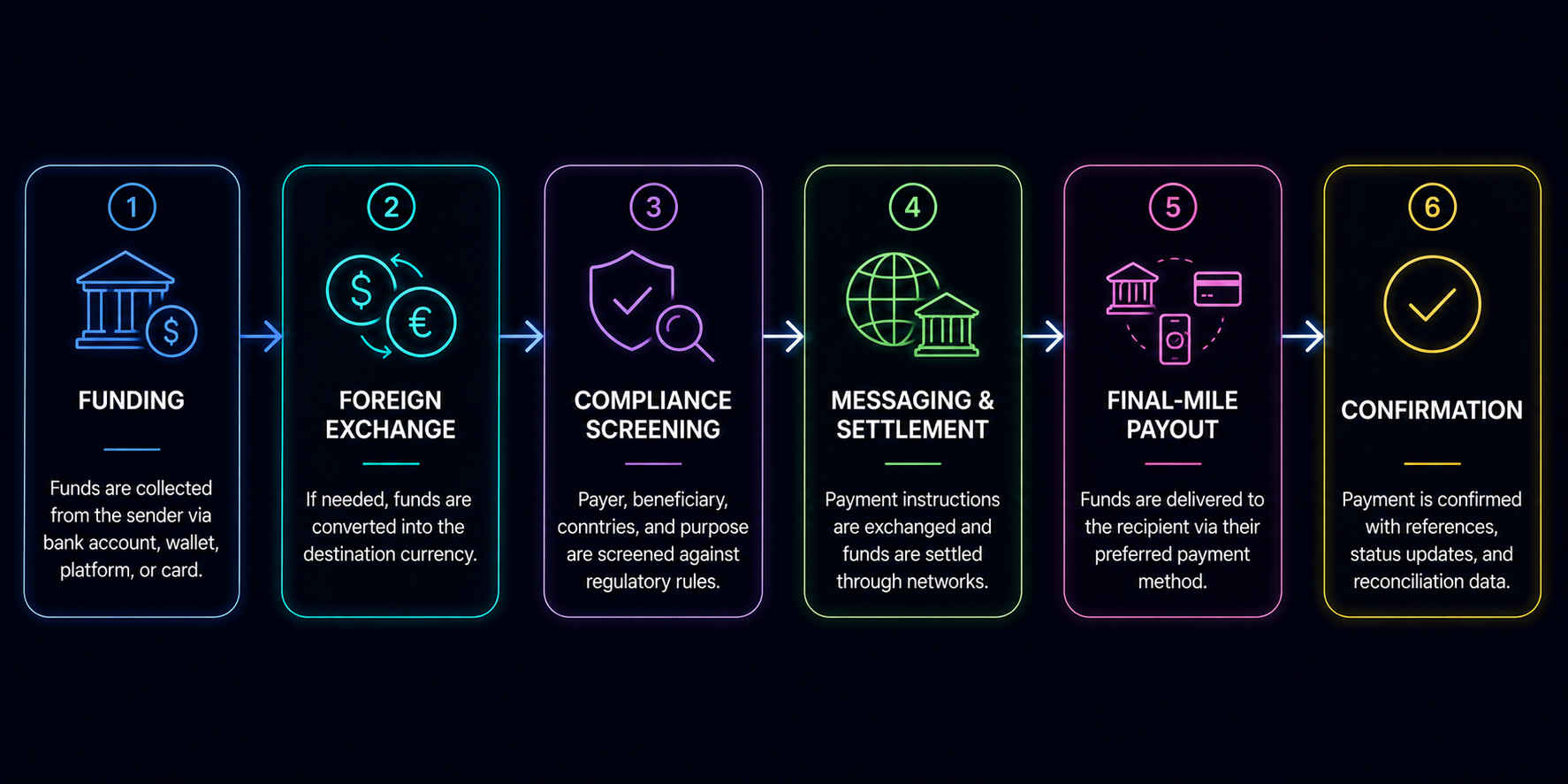
Each stage introduces its own operational considerations.
Understanding these stages helps explain why two international payments can have very different outcomes. One payment may settle within minutes, while another takes several days because the corridor requires additional compliance reviews, intermediary institutions, or manual processing.
It's also important to distinguish messaging speed from settlement speed. A payment instruction may be transmitted almost instantly, but that does not necessarily mean the recipient can immediately access the funds.
To gain more perspective, see our guide on the Fastest Cryptocurrencies for Cross-Border Payments.
For finance teams, payment visibility is just as important as settlement speed. Providers that expose clear payment statuses, references, and reconciliation data reduce investigation work, improve supplier communication, and simplify month-end close.
There is no single payment method that works best for every market. The right choice depends on the payment corridor, transaction value, recipient preferences, compliance requirements, and the level of speed or visibility the business requires.
The comparison below outlines the most common cross-border payment methods used by finance and treasury teams.
Businesses managing multiple payment methods across markets often automate routing through a cross-border payments API, allowing finance teams to connect a single integration while supporting multiple payment rails, currencies, and payout corridors.
Most organizations do not rely on just one payment method. Instead, they build a routing strategy that combines multiple rails for different scenarios. A recurring supplier payment may be sent through a local bank rail, while a high-value treasury transfer continues to use an international wire. In markets where bank access is limited, digital wallets or mobile-money payouts may provide a better recipient experience.
Rather than choosing a single "best" payment method, mature finance teams define a primary payment route, a fallback option, and a documented exception path for each important payment corridor.
Choosing the right payment method should be a repeatable operating process, not a decision that depends on individual experience. As businesses expand into new markets, documenting preferred payment routes helps reduce operational risk and creates consistency across finance, treasury, and payment operations.
Rather than deciding payment methods one transaction at a time, maintain a payment matrix for each major corridor.
The matrix should capture:
This becomes the operating playbook for recurring international payments and makes onboarding new markets significantly easier.
The importance of corridor-specific routing becomes clear when looking at individual markets.
Within the euro area, SEPA Instant allows participating payment service providers to credit euro transfers in as little as ten seconds, provided both institutions support the scheme.
In Brazil, Pix has become the country's primary instant payment infrastructure, enabling transfers within seconds throughout the day, including weekends and public holidays. Businesses should still consider transaction limits, fraud controls, and provider support before relying on Pix for cross-border payouts.
In India, UPI has transformed domestic payments through instant bank transfers. While its international use continues to expand, cross-border business payouts still depend on provider connectivity, local regulation, and compliance design.
In Mexico, SPEI enables near real-time electronic bank transfers and forms an important part of local payout infrastructure for businesses operating in the market.
Meanwhile, in the Philippines, organizations typically choose between PESONet for scheduled or batch transfers and InstaPay for lower-value payments that require immediate settlement.
These examples illustrate why payment strategies cannot simply be copied from one region to another. A method that performs well across Europe may not be the best option in Latin America or Southeast Asia, where payment infrastructure, documentation requirements, wallet adoption, and banking access differ significantly.
Payment method selection should reflect the business objective rather than following a single rule for every transaction.
The differences between payment types become much clearer when viewed through an operational lens.
High-value supplier invoices and treasury transfers generally prioritize settlement certainty, approval controls, traceability, and audit evidence. In these situations, paying slightly more for greater reliability is often justified.
Recurring supplier payments, contractor payouts, and payroll typically place greater emphasis on predictable settlement, automation, and low processing costs. Small improvements in unit economics can produce meaningful savings when payments are repeated every month.
Marketplace payouts and customer refunds have different priorities again. Recipient experience, payment success rates, and efficient reconciliation often matter more than absolute settlement speed.
Rather than relying on individual judgement, finance teams should document why each transaction type follows a particular payment route. Clear routing policies improve audit readiness, reduce operational inconsistency, and make payment decisions easier as transaction volumes grow.
The advertised transfer fee is only one part of the total cost of sending money internationally. A payment that appears inexpensive at initiation can become significantly more expensive once FX markups, intermediary deductions, payment investigations, and internal operational effort are taken into account.
To compare payment methods fairly, calculate the all-in landed cost for each major corridor and transaction type.
This includes:
A practical way to model this is:
All-in landed cost = Visible fees + Hidden fees + FX spread + Principal deductions + Failure costs + Operational handling time
Rather than analysing every international payment, start with your ten highest-volume or highest-value corridors. Compare international wires, local payout rails, global ACH, instant payment networks, and platform pricing where each option is available.
The amount received by the beneficiary is often a better performance indicator than the amount originally sent. Hidden deductions can make a seemingly inexpensive payment considerably more costly once it reaches the recipient.
Because provider pricing, FX conditions, and payment volumes change over time, landed-cost analysis should become a recurring finance exercise rather than a one-off procurement project.
Payment speed is only one dimension of payment performance.
A provider may process payment instructions almost immediately while settlement takes considerably longer. Likewise, funds may settle between financial institutions before they become available for the recipient to use.
For that reason, finance teams should evaluate four separate stages of payment performance:
Confirmation quality deserves equal attention. A payment that settles quickly but offers little visibility often creates unnecessary supplier queries, investigation work, and reconciliation effort.
Before adopting a payment method, answer a few practical questions:
The best payment method combines predictable settlement with clear operational visibility, not simply the shortest advertised delivery time.
Compliance should influence payment-method selection from the beginning, not after the payment has been initiated.
Some corridors require additional documentation, stronger approval workflows, enhanced sanctions screening, or local reporting obligations. These requirements can make one payment method considerably more suitable than another.
Areas that should be evaluated include:
High-value supplier payments and treasury transfers generally benefit from payment methods that provide stronger auditability, richer payment references, and clearly documented approval processes.
Conversely, high-volume recurring payouts often benefit from automated screening, structured payment data, and exception-based workflows that minimise manual intervention while maintaining compliance.
When operating in higher-risk jurisdictions or markets with additional regulatory requirements, businesses should define documented exception procedures before payments are sent. This reduces delays and avoids inconsistent operational decisions.
The goal is not to find a single "best" payment method. The goal is to choose the most appropriate payment method for each payment corridor and business scenario.
A simple decision framework helps finance teams make consistent routing decisions while reducing operational exceptions.
Use the following process for every major payment corridor:
This framework helps turn payment routing into a documented operating process instead of relying on individual judgement or historical habit.
Cross-border payment strategies should evolve alongside your business.
Entering new markets, increasing payment volumes, changing providers, or expanding into new currencies can all alter the economics of your payment operations.
A review is worthwhile when you notice:
Rather than waiting for operational problems, review your major payment corridors on a quarterly basis. Compare actual settlement times, cross-border payment costs, exception rates, and reconciliation effort against your internal targets.
Maintaining an up-to-date payment matrix, with a primary route, fallback option, and exception owner for every significant corridor, helps ensure routing decisions remain consistent as the business grows.
Selecting the right cross-border payment method is no longer about choosing between a wire transfer and an alternative. Modern finance teams need the flexibility to route payments based on the destination market, recipient preferences, settlement requirements, compliance obligations, and overall cost.
Fuze Finance helps businesses simplify that decision by providing access to modern cross-border payment infrastructure through a single platform. Instead of managing multiple providers across different markets, finance teams gain better visibility into payment routing, FX execution, settlement, and reconciliation while retaining the flexibility to choose the most appropriate payment method for each corridor.
Whether you're paying suppliers, contractors, employees, marketplaces, or subsidiaries, the objective remains the same: reduce unnecessary payment friction while maintaining speed, transparency, and operational control.


%20(1)%20(1).png)