
Digital assets are no longer limited to cryptocurrency trading. Today, banks, fintechs, payment providers, and enterprises use blockchain-based assets for stablecoin payments, treasury management, tokenized assets, embedded wallets, and cross-border settlement.
For businesses, understanding this infrastructure is becoming increasingly important. It influences how quickly products can be launched, how regulators assess the business, how assets are secured, and how operations scale over time.
This guide explains what digital asset infrastructure is, the core components that make it work, how enterprise architectures are designed, common business use cases, and the key decisions involved in building or buying the right infrastructure.
Digital asset infrastructure is the technology, compliance, custody, connectivity, and operational framework that enables businesses to issue, hold, transfer, settle, and manage blockchain-based assets.
It is much broader than a crypto wallet or a blockchain node. A wallet may allow a customer to view balances or initiate a transaction, but the infrastructure determines whether that transaction is permitted, who can authorise it, how the cryptographic keys are protected, how value is settled, and how every movement is recorded for finance and compliance teams.
In practice, digital asset infrastructure is the foundation that allows regulated financial products to operate safely on blockchain networks.
Enterprise platforms are typically built around four interconnected layers.
Rather than being a single application, digital asset infrastructure is an integrated operating stack that enables businesses to use digital assets within regulated financial products.
Digital assets have evolved beyond cryptocurrency trading into infrastructure for payments, treasury, settlement, and embedded financial products. Rather than viewing them as speculative assets, many businesses now use blockchain to move value more efficiently and build programmable financial services.
One of the biggest drivers is stablecoin payments, which enable faster cross-border transfers but still require regulated custody, liquidity, compliance, reporting, and settlement infrastructure. Treasury teams are also using digital assets to hold, convert, and move value while maintaining governance, accounting, and risk controls.
Financial institutions are exploring tokenized deposits and digital money, while asset managers are bringing real-world assets (RWAs) such as funds, bonds, and deposits onto blockchain networks. At the same time, embedded finance platforms are integrating wallets, custody, and compliance into existing products through infrastructure providers instead of building these capabilities internally.
For most businesses, the opportunity is not simply offering access to crypto. It is using digital asset infrastructure to build faster, more efficient financial products without compromising on security, compliance, or operational control.
Every enterprise digital asset platform is built from a collection of specialised infrastructure layers. Some businesses only require wallets and compliance, while others need custody, settlement, liquidity management, reporting, and tokenisation capabilities. The exact combination depends on the product being built, but most enterprise deployments rely on the following core components.
Not every business needs every component. A stablecoin payout platform may prioritise wallet infrastructure, settlement, compliance, and reporting, while a tokenisation platform may require issuance logic, transfer restrictions, custody, and investor eligibility controls.
The key is designing an infrastructure stack that matches the product being built rather than adopting unnecessary technologies or exposing the business to additional operational and regulatory complexity.
Also read our blog: Digital Asset Infrastructure Benefits for Fintechs
The easiest way to understand digital asset infrastructure is to follow the lifecycle of a single transaction. While implementations differ across providers, most enterprise platforms follow a similar sequence of checks before assets move.
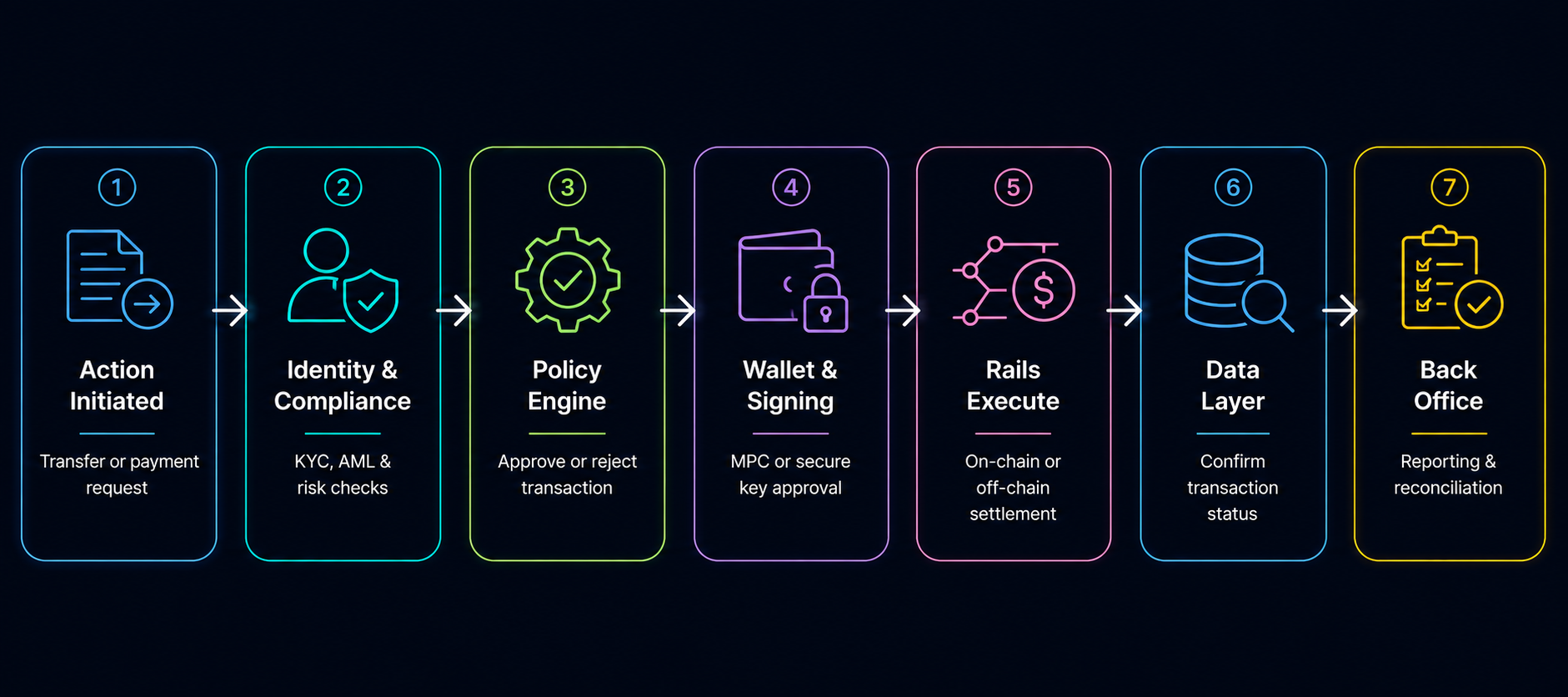
Most enterprise deployments are hybrid architectures. Asset movement may occur on-chain, while identity, legal agreements, approvals, accounting, and exception handling remain off-chain.
This hybrid model is important. It allows companies to use blockchain rails without abandoning the controls needed in regulated financial services.
Custody is one of the most important decisions in any digital asset architecture because control of digital assets ultimately depends on control of cryptographic keys. The custody model determines who can authorise transactions, how assets are protected, and how compromised or lost credentials are recovered.
A custodial model places key management with a regulated provider, reducing operational overhead while introducing third-party dependency. Self-custody gives organisations full control of private keys but also makes them responsible for security, governance, backups, recovery, and incident response.
Many institutional platforms use Multi-Party Computation (MPC), which distributes signing authority across multiple participants so a complete private key is never reconstructed, improving security without sacrificing operational flexibility. Others use multi-signature wallets, where multiple approvals are required before transactions can be executed, making them well suited to treasury management and corporate governance.
Businesses must also choose between omnibus wallets, which pool customer assets while tracking ownership through internal ledgers, and segregated wallets, which assign dedicated wallets to individual customers or entities. Omnibus models improve efficiency, while segregated wallets provide clearer asset separation at the cost of greater operational complexity.
When evaluating any custody model, businesses should answer four questions: Who controls the assets? Who can approve transactions? How are compromised keys recovered? And what governance controls prevent unauthorised transfers? These responsibilities should be clearly defined when working with infrastructure providers such as Fuze, where custody, wallet management, and transaction execution may be shared between the provider and the business.
Unlike traditional software, digital asset infrastructure operates within regulated financial environments, making compliance a core part of the infrastructure rather than an optional feature.
Depending on the products and jurisdictions involved, businesses may be subject to regulations covering payments, money transmission, custody, crypto-asset services, securities, stablecoins, and anti-money laundering. As a result, compliance controls must be built into every stage of the transaction lifecycle.
Enterprise platforms typically include KYC/KYB, AML monitoring, and sanctions screening to verify customers, detect suspicious activity, and identify high-risk counterparties. Many also support Travel Rule workflows for cross-border transfers and wallet risk scoring to detect exposure to sanctioned entities, hacks, mixers, scams, and other illicit activity.
Beyond regulatory checks, infrastructure platforms enforce operational controls such as transaction limits, approval workflows, jurisdiction restrictions, asset allowlists, destination controls, and audit logs, helping businesses maintain governance while providing a complete record for finance teams, auditors, and regulators.
For many organisations, partnering with a licensed infrastructure provider is more practical than building these capabilities internally. Providers such as Fuze Finance can manage regulated functions like custody, settlement, compliance, and stablecoin conversion, while businesses continue to own the customer experience and product. Although regulatory responsibility is shared, not eliminated, this approach significantly reduces the complexity of building and maintaining enterprise-grade compliance operations.
Enterprise settlement involves far more than broadcasting blockchain transactions. It coordinates blockchain networks, fiat payment rails, liquidity providers, custody systems, and internal ledgers to ensure value moves accurately and every transaction can be reconciled.
Although customers typically see a single account balance, the platform may be managing multiple wallets, bank accounts, liquidity pools, exchange connections, stablecoin balances, and accounting records behind the scenes.
Two settlement models are commonly used. On-chain settlement transfers ownership directly on a blockchain, requiring businesses to manage network fees, confirmation times, congestion, failed transactions, and differing finality assumptions. Internal ledger settlement updates balances within the platform before assets move on-chain, improving operational efficiency but requiring accurate reconciliation between customer balances, custody accounts, backing assets, and eventual blockchain settlements.
Settlement speed is often a key advantage of digital asset infrastructure, particularly for stablecoin payments and cross-border transfers. However, processing times still depend on compliance checks, liquidity availability, banking hours, and approval workflows. While blockchain networks operate 24/7, businesses must also account for fiat conversion windows, bank cut-off times, and customer support availability.
Liquidity and reconciliation are equally important. Payments can only be completed when the required assets, networks, and conversion routes are available, while finance teams must keep customer balances, wallet balances, pending transactions, fees, and accounting records synchronised to support reporting, audits, and financial controls.
Ultimately, settlement is not just a technical process, it combines payments infrastructure, financial operations, risk management, and customer experience to determine the reliability of a digital asset platform.
Digital asset infrastructure becomes valuable when businesses need secure, compliant, and programmable ways to move value. While the underlying technology remains largely the same, the infrastructure is configured differently depending on the product being built and the regulatory obligations involved.
Common examples include:
The exact infrastructure required varies by business model, jurisdiction, customer type, and regulatory obligations. Rather than building every component internally, many businesses use providers such as Fuze Finance to integrate regulated wallet infrastructure, custody, settlement, and compliance capabilities while focusing internal resources on their core product and customer experience.
One of the biggest decisions businesses face is whether to build digital asset infrastructure in-house or integrate an existing platform. The right choice depends on regulatory requirements, engineering resources, long-term strategy, and time to market.
Building internally provides greater control over the technology stack, customer experience, and operations, but it also means taking responsibility for licensing, custody, compliance, blockchain infrastructure, security, and ongoing maintenance.
Depending on the markets served, businesses may need payment, custody, money transmission, or crypto-asset licences, along with dedicated compliance teams and governance processes. They must also build secure custody systems, implement HSM or MPC architectures, establish recovery procedures, maintain audit controls, and operate continuous AML monitoring, sanctions screening, Travel Rule compliance, and regulatory reporting.
Supporting multiple blockchain networks adds further complexity, as each network has different transaction formats, fee models, node infrastructure, and confirmation rules. Businesses must also establish banking, liquidity, exchange, and payment partnerships while maintaining enterprise-grade monitoring, disaster recovery, and operational resilience.
For many organisations, partnering with a licensed infrastructure provider is the faster and more practical approach. Providers such as Fuze Finance can manage custody, compliance, settlement, liquidity, and regulated financial operations, allowing internal teams to focus on product development, customer experience, and business growth.
In practice, build versus buy is rarely an either-or decision. Many fintechs adopt a hybrid model, owning the customer-facing product while outsourcing infrastructure layers that are highly regulated, operationally complex, or strategically non-core.
Also read: Digital Asset Infrastructure Strategy: A Step-by-Step Guide
Choosing a digital asset infrastructure provider is about more than comparing APIs or supported blockchains. The right partner should align with your product roadmap, regulatory obligations, operational model, and long-term growth strategy. Before making a decision, evaluate providers across the following areas.
Start by defining exactly what you're building. A stablecoin payout platform has very different infrastructure requirements from a treasury solution, tokenization platform, or embedded wallet product.
Identify the assets you plan to support at launch and over time, whether those include fiat currencies, stablecoins, cryptocurrencies, tokenized deposits, or other digital assets. You should also consider the jurisdictions, customer types, and counterparties your product will serve, as these factors directly influence licensing and compliance requirements.
Understand which party is responsible for regulatory obligations throughout the customer lifecycle. Confirm whether the provider is appropriately licensed or authorised for the markets in which you plan to operate and determine how responsibilities for KYC, KYB, AML monitoring, sanctions screening, Travel Rule compliance, and regulatory reporting are divided.
It's equally important to understand how jurisdiction restrictions, prohibited assets, and high-risk wallets are identified and enforced within the platform.
Custody is one of the most critical areas to evaluate because it determines how digital assets are protected and who ultimately controls them.
Understand whether custody is provided directly by the platform or through a regulated third-party custodian. Review the custody model being used, whether custodial, MPC, multi-signature, omnibus, or segregated, and examine how transfer approvals, recovery procedures, emergency controls, and governance policies are implemented.
Evaluate how easily the infrastructure integrates into your existing technology stack. Review the available APIs, SDKs, webhooks, dashboards, and sandbox environments, and confirm support for the blockchain networks, payment rails, exchanges, and liquidity providers your business requires.
You should also understand how the platform handles practical operational challenges such as failed transactions, gas fees, network congestion, confirmations, and blockchain reorganisations.
Settlement capabilities should extend beyond simply moving assets between wallets. Ask how the provider reconciles customer balances, custody accounts, blockchain transactions, bank accounts, pending settlements, and network fees.
Review the reporting tools available for finance, accounting, compliance, audit, and customer support, and understand how the platform manages delayed, rejected, underpaid, or incorrectly routed transactions.
Finally, assess the provider's operational maturity. Review uptime commitments, disaster recovery procedures, incident response processes, and customer support SLAs. Understand how the platform responds to blockchain outages, banking disruptions, sanctions events, liquidity shortages, or infrastructure failures.
Enterprise buyers should also request independent assurance documentation such as SOC reports, penetration testing summaries, insurance information, financial stability indicators, and relevant security certifications before committing to a long-term infrastructure partner.
Businesses evaluating digital asset infrastructure often assume that blockchain technology automatically solves operational and regulatory challenges. In reality, the infrastructure is only as effective as the controls that sit around it. Understanding the most common misconceptions can help avoid costly implementation mistakes.
Blockchain networks provide transparent transaction records, but they do not perform customer verification, sanctions screening, AML monitoring, or regulatory reporting. These responsibilities still require dedicated compliance systems and operational processes. Compliance remains a business responsibility, regardless of the technology being used.
One of the biggest advantages of digital assets is faster settlement, particularly for stablecoin payments. However, shorter settlement times leave less opportunity to correct errors before funds move. Businesses still need strong approval workflows, transaction monitoring, liquidity management, and exception handling to reduce operational risk.
A blockchain token can represent ownership or a financial claim, but the legal rights associated with that token are defined by contracts, regulations, and the underlying issuer. Tokenization improves efficiency and programmability, but it does not replace the legal framework that determines ownership.
Many first-time buyers confuse wallet interfaces with custody. A wallet is simply the user interface used to interact with digital assets, while custody determines how cryptographic keys are secured, who can authorise transactions, how assets are recovered, and what governance controls protect against unauthorised transfers.
Enterprise platforms frequently use internal ledgers, omnibus wallets, pending settlement queues, and reconciliation processes alongside blockchain transactions. As a result, the balance visible on-chain may not always represent an individual customer's available balance. Finance and operations teams must continuously reconcile blockchain activity with internal accounting records.
Licensing requirements, supported assets, payment rails, stablecoin availability, and regulatory expectations vary significantly between jurisdictions. A provider that is well suited for one market may not support another. Businesses should evaluate infrastructure providers based on their specific product, geography, regulatory exposure, and long-term expansion plans rather than assuming one platform will meet every requirement.
Ultimately, selecting digital asset infrastructure is a business decision as much as a technical one. The right solution depends on the products being built, the markets being served, the regulatory obligations involved, and the level of operational control the organisation wants to retain.
Building digital asset infrastructure internally can require years of investment across custody, compliance, settlement, liquidity, wallet management, and blockchain integrations. For many fintechs and enterprises, partnering with a regulated infrastructure provider is the faster and more scalable path.
Fuze Finance provides the core building blocks businesses need to launch and scale digital asset products without assembling multiple vendors. Through a single platform, businesses can integrate embedded wallets, stablecoin payments, treasury infrastructure, fiat on/off ramps, custody, compliance workflows, and settlement capabilities using production-ready APIs.
Rather than managing separate providers for wallet infrastructure, transaction orchestration, compliance, reporting, and reconciliation, businesses can access these capabilities through one regulated operating layer. This simplifies implementation, reduces operational complexity, and shortens time to market while maintaining enterprise-grade security and governance.
Whether you're launching stablecoin payment products, embedded financial services, treasury operations, or cross-border settlement solutions, Fuze Finance provides the infrastructure needed to build securely, remain compliant, and scale with confidence.


%201.jpg)