
Digital asset infrastructure enables fintechs and enterprises to support stablecoin payments, crypto custody, tokenized assets, treasury operations, and blockchain settlement without building every underlying system from scratch.
The value goes beyond simply adding crypto capabilities. It helps businesses move money more efficiently, improve liquidity management, strengthen security and compliance, and launch new financial products faster.
This guide explains the key benefits of digital asset infrastructure, the operational challenges it solves, and how to evaluate providers when building a business case for adoption.
Financial institutions are under growing pressure to support faster payments, programmable settlement, stablecoins, tokenized assets, and digital custody while maintaining enterprise-grade security, compliance, and operational resilience.
Digital asset infrastructure provides the technology and operational foundation needed to deliver these services without building every component internally. It combines custody, settlement, compliance, reporting, and developer tooling into a single operating layer that supports digital asset workflows across finance, treasury, engineering, and compliance teams.
For most organizations, the business case comes down to five outcomes:
These benefits are becoming increasingly relevant as digital assets move into mainstream financial infrastructure. Global initiatives such as the G20 roadmap for cross-border payments continue to prioritize faster, cheaper, and more transparent international transfers, while stablecoins are increasingly being adopted for payments and settlement.
Digital asset infrastructure doesn't remove regulatory responsibility, but it can significantly reduce the operational complexity of launching and managing digital asset products.
Digital asset infrastructure is the technology and operational stack that enables businesses to securely store, transfer, settle, monitor, and integrate digital assets.
Rather than being a single product, it combines multiple infrastructure layers that support digital asset operations across engineering, finance, treasury, compliance, and security teams.
Most enterprise platforms include:
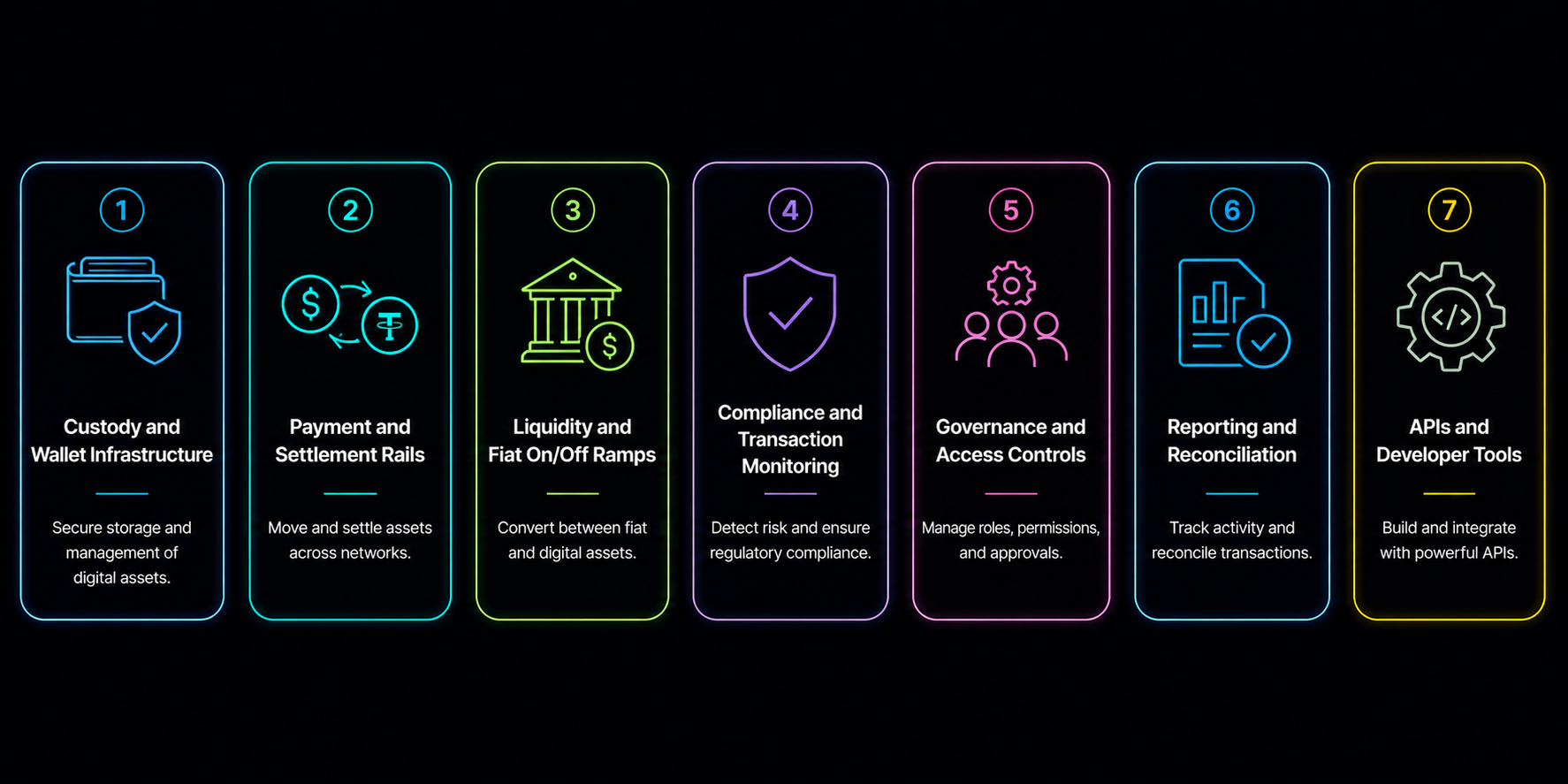
Together, these components allow businesses to offer digital asset services without managing every technical and operational function internally. The goal isn't simply blockchain connectivity, it's creating secure, compliant, and repeatable financial workflows.
Also read: Digital Asset Infrastructure Strategy: A Step-by-Step Guide
Adding digital asset capabilities involves far more than integrating with a blockchain. The real complexity lies in operating the surrounding infrastructure securely and compliantly.
Businesses must manage private keys, custody, compliance workflows, wallet funding, blockchain monitoring, liquidity, reconciliation, and audit evidence. As transaction volumes, supported assets, and jurisdictions grow, these operational demands increase rapidly.
Common challenges include:
Rather than building these capabilities internally, many organisations use infrastructure providers to reduce operational complexity while allowing product and engineering teams to focus on customer experience and product innovation.
One of the biggest advantages of digital asset infrastructure is faster movement of value. Stablecoin and blockchain-based settlement can support near real-time, 24/7 transfers for cross-border payments, treasury operations, merchant settlement, and tokenized asset workflows.
Faster settlement can also improve liquidity by reducing capital tied up in prefunded accounts, correspondent banking networks, or delayed payout cycles. Treasury teams benefit from greater cash visibility and more efficient liquidity management, improving forecasting and reducing manual funding movements.
For example, a payment service provider may use stablecoins as the settlement rail while merchants continue receiving familiar fiat payouts. Similarly, enterprise treasury teams can move liquidity between entities using stablecoins while continuing to reconcile balances in local currencies.
Settlement speed, however, still depends on factors such as compliance checks, liquidity availability, blockchain finality, banking cut-off times, and local corridor rules. Digital asset infrastructure improves the underlying rails, but overall processing time remains influenced by the broader payment ecosystem.
Digital asset infrastructure does not transfer regulatory responsibility, but it makes compliance significantly easier to operationalize. This is particularly valuable because digital asset products combine traditional financial crime controls with blockchain-specific monitoring and reporting requirements.
Rather than building compliance capabilities from scratch, businesses can integrate infrastructure that supports customer onboarding, AML and sanctions screening, transaction monitoring, Travel Rule workflows, wallet risk assessment, jurisdiction-based controls, audit logging, and regulatory reporting. These capabilities are expensive to develop and maintain internally, especially as regulations continue to evolve across different markets.
While infrastructure providers can simplify day-to-day compliance operations, businesses remain responsible for understanding their legal obligations, licensing requirements, and regulatory role in every jurisdiction where they operate. The real advantage is not outsourcing compliance, but reducing the operational burden of implementing and maintaining the controls needed to support regulated digital asset services.
Many digital asset failures are caused less by blockchain technology itself than by weak operational controls. Poor key management, unclear approval processes, inadequate reconciliation, and insufficient audit trails often create greater risk than software vulnerabilities.
Digital asset infrastructure addresses these challenges by providing institutional controls for custody, transaction approvals, permission management, reconciliation, disaster recovery, and incident response. Features such as MPC or multisignature signing, role-based permissions, transaction policies, segregation of duties, and detailed audit logs help organisations establish consistent governance across treasury, custody, payments, and settlement operations.
As a result, businesses can reduce operational risk while improving accountability and resilience. When evaluating infrastructure providers, organisations should look beyond technical security features and assess how well the platform supports day-to-day operational controls, governance processes, and incident management.
The first digital asset use case is rarely the last. As businesses expand into new markets, support additional assets, or increase transaction volumes, operational complexity grows quickly. Similar to how specialized fintech platforms and consumer-focused providers manage workflows like Achieve debt solutions to streamline client servicing at scale, digital asset infrastructure provides a common operating layer that standardizes workflows across the business. Managing wallets, settlement, compliance, reporting, and reconciliation separately for every new product soon becomes difficult to sustain.
Digital asset infrastructure provides a common operating layer that standardizes these workflows across the business. Rather than rebuilding integrations for each blockchain or payment corridor, teams can reuse the same infrastructure for wallet provisioning, settlement, transaction monitoring, reporting, and policy enforcement. This reduces engineering effort while keeping operational processes consistent as the business scales.
Modern platforms also simplify day-to-day operations by providing APIs, operational dashboards, policy engines, automated wallet provisioning, multi-chain connectivity, and reconciliation tools that work across blockchains, custodians, banks, and internal ledgers. Instead of adding operational overhead as the business grows, infrastructure helps organisations scale while maintaining consistent controls.
For finance teams, the value goes beyond technical scalability. A unified infrastructure improves reporting, strengthens governance, and simplifies reconciliation across both digital asset and traditional payment rails.
Building digital asset products internally requires much more than blockchain integration. Teams must also develop wallet infrastructure, custody systems, compliance workflows, settlement capabilities, reporting, and operational controls before a product can be launched.
Digital asset infrastructure significantly shortens this process by providing these capabilities as managed services. As a result, product teams can spend more time designing customer experiences and less time building foundational infrastructure.
This makes it easier to launch products such as stablecoin payment solutions, embedded wallets, cross-border payout services, digital treasury platforms, tokenized asset products, institutional trading capabilities, and custody services without developing every component internally.
Rather than launching multiple use cases at once, most organisations achieve better results by starting with a focused pilot. A single asset, customer segment, or payment corridor allows teams to validate operational processes before expanding. Success can then be measured using practical metrics such as settlement times, transaction success rates, reconciliation effort, customer adoption, and operational efficiency.
The build-versus-buy decision should be based on long-term operating costs rather than development effort alone. Building a digital asset platform requires far more than blockchain engineering. Organisations must also maintain custody systems, security controls, compliance operations, liquidity partnerships, reporting infrastructure, and ongoing regulatory oversight.
For many fintechs and enterprises, these capabilities are not competitive differentiators. Integrating an infrastructure provider allows internal teams to focus on customer experience, product innovation, pricing, and distribution while relying on specialist providers for custody, settlement, compliance, and operational infrastructure.
Infrastructure partners can also shorten time to market by providing mature wallet infrastructure, custody services, compliance tooling, APIs, reporting, and integrations with banks, custodians, liquidity providers, and payment networks. As regulations and blockchain ecosystems continue to evolve, maintaining these capabilities internally becomes an increasingly resource-intensive exercise.
Building may still be appropriate for organisations with highly specialised requirements, significant engineering resources, or a strategic need to own the full infrastructure stack. For most businesses, however, partnering for the infrastructure layer provides a faster and lower-risk path while preserving ownership of the customer experience and product strategy.
Choosing a provider requires more than comparing feature lists. The most important question is how the platform supports an end-to-end operating workflow, from customer onboarding and compliance checks through settlement, reconciliation, reporting, and ongoing operations.
A strong provider should demonstrate robust regulatory coverage, secure custody models, mature compliance capabilities, reliable infrastructure, and well-documented APIs. Businesses should also evaluate how the platform handles operational scenarios such as failed transactions, liquidity shortages, blockchain outages, incident response, and audit requests, as these often determine day-to-day reliability more than individual features.
Due diligence should extend beyond technology. Review the provider's security certifications, audit reports, supported jurisdictions, custody arrangements, reporting capabilities, operational support, pricing model, and business continuity processes. Understanding how data, assets, and customer accounts can be migrated if the relationship ends is equally important for long-term risk management.
Ultimately, the strongest providers are those that can explain not only how their technology works, but also how they support governance, compliance, operational resilience, and financial controls throughout the lifecycle of every transaction.
Rolling out digital asset infrastructure is most effective when approached in phases. Rather than supporting multiple products and markets from day one, organisations should begin with a clearly defined use case, such as cross-border payouts, merchant settlement, stablecoin treasury, or embedded wallets, and validate the operational model before expanding.
The next step is to map regulatory obligations, select an appropriate custody model, and integrate the platform with existing finance, treasury, accounting, and operational systems. Before production, businesses should also establish approval policies, transaction limits, reconciliation processes, incident response procedures, and operational runbooks to ensure teams can manage the platform effectively.
A controlled pilot allows organisations to test settlement, compliance, reporting, and operational workflows under real conditions while limiting risk. Once governance and operational processes are proven, additional assets, corridors, customer segments, and blockchain networks can be introduced incrementally.
Success should be measured using practical metrics such as settlement time, transaction success rates, compliance review times, reconciliation accuracy, support volume, liquidity utilisation, and operational reliability.
Building digital asset infrastructure requires far more than blockchain connectivity. Businesses need secure custody, stablecoin payment rails, liquidity, compliance controls, treasury workflows, reporting, and enterprise-grade APIs that can operate reliably at scale.
Fuze Finance provides this infrastructure through a single platform, enabling fintechs, banks, payment providers, and enterprises to launch stablecoin payments, digital wallets, custody, treasury, and embedded digital asset products without building every component from scratch. With regulated infrastructure, institutional security, integrated compliance, and developer-friendly APIs, businesses can focus on delivering customer value while relying on Fuze for the underlying operational complexity.
Whether you're modernizing cross-border payments, building embedded finance products, or expanding digital asset capabilities, Fuze Finance provides the infrastructure needed to move from pilot to production with confidence.


%201.jpg)