
Digital asset records become high-risk faster than most teams expect. Wallet records, tokenized assets, smart contracts, customer identity documents, and consent records all affect ownership, transferability, regulatory compliance, and audit requirements.
Digital asset infrastructure governance is the operating model for managing these records throughout their lifecycle. It defines how assets are created, accessed, transferred, modified, retained, and evidenced, and ensures governance policies are consistently enforced across products, teams, and jurisdictions.
This guide explains how to build a governance framework covering asset inventory, ownership, permission controls, rights management, and audit evidence.
Governance defines how digital assets and related records are created, stored, accessed, transferred, modified, retained, and audited throughout their lifecycle. Rather than starting with tools, start with the policies, ownership structures, and controls needed to manage assets consistently and meet regulatory requirements.
For fintechs, this means governance must cover regulated financial records, tokenized assets, custody operations, customer data, and legally significant ownership information, not just file organisation. Compliance, transfer restrictions, investor rights, and audit evidence all need to be addressed from the start.
Practical checkpoint: Write a one-page governance charter defining the governed assets, regulated workflows, ownership responsibilities, audit evidence requirements, and escalation procedures before selecting any tools.
Governance starts with knowing what needs to be governed. Create a complete inventory covering customer records, contracts, wallet and custody records, tokenized assets, smart contracts, audit logs, reconciliation records, and operational evidence.
Then map the lifecycle of each asset, from creation and approval through storage, access, transfer, modification, retention, and disposal. Some assets will also move through states like suspension, legal hold, or revocation depending on regulatory requirements.
Lifecycle mapping exposes where controls, approvals, and audit evidence are required and surfaces processes that rely on manual intervention or undocumented knowledge.
Practical checkpoint: Build a lifecycle matrix for each asset class showing every stage, required approvals, applicable regulatory controls, and audit evidence that must be retained.
Every governed asset and high-risk workflow needs clearly assigned owners. Without this, accountability gaps and inconsistent decisions are inevitable.
A typical fintech governance model assigns ownership across compliance teams, security and IAM teams, legal, custody operations, audit, and incident response. Each role covers a specific aspect, from enforcing regulatory requirements and managing custody operations to validating controls and responding to incidents.
Governance also depends on separation of duties. The same person should not define policy, approve high-risk actions, execute them, and validate the evidence. Separating these responsibilities reduces operational risk and strengthens internal controls.
Practical checkpoint: Create a RACI matrix for high-risk workflows such as custody transfers, permission changes, asset creation, and disposal. Review it regularly as teams and regulatory requirements change.
Metadata enables organisations to identify assets, enforce policies, manage lifecycles, and produce reliable audit evidence. Without consistent metadata, access controls, compliance checks, and governance decisions become unreliable.
For fintech infrastructure, a governance-ready metadata model should capture asset ID, owner, source system, jurisdiction, classification, lifecycle status, retention requirements, legal rights, approval state, and where relevant, custody, settlement, or transferability details. These attributes allow systems to automate governance decisions, from enforcing transfer restrictions to flagging expired licences or legal holds.
Every metadata field that drives access control, compliance, or reporting should have a defined source of truth, controlled values, an assigned owner, and documented update procedures.
Practical checkpoint: Document the source of truth, permitted values, owner, validation rules, and evidence requirements for every metadata field that supports governance decisions.
Permissions should define what actions users can perform, not just whether they can access an asset. A strong governance model controls actions including viewing, approving changes, initiating transfers, managing permissions, and performing privileged administrative tasks.
These permissions should follow least privilege, users receive only the access required for their role, and separation of duties, no individual can independently create, approve, transfer, delete, and audit the same high-risk asset. These controls are especially important for custody operations, treasury management, and tokenized assets.
Administrative privileges should be protected through enhanced authentication, detailed logging, regular access reviews, and automated provisioning.
Practical checkpoint: Create a permissions matrix mapping business roles to permitted actions. Identify conflicting combinations such as initiating and approving transfers, or deleting records while managing audit logs.
Role-based access control works well in straightforward environments but breaks down when access depends on jurisdiction, asset sensitivity, ownership, or lifecycle stage. For example, access to a tokenized asset may depend on investor eligibility or completed KYC, not just job title.
In these cases, extend role-based controls with attribute-based access control. Instead of relying on roles alone, the system evaluates user attributes, asset attributes, and contextual factors before granting access. This enables policies that require additional approval, enforce transfer restrictions, or automatically revoke access when regulatory conditions change.
Practical checkpoint: Start with attribute-based policies for high-risk scenarios, cross-border access, restricted token transfers, expired licences, then expand coverage as governance matures.
Rights governance defines who can use, hold, transfer, or modify a digital asset, and under what conditions. While permissions control access, rights governance establishes the legal and commercial rules that govern an asset throughout its lifecycle.
Each asset should maintain records covering ownership, customer consent, investor eligibility, contractual obligations, transfer restrictions, permitted uses, geographic limitations, expiry dates, and revocation triggers such as failed KYC, sanctions updates, or licence expiration. For tokenized assets, legal ownership and investor rights continue to exist off-chain even when the token moves on-chain.
Practical checkpoint: Maintain a rights register for every asset class recording ownership, permitted uses, transfer restrictions, expiry dates, revocation triggers, and supporting evidence.
Governance works best when policies are built into operational workflows, not stored in separate documents. High-risk activities, custody transfers, smart contract deployments, permission changes, deletion of regulated records, should automatically trigger required approvals, validations, and evidence collection.
Key operational safeguards include dual approval for high-risk actions, time-bound permissions, step-up authentication, documented exceptions, and approval records linked directly to the relevant asset.
Practical checkpoint: Document the approval process for your highest-risk workflows, triggers, approvers, required evidence, exception handling, expiry rules, and audit events.
Audit trails should explain what happened, who authorised it, and which policy governed the decision, not just log system activity. This is essential for regulatory reviews, internal audits, and customer disputes.
Capture all significant lifecycle events: asset creation, access, modifications, approvals, transfers, permission changes, rights updates, and on-chain or off-chain asset movements. For custody and tokenized assets, reconcile blockchain records, custody systems, client positions, and legal documentation.
At audit time, your team should be able to generate a single evidence pack — asset record, metadata history, approvals, access logs, rights documentation, custody records, reconciliation status, and exceptions, without pulling from multiple systems.
Practical checkpoint: Regularly test evidence pack retrieval for high-risk assets under real scenarios: regulator request, customer dispute, internal audit.
Every governance control should directly support a regulatory or business obligation. AML/KYC controls rely on accurate identity, jurisdiction, and transfer eligibility data. Custody controls depend on ownership records, segregation evidence, and asset movement logs. Privacy and securities regulations require governance over customer information, investor rights, and legal ownership records.
Map each control to the obligation it supports. This simplifies compliance reviews, highlights gaps, and makes regulatory examinations faster.
Practical checkpoint: Build a governance crosswalk linking regulatory obligations to asset classes, permissions, workflows, audit logs, retention rules, control owners, and evidence locations.
Start by inventorying governed assets, assigning ownership, and identifying high-risk workflows. Then establish metadata standards and validation rules. Once foundations are in place, strengthen permissions, formalise rights management, and embed approvals into critical workflows. The final phase focuses on continuous governance, monitoring, reconciliation, evidence management, and regular control reviews.
Track progress using KPIs: metadata completeness, stale permissions, expired rights, privileged access exceptions, reconciliation issues, audit evidence retrieval times, and the percentage of high-risk workflows covered by dual approval.
Also read: Digital Asset Infrastructure Strategy: A Step-by-Step Guide
Building digital asset infrastructure in-house requires significant investment in custody, compliance, settlement, security, and ongoing operational management. Fuze Finance enables businesses to launch regulated digital asset products without building these complex infrastructure layers from scratch.
With enterprise-grade APIs, regulated infrastructure, and operational support, Fuze Finance helps fintechs, financial institutions, and enterprises integrate digital asset capabilities while maintaining full control over their customer experience.
Fuze Finance provides:
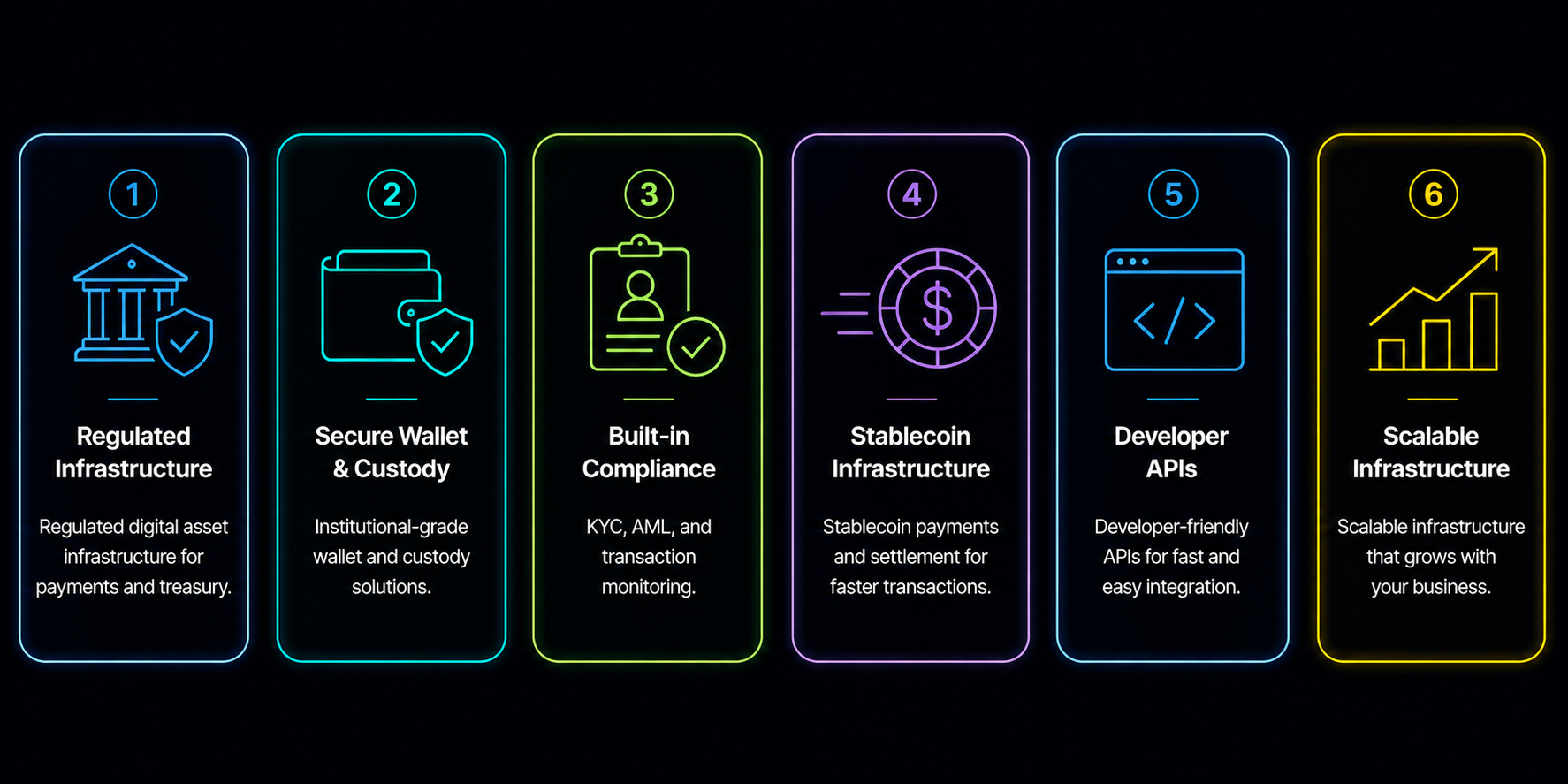
Instead of spending years building regulated infrastructure internally, businesses can focus on product innovation while relying on Fuze Finance to manage the underlying infrastructure that powers secure, compliant, and scalable digital asset operations.


%201.jpg)