
Digital asset products are becoming part of mainstream financial services, but launching them safely requires much more than integrating a blockchain or adding wallet functionality. Fintechs must decide how customer assets will be held, which regulations apply, who authorizes transactions, how funds are reconciled, and what happens when something goes wrong.
This guide explains how to build a practical digital asset infrastructure strategy, from defining the product and regulatory perimeter to selecting custody models, evaluating providers, rolling out infrastructure in phases, and measuring long-term operational success.
Digital asset infrastructure is the combination of technology, custody, compliance, settlement, wallets, data, and operational controls that enables fintechs to safely support stablecoins, crypto assets, tokenized deposits, securities, and other digital assets. It is not simply blockchain connectivity, but the operating environment that governs how value is stored, transferred, monitored, and reconciled.
Every digital asset workflow raises practical questions: Who owns the asset? Who authorizes transactions? Who performs compliance checks? How is settlement reconciled? How are incidents handled? Answering these questions requires more than blockchain, it requires coordinated controls across engineering, finance, treasury, compliance, and operations.
A complete infrastructure stack typically includes wallet and key management, custody, blockchain connectivity, payment rails, compliance tooling, transaction monitoring, reporting systems, APIs, and governance controls. For tokenized assets, legal ownership, investor rights, custody arrangements, and dispute resolution often remain partly off-chain, while blockchain records transfers and settlement events.
Practical checkpoint: Create a one-page infrastructure overview that identifies every core layer- wallets, custody, settlement, compliance, reporting, and governance, and assign a clear business owner and system of record for each.
A successful digital asset infrastructure strategy begins by defining the financial product, not by choosing a blockchain, wallet SDK, or custody provider. Technology should support the business model rather than determine it.
Start by identifying the workflow your product enables, whether stablecoin payments, cross-border settlement, embedded wallets, crypto investing, treasury operations, tokenized assets, loyalty programs, or institutional custody. Then map the complete customer journey, from onboarding and funding to custody, transfers, redemption, reporting, and support, while documenting the asset type, jurisdictions, counterparties, and whether your business controls customer assets, transaction approvals, or private keys.
This classification shapes every downstream decision, including regulatory obligations, custody architecture, compliance controls, vendor selection, and implementation planning. A stablecoin payout product, for example, requires a very different operating model from a tokenized investment platform or an internal treasury solution.
Practical checkpoint: Document the complete customer journey, from onboarding to settlement, and identify the supported asset, jurisdictions, counterparties, regulatory obligations, and where your business controls customer assets, approvals, or private keys before evaluating infrastructure providers.
Regulatory obligations depend on the financial activity your business performs, not on how the product is marketed. Whether described as a wallet, treasury tool, rewards platform, or Web3 feature, any service involving customer assets, payments, custody, or exchanges may trigger financial-services regulation depending on the asset, jurisdiction, customer type, and level of control.
Before making architectural decisions, classify exactly which regulated activities the product performs, such as custody, fiat-to-crypto exchange, payments, money transmission, stablecoin issuance, or securities-related services. In the United States, FinCEN guidance states that businesses acting as administrators or exchangers of convertible virtual currency may qualify as money transmitters, while the GENIUS Act establishes a federal framework for payment stablecoins. In the European Union, MiCA introduces specific obligations for Crypto-Asset Service Providers (CASPs), including custody, recordkeeping, and client-asset protection requirements.
The key lesson is to complete the legal assessment before finalising the technology stack. Engineering decisions should support the regulatory model, not define it. A clear understanding of product activities, licensing implications, supported jurisdictions, customer types, and third-party responsibilities helps prevent costly redesigns later.
Practical checkpoint: Before evaluating infrastructure providers, prepare a regulatory classification memo documenting the product activity, supported assets, customer segments, jurisdictions, licensing implications, third-party responsibilities, and key compliance obligations.
Once the product scope and regulatory perimeter are defined, map the operational layers that support the entire customer journey. Digital asset infrastructure should be viewed as a connected operating model rather than a collection of individual tools. Most environments include identity verification, compliance screening, wallet and key management, custody, blockchain connectivity, fiat payment rails, transaction monitoring, accounting, reconciliation, reporting, and incident response.
For each layer, document whether it is managed internally, outsourced, or shared with a provider. Identify the system of record, assign a control owner, define service-level expectations, and specify the audit evidence required. This creates clear accountability across engineering, compliance, finance, treasury, and operations.
An infrastructure map also reveals hidden dependencies, duplicated controls, and operational gaps that architecture diagrams often miss. It becomes the reference point for evaluating vendors, expanding into new jurisdictions, and supporting future product launches.
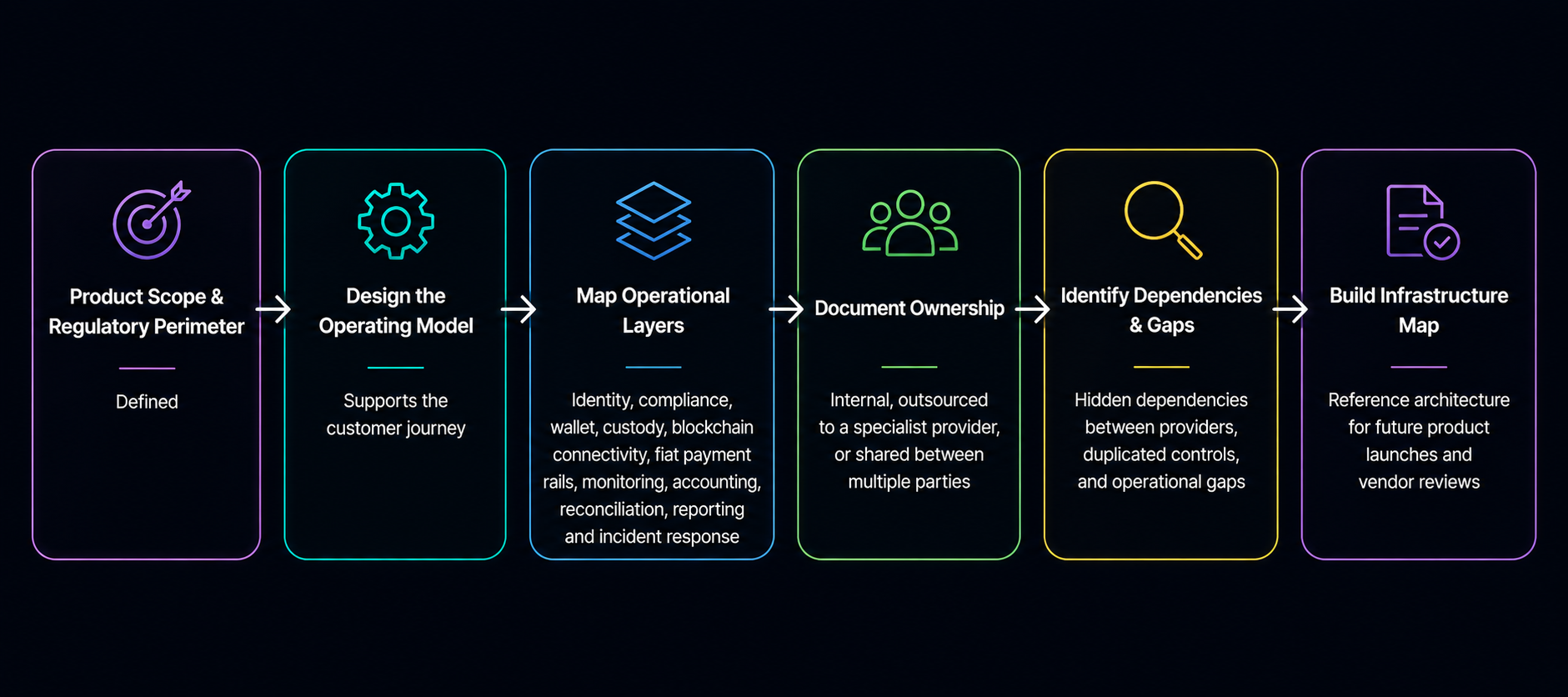
Practical checkpoint: Build a one-page infrastructure map showing every operational layer, the responsible owner, supporting vendors, primary data source, recovery process, SLA, and audit evidence. This becomes the reference architecture for future product launches and vendor reviews.
Also read : Top 5 Benefits of Digital Asset Infrastructure for Fintechs
Custody is one of the most important strategic decisions because it affects regulation, security, customer experience, operational complexity, and legal responsibility. Rather than viewing custody as private key storage, treat it as the framework that governs how assets are controlled, approved, recovered, segregated, and protected throughout their lifecycle.
Most fintechs adopt one of four approaches: self-custody, third-party custody, MPC-based wallet infrastructure, or a hybrid model. The right choice depends on the products offered, regulatory obligations, transaction volumes, customer expectations, and internal security capabilities. The evaluation should focus on who controls assets, who authorises transactions, how recovery works, how client assets are segregated, and which party is responsible during operational or security failures.
Institutional custody combines legal ownership records, governance controls, transaction approvals, reconciliation, and incident response into a single operating model. Understanding these responsibilities is far more important than comparing wallet features alone.
Practical checkpoint: Select a custody model only after documenting who controls assets, who approves transactions, how assets are recovered, what regulations apply, and which party is responsible if an operational or security failure occurs.
Compliance should be embedded into the infrastructure rather than added after launch. Every onboarding, funding event, transfer, redemption, and settlement should automatically trigger the required identity verification, sanctions screening, wallet-risk analysis, transaction monitoring, and, where applicable, Travel Rule requirements before value is allowed to move.
The infrastructure should also enforce jurisdiction-specific controls such as customer eligibility, asset restrictions, transaction limits, reporting obligations, and investigation workflows. Every compliance decision should generate an audit trail showing what was checked, which policy applied, why the decision was made, and who approved any exceptions.
Before launch, test realistic scenarios, including sanctioned counterparties, blocked jurisdictions, incomplete Travel Rule data, unusual transaction activity, and manual review queues, to identify operational gaps early. Infrastructure providers such as Fuze Finance can simplify implementation, but fintechs remain responsible for understanding which controls are managed by the provider and which remain internal.
Practical checkpoint: Map every compliance control to the customer journey and confirm each decision point produces the approvals, audit evidence, and regulatory records needed for future reviews.
Provider selection should focus on operational capability rather than feature lists. Begin by assessing regulatory coverage, supported jurisdictions, custody model, asset segregation, security posture, and compliance capabilities to understand exactly which responsibilities the provider performs and where legal accountability remains with your business.
Next, evaluate technical and operational capabilities, including API quality, reporting, supported assets and blockchains, uptime, banking integrations, implementation support, incident response, commercial terms, and exit planning. These factors determine how well the provider performs under real production conditions rather than during product demonstrations.
A critical due-diligence question should always be: Which functions do you perform directly, which are handled by partners, and who is legally responsible if one of those partners fails? The answer often reveals more about operational resilience than any feature comparison.
Practical checkpoint: Build a vendor scorecard covering regulatory coverage, custody, security, compliance, APIs, reporting, operational resilience, commercial terms, and exit planning, then score every provider against the same criteria before making a decision.
Most fintechs adopt one of three digital asset infrastructure models: a full-stack provider, a best-of-breed ecosystem, or a phased hybrid approach. The right choice depends on product complexity, regulatory obligations, engineering capacity, and long-term business goals rather than technology alone.
A full-stack provider offers the fastest route to market by combining custody, wallets, compliance, settlement, reporting, and APIs into a single platform. This reduces integration effort and operational complexity but increases dependence on one vendor. A best-of-breed architecture provides greater flexibility by selecting specialised providers for each layer, though it also increases integration work, reconciliation, vendor management, and operational ownership. Many fintechs begin with an integrated provider and gradually replace individual components as transaction volumes, regulatory requirements, or product sophistication grow.
Ultimately, the decision is a balance between launch speed and flexibility, unified accountability and specialist capability, operational simplicity and customization, and short-term implementation cost versus long-term ownership.
Practical checkpoint: Evaluate every architecture against your product roadmap, regulatory obligations, engineering capacity, and exit strategy, not just implementation cost or vendor convenience.
Launching digital asset infrastructure is a governance exercise as much as a technology project. Before customer funds or regulated assets are involved, every significant operational and regulatory risk should have a documented owner, tested controls, and a predefined response plan.
Your risk register should cover custody and key management, smart contract vulnerabilities, counterparty and liquidity risk, sanctions and AML exposure, blockchain disruptions, reconciliation failures, vendor dependency, regulatory change, and operational resilience. For every scenario, document its likelihood, business impact, owner, preventive controls, monitoring approach, response plan, and evidence that the controls have been tested.
The objective is not to eliminate every risk, but to ensure no high-impact scenario is left unmanaged. A well-maintained risk register also demonstrates to regulators, auditors, and internal governance teams that risks have been assessed systematically rather than reactively.
Practical checkpoint: Before production deployment, create a launch risk register assigning ownership, controls, monitoring, response procedures, and supporting evidence for every critical operational, compliance, custody, and technology risk.
Launching every product, asset, corridor, and customer segment at once creates unnecessary operational risk. A phased rollout allows teams to validate controls, refine processes, and resolve issues before scaling.
A typical implementation begins with product discovery and regulatory classification, followed by proof-of-concept testing, vendor due diligence, sandbox integration, compliance policy design, and operational testing. Only then should a limited production pilot begin, with strict limits on supported assets, jurisdictions, customer groups, and transaction values while monitoring settlement, compliance, reconciliation, and operational performance.
Each stage should include formal go/no-go criteria. Before production, confirm transaction limits, approved jurisdictions, reconciliation accuracy, incident-response testing, customer disclosures, and compliance workflows are fully operational. Even when using providers such as Fuze Finance, fintech remains responsible for ensuring its legal, operational, and governance requirements have been met.
Practical checkpoint: Define measurable exit criteria for every rollout phase and require formal approval from engineering, compliance, finance, legal, and product leadership before progressing.
A digital asset infrastructure strategy should be evaluated by business outcomes rather than successful deployment alone. The goal is to support growth while maintaining strong compliance, operational resilience, and effective risk management.
Track performance across three areas. Product metrics measure onboarding, wallet activation, transaction success, settlement reliability, and customer support demand. Compliance metrics monitor alerts, investigation times, sanctions screening, Travel Rule completion, and regulatory findings. Operational metrics focus on reconciliation accuracy, custody exceptions, provider uptime, transaction costs, API reliability, and service-level performance.
These KPIs provide the evidence needed to determine when new assets, payment corridors, jurisdictions, or customer segments can be added safely. Expansion should be driven by operational stability, not market demand alone.
Practical checkpoint: Build a governance dashboard that combines product, compliance, and operational KPIs, and review it regularly before increasing transaction limits or expanding into new markets.
Launching digital asset products does not require building every custody, wallet, compliance, and settlement capability from scratch. For many fintechs, partnering with a specialist infrastructure provider is the fastest and lowest-risk path to market.
Fuze Finance provides the infrastructure businesses need to launch and scale digital asset products through a single platform, supporting wallets, custody, stablecoin payments, treasury operations, digital asset trading, tokenization, and compliance workflows. By combining institutional-grade infrastructure with integrated governance and reporting, fintechs can focus on building customer experiences while relying on infrastructure designed for secure, regulated financial operations.


.jpg)