
If you have ever wondered how institutional traders move millions of dollars in crypto without triggering a visible price movement on any public exchange, the answer is the OTC desk. OTC desks accounted for approximately $267 billion in institutional crypto volume in Q1 2026 alone, according to TRM Labs' Q1 2026 Global Crypto Adoption Index. That volume does not move through a single click on a public exchange. It moves through a structured, documented institutional crypto trading workflow that most articles describe only at the surface level.
This guide explains how crypto OTC works mechanically at every stage, from onboarding through to post-settlement documentation, so you know exactly what is happening and why before you commit to your first trade.
If you want the step-by-step process, read our guide on how to buy crypto OTC. This blog explains what is happening under the hood at each stage.
A buyer and a seller agree on a fixed price for a large transaction outside a public exchange order book. The price is agreed privately, the trade executes at that price, and proceeds settle directly to bank accounts or whitelisted wallets.
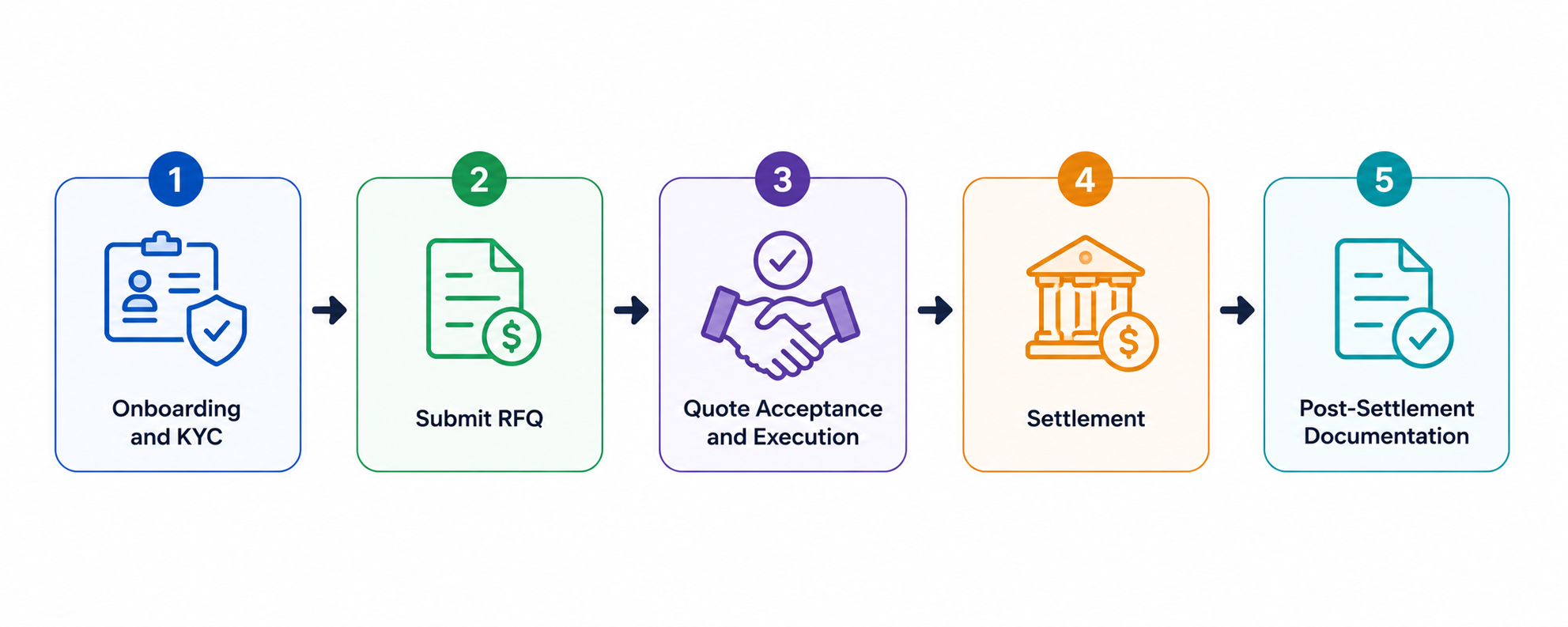
The institutional crypto trading workflow has five distinct stages. Each stage has a specific function and a specific timeline.
In 2026, institutional OTC desks are moving from chat-based operations to full platform-based workflows because liquidity is fragmented and reporting expectations are tighter, according to Pixelplex's 2026 OTC platform analysis. Understanding the crypto OTC desk workflow is no longer optional for institutions moving serious volume.
The first step in using a crypto OTC desk is onboarding. Before your first trade can execute, the desk must verify who you are, where your funds come from, and that every wallet and bank account you plan to use is legitimate.
At Fuze Finance, your KYC takes up to 7 working days and is a one-time process.
Wallet whitelisting is a distinct part of the crypto OTC desk workflow that the exchange model does not require. Before you can transfer your existing crypto to the desk or receive crypto to an external wallet, every wallet address must be pre-approved.
To begin, navigate to Profile → External Wallets. At Fuze Finance, this involves two steps:
Wallet whitelisting also takes up to 7 working days.
Because KYC verification in banking systems and whitelisting can take up to seven working days, how a desk communicates during that window matters.. The best operators run structured onboarding email flows that keep you updated on what is received, what is outstanding, and what happens next. Once you are trading, a regular crypto newsletter keeps you current on pricing, new listings, and regulatory changes.
Also Read: OTC Trading vs. Exchange: Which One Should Institutions Use in 2026?
The Request for Quote (RFQ) process is at the heart of how over-the-counter crypto trading works and is the stage most institutions misunderstand before using it for the first time.
When you are ready to trade, you submit a request for a quote specifying:
The OTC desk responds with a firm, all-inclusive price. This is not a negotiation but a precise quote based on the OTC desk's aggregated liquidity position across multiple venues, its internal risk model, and current market conditions. This is structurally different from placing an order on an exchange. On an exchange, your order fills against whatever liquidity is available at each price level. When submitting an RFQ on a crypto OTC desk, you receive a single fixed price for your entire order before any part of it moves.
How OTC desks price their RFQ responses matters for understanding your all-in cost. The desk builds its margin into the spread between the buy and sell price rather than charging a separate commission. At Fuze Finance, every quote is all-inclusive (fees and taxes are built into the price shown), with nothing added after you accept.
Markets move continuously. A quote without a time window allows the desk to re-price between your viewing and your acceptance if conditions shift. At Fuze Finance, your quote is locked for 10 seconds (among the highest price lock windows in the industry). When using a crypto OTC desk for the first time, understanding what that 10-second protection is worth becomes clear the moment markets start moving quickly.
When you accept a quote, a binding agreement forms between you and the desk at the quoted price. The moment you accept, two things happen simultaneously:
Your order never appears on any public order book at any stage. Execution is entirely private. The market price continues to move after your acceptance, but that risk is carried by the desk, not by you. On an exchange, you absorb every basis point of market movement until your order finishes filling.
Also Read: 7 Benefits of Using a Crypto OTC Desk in 2026
The OTC desk trade settlement process is where the crypto OTC desk workflow diverges most significantly from exchange settlement. It is the most important stage for institutional treasury management.
It works through daily netting. All your buys, sells, and swaps over a 24-hour period are added up, and the net position settles once. For example:
This reduces banking friction, reduces the number of fiat wires your treasury team needs to reconcile, and simplifies your compliance documentation.
Your notional trading mechanics affect how you manage your intraday position. The moment your trade executes, its notional value is instantly available for further trades. If you sell BTC worth $500,000, that $500,000 is immediately available for you to purchase other assets. You cannot withdraw it to your bank account until after the daily settlement completes. This distinction is relevant for treasury planning: your capital is productive immediately after execution, but your fiat is accessible only after settlement.
Fuze Finance operates T+0 settlement for all major tokens, including USDC, USDT, BTC, ETH, and SOL. T+0 means your trade settles the same day rather than the next business day. Your capital is not locked in an unsettled position overnight.
Once the settlement completes, initiate your fiat withdrawal through the OTC web app. Specify the amount and your destination bank account. Fuze Finance’s team reviews the details and processes the withdrawal within 12 to 24 hours. Your fiat is available in AED, USD, and TRY for standard withdrawals. GBP and EUR are available on request.
To summarize the crypto OTC trade settlement: your net position settles daily and your fiat arrives in your bank account within 24 hours of initiating withdrawal.
Post-settlement documentation is the most overlooked stage of the crypto OTC desk workflow and the one that determines whether your institutional operation runs smoothly or hits compliance friction downstream.
After every settlement, a regulated OTC desk issues:
These documents establish the complete chain from trade instruction through to fiat receipt: counterparty identity, settlement amounts, timestamps, and the regulatory framework under which the trade was executed. This is what your bank needs to accept a large incoming fiat transfer from a crypto-related counterparty without flagging it. It is also what your auditors need to sign off on the trade as part of your annual compliance review.
Exchange transaction records cannot replace this documentation. Wallet addresses, timestamps, and platform confirmations do not establish the compliance trail that correspondent banks and institutional auditors require. At Fuze Finance, full trade confirmations, wire records, and compliance reports are issued after every settlement, produced under its VARA-regulated, SOC 2 Type II, and ISO 27001 certified infrastructure.
The five workflow stages above apply to any regulated OTC desk. But not all desks execute your trade the same way. Before you onboard, it is worth understanding which model your desk operates because it directly affects your execution certainty, your counterparty risk, and the compliance trail your bank will review after settlement.
When evaluating how to use a crypto OTC desk for the first time, asking which model the desk operates is one of the most important questions you can ask. The principal model is almost always the right choice for institutional execution at scale because it gives you execution certainty and a clear counterparty relationship for compliance purposes.
Also Read: How to Buy Crypto OTC in 2026: Step-by-Step Institutional Guide
Fuze Finance is VARA-regulated with active registrations with the Central Bank of UAE, the Central Bank of Jordan, and FINTRAC in Canada. Its infrastructure is SOC 2 Type II and ISO 27001 certified. It processes over $4 billion in annual volume across more than 400 onboarded institutions and supports over 100 digital assets.
Here is how your institutional crypto trading workflow looks on Fuze Finance:


%20(1)%20(1).png)