
When a large institution or high-net-worth individual tries to buy or sell a significant amount of crypto on a public exchange, something predictable happens: the price moves against them before the order is even finished filling. Each partial fill executes at a slightly worse rate than the last. By the time the full order completes, the average price paid is materially different from the price shown at the start. That gap is called slippage, and at scale, it is a direct cost.
This is the problem an over-the-counter (OTC) desk is built to solve. An OTC desk lets institutions and high-volume traders execute large crypto transactions at a single, fixed price, privately and without any market impact. This guide explains what an OTC desk is, how the process works from onboarding to settlement, the benefits, the risks, and what to look for when choosing one.
An OTC desk, or over-the-counter desk, is a trading service that executes large cryptocurrency transactions directly between two parties at a single fixed price, outside of a public exchange order book. You agree on a price upfront for the full amount, the trade executes at that price, and the proceeds settle directly to your bank account or whitelisted wallet.
On a public exchange, every trade fills against whatever orders are sitting on the open order book at each price level. A large order consumes multiple levels, each slightly worse than the last, and the bigger the order, the worse the average execution price becomes. An OTC desk removes this problem entirely. You request a quote, receive one fixed price for the full order, and if you accept it, that is the price you pay regardless of what the market does during settlement.
Over-the-counter trading is not a crypto invention. Equities, bonds, and foreign exchange have been traded bilaterally in traditional finance for decades. As crypto markets matured and institutional capital entered, the same need emerged. Public exchanges were built for retail volume rather than institutional size, and over-the-counter crypto trading desks were developed to fill that gap. According to Finery Markets' 2026 institutional crypto report, institutional spot OTC volumes have since expanded 109% year over year, while top-20 centralized exchanges grew just 9% over the same period.
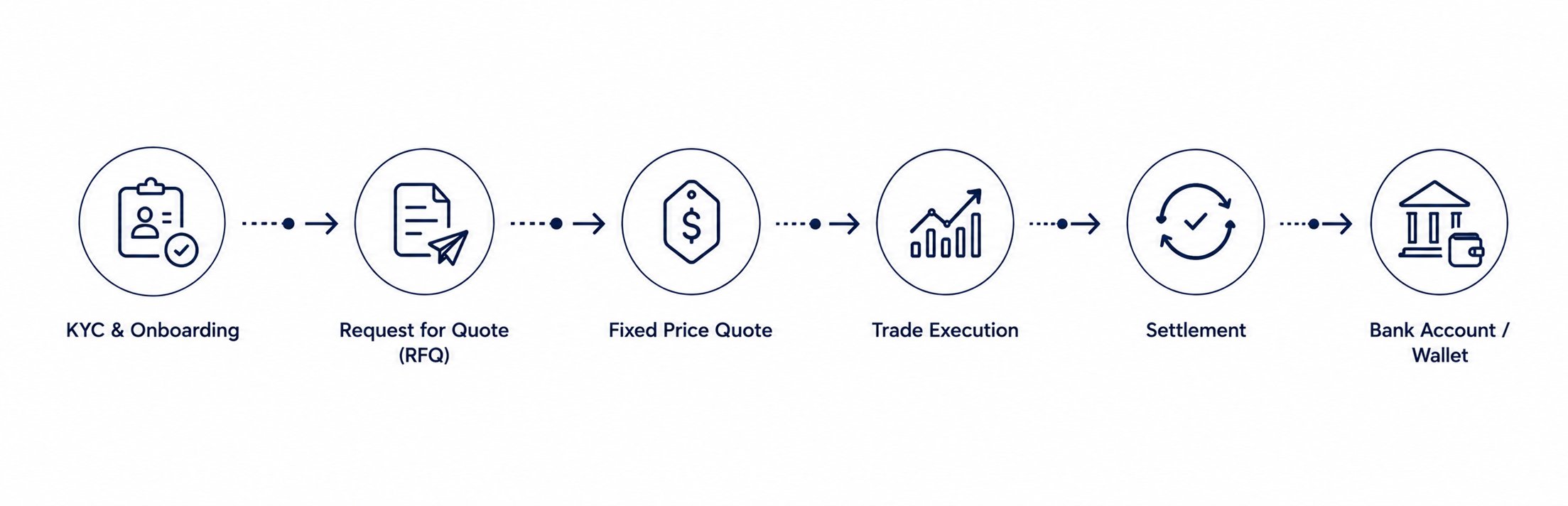
A regulated institutional crypto OTC desk runs every client through a structured process before a single trade is executed. Here is how it works:
The core difference between an OTC desk and a crypto exchange lies in how your order is priced and executed. In over-the-counter crypto trading, you trade against a single privately negotiated quote. On a public exchange, you trade against an open order book, which is what creates slippage on large orders and is the fundamental reason institutional traders use an OTC desk instead.
Beyond pricing, the differences extend to settlement, privacy, and support. The table below breaks down how the two compare across these components.
For institutions and high-net-worth individuals trading at scale, the advantages of an OTC desk go beyond getting a better price. The structure of how trades are executed, settled, and documented makes a material difference to treasury operations, compliance, and banking relationships.
The most direct benefit is price certainty. The quote you receive is the price you pay for the entire order, with no partial fills at progressively worse rates and no uncertainty about your average execution price.
OTC trades happen entirely off public order books, meaning your order is not visible to other market participants.
A regulated OTC desk can wire fiat proceeds directly to your verified bank account once a trade settles, which is operationally essential for institutions converting crypto to working capital. Stablecoins now represent 78% of institutional OTC settlement volume, according to Finery Markets, up from just 23% in 2023, reflecting how central fiat-accessible settlement has become to institutional crypto operations.
Every Fuze Finance OTC client is assigned a dedicated relationship manager available via chat and phone, 24 hours a day, 7 days a week, 365 days a year. For large or time-sensitive trades, having a named contact who knows your account and trading patterns is a practical operational advantage.
OTC trading is the right mechanism for institutional volume, but the desk you choose introduces its own set of risks. Understanding them is important before you move significant capital through any counterparty.
An unregulated desk may onboard faster and ask fewer questions, but it offers no regulatory recourse if something goes wrong. More practically, fiat proceeds arriving at a bank from an unregulated counterparty are frequently flagged or rejected outright.
The regulatory status and permitted activities of your OTC desk can directly affect whether your settlement completes cleanly.
Some OTC desks negotiate prices informally over the phone with no upfront locked-in quote. An RFQ, or Request for Quote, system changes this entirely. Instead of an informal negotiation, you submit your trade parameters through a platform and receive a firm, executable price in response.
At Fuze Finance, every RFQ quote is fixed for 10 seconds and is all-inclusive, so you know the exact final price before you commit.
Thorough KYC takes time, and that is a feature rather than a flaw. Institutions that anticipate needing to move large positions should onboard with a regulated desk before the need becomes urgent, not during a time-sensitive trade.
40% of surveyed institutions now name OTC as their first-choice execution venue, routing more than half of their trades off public exchanges. In practice, the clients who use an institutional crypto OTC desk fall into three consistent categories.
The OTC desk you choose affects not just the price you get but whether your settlement completes, whether your bank accepts the proceeds, and whether you have any recourse if something goes wrong. These are the four factors that you should look for.
There is no single licence that applies to every crypto OTC desk worldwide. The required authorisation depends on the jurisdiction, the assets and services offered, and whether the provider handles activities such as brokerage, trading, custody, or fiat payment services. For example, in Dubai, Fuze's Finance OTC desk operates through Morpheus Software Technology FZE, which holds an active VARA VASP licence for Broker-Dealer Services under licence VL/23/10/002.
When evaluating an OTC provider, verify that its licence or registration covers the specific activities it performs in the jurisdiction where you are trading.
OTC desks make money through spreads, explicit transaction fees, or a combination of both. Some embed their margin in the quoted price without disclosing it separately, making it difficult to assess the true cost of a trade. At Fuze Finance, every quote covers fees and taxes in full with no additional charges after acceptance.
T+0 settlement matters for treasury and cash flow management. After every trade, you should receive trade confirmations, wire records, and compliance reports in a format that banks and auditors will accept. Ask any desk what documentation they provide before you onboard, not after.
Your OTC desk must be able to fill your full order at the quoted price without breaking it into multiple partial fills. Fuze Finance supports over 100 digital assets with deep liquidity and processes over $4 billion in annual volume across more than 400 institutions.
If you are looking for an institutional crypto OTC desk for global markets, Fuze Finance operates through regulated and registered entities across multiple jurisdictions and maintains SOC 2 Type II and ISO 27001 certifications. Fuze processes over $4 billion in annual volume, has onboarded more than 400 institutions, and supports over 100 digital assets, including BTC, ETH, SOL, USDC, and USDT. Fiat settlement is available in AED, USD, EUR, GBP, and TRY, supporting major currency corridors across the globe.
Getting started takes three steps. First, you sign up and complete KYC digitally, whitelisting your bank account and wallet addresses. Second, you fund your account with fiat or your existing crypto, request a live RFQ quote, and confirm the trade at a fixed price. Third, you move your funds, sending the final crypto or fiat directly to your whitelisted wallet or verified bank account. Fuze is designed to take clients from sign-up to first trade in under 24 hours.
Every client is assigned a dedicated relationship manager available via chat and phone around the clock. For institutions trading regularly or managing time-sensitive positions, that direct line of support is part of the operational infrastructure, not an add-on.
If you are trading $100,000 or more daily, Fuze also offers the option to skip the RFQ process on the platform entirely and work directly with the desk for bespoke pricing and execution.


%20(1)%20(1).png)