
If you are buying crypto in large volumes, you already know the problem. You place an order on a public exchange, the price moves against you before it fills, and by the time it completes, you are paying materially more than the rate you saw when you started. That gap is slippage, and it is not a glitch. It is a structural feature of how public exchange order books work.
OTC desks accounted for approximately $267 billion in institutional crypto volume in Q1 2026 alone, according to TRM Labs' Q1 2026 Global Crypto Adoption Index. That figure was large enough to be excluded entirely from retail exchange volume analysis to avoid double-counting institutional flows. If you are moving capital at that scale, buying crypto OTC is not an alternative to exchange trading. It is the standard
This guide walks you through exactly how to buy crypto over the counter, step by step, from choosing a desk to receiving settlement in your bank account.
According to Finery Markets' 2026 institutional OTC report, 40% of surveyed institutions now name OTC as their first-choice execution venue, routing more than half of all their digital asset trades off public exchanges. That said, not every trade needs an OTC desk, and it is worth knowing where you sit before starting the process.
What all three cases share is a need for price certainty, execution privacy, and compliance documentation that your bank will accept.
Before walking through how to buy large amounts of crypto without market impact, it helps to understand exactly what you are up against on a public exchange.
TokenInsight's March 2026 crypto exchange liquidity report tested $500,000 and $1 million sell orders across seven major centralized exchanges. Gate exchange recorded 2.109% ETH slippage on a $1 million order. That is over $21,000 lost on a single trade. Even on the deepest venues in the test, slippage at $1 million was measurably worse than at $500,000. The more you buy, the worse your average execution price gets on every exchange tested.
Here is why.
When you place a large buy order, it fills against sell orders sitting at progressively higher price levels. Your first tranche fills at the best available price. Your next tranche fills at a worse level. Your remainder fills worse still. You only know your average execution price after the order completes. That gap between what you expected to pay and what you actually paid is slippage, and it compounds across every trade you execute.
There is also front-running to contend with. The moment your large pending order appears on a public mempool, automated algorithms detect it, buy ahead of you, and sell back at a higher price before your order finishes filling. This happens on every large order you place on a public exchange. How to avoid slippage when buying crypto at an institutional scale requires removing your order from the public book entirely, which is exactly what an OTC desk does.
Also Read: OTC Trading vs. Exchange: Which One Should Institutions Use in 2026?
This is how you buy large amounts of crypto without moving the market in practice.
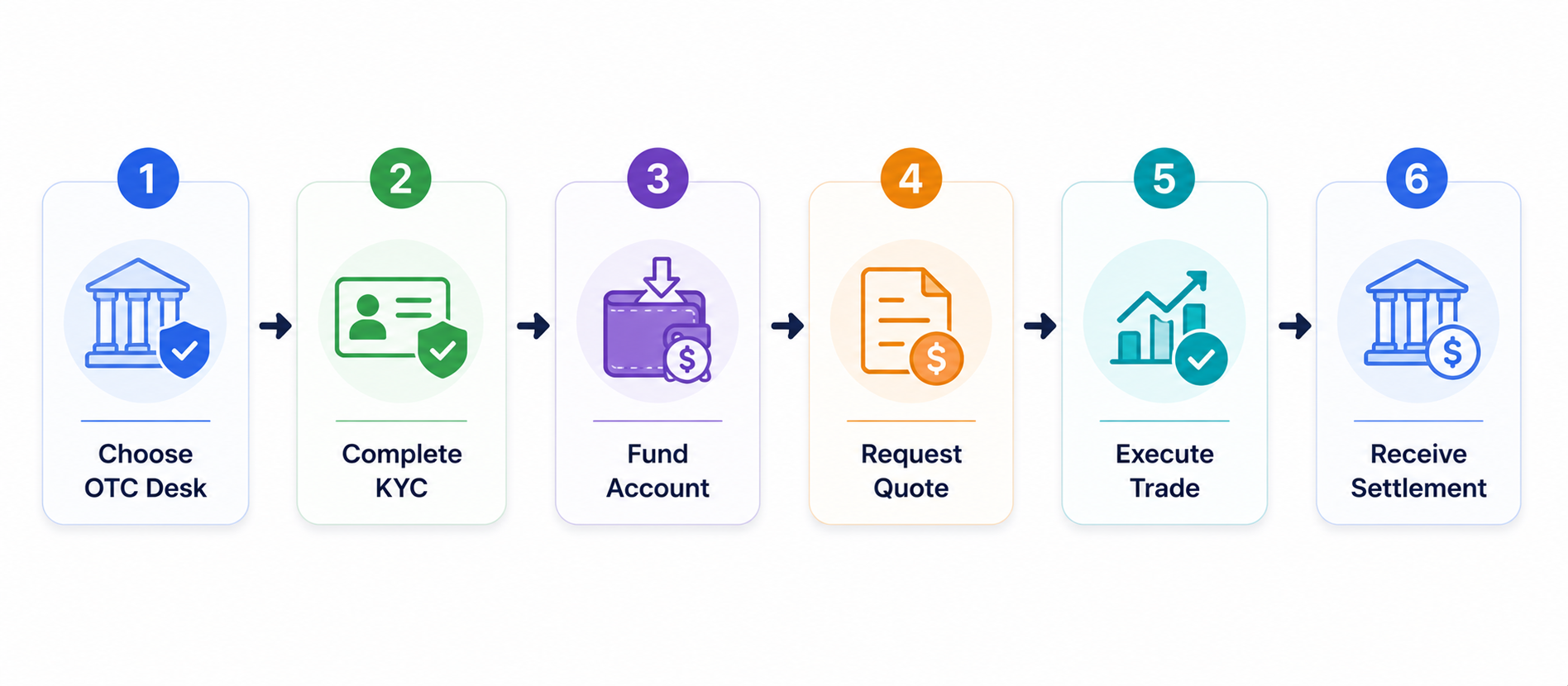
Your choice of desk is the most consequential decision in this process. It determines your compliance trail, your settlement path, and your counterparty risk.
Before you apply, check these six things.
If you need your fiat proceeds to land cleanly in a UAE bank account, you need a VARA-regulated desk. Fuze Finance holds a VARA license, which means the compliance documentation it issues meets the standards that UAE correspondent banks require. An unregulated desk cannot produce the same documentation regardless of how smoothly your trade executes.
Apply at Fuze OTC to get started. Fuze is designed to take you from sign-up to first trade in under 24 hours for straightforward onboarding cases.
Your KYC process on a regulated OTC desk covers identity verification, sanctions screening, a review of your source of funds, and a review of your business activities if you are a legal entity. The final step is verifying the bank accounts you will use for transactions. To do this, navigate to Profile → External Bank Accounts and upload the required supporting document for verification. At Fuze Finance, the full KYC process takes up to 7 working days. It is a one-time process.
Wallet whitelisting is a step most guides skip, and it catches first-time OTC buyers off guard. Before you can transfer your existing crypto to the desk or withdraw crypto to an external wallet after settlement, your wallet address needs to be verified as yours. Navigate to Profile → External Wallets to whitelist your wallet. This covers both incoming transfers and future withdrawals, so you will not need to repeat it.
Once your onboarding is complete and your bank account is whitelisted, you have two ways to fund your account.
The first is a fiat deposit. Navigate to Balances → Deposit in the OTC web app. Select your currency (AED, TRY, and USD are available for standard deposits, while GBP and EUR are available on request). Enter the deposit amount and select your originating bank account. You will then be shown the beneficiary bank details to transfer your funds to. A deposit ID is generated for tracking. You should paste this in the transaction remarks when you initiate your bank transfer so Fuze can match it to your account. Your deposit reflects once the funds are received and reconciled, which typically takes 12 to 24 hours after your bank transfer clears.
The second is a crypto deposit. Transfer crypto directly from your whitelisted wallet to Fuze. This is typically faster than a fiat wire and available to you as soon as your wallet whitelisting is complete.
When you are ready to trade, specify the asset, the amount, and whether you are buying or selling. The Fuze Finance team books the trade on your behalf at a firm, all-inclusive RFQ price. Your quote is locked for 10 seconds and covers fees and taxes in full. Once you accept, your trade executes at that fixed price regardless of any market movement during settlement.
All your buys, sells, and swaps over a 24-hour period are netted and settled once daily. You can trade on notional values immediately after your trade executes. If you sell $500,000 worth of BTC, that amount is instantly available for further purchases. You cannot withdraw it to your bank account until the daily settlement is complete.
Once your settlement is done, initiate your fiat withdrawal through the OTC web app. Specify the amount and your destination bank account. Fuze Finance's team processes your withdrawal within 12 to 24 hours. Your fiat lands in AED, USD, or TRY for standard withdrawals. GBP and EUR withdrawals are available on request.
For crypto withdrawals, navigate to Wallets → Withdraw, select your token and blockchain network, choose your whitelisted wallet, enter the withdrawal amount, and confirm your request. You also receive full trade confirmations, wire records, and compliance reports that your bank and auditors will accept.
Also Read: 7 Benefits of Using a Crypto OTC Desk in 2026
You have the full picture now. You know which desk to choose, what to expect at each step, and how your proceeds land in your bank account.
When you trade on Fuze, your quote is locked for 10 seconds, your settlement completes the same day, and your compliance documentation is ready after every trade. Your relationship manager is available around the clock if anything comes up. If you are trading $100,000 or more daily, Fuze also offers direct desk access that bypasses the platform RFQ process entirely for competitive pricing and fast execution.
Fuze Finance holds a VARA license in the UAE and maintains active registrations with the Central Bank of UAE, the Central Bank of Jordan, and FINTRAC in Canada. Its infrastructure is SOC 2 Type II and ISO 27001 certified. It has processed over $4 billion in annual volume across more than 400 onboarded institutions and supports over 100 digital assets across its liquidity network.


%20(1)%20(1).png)