
If you're buying or selling a large amount of cryptocurrency, placing the order on a public exchange isn't always the best option. Large trades can move market prices, increase trading costs, and reveal your intentions to other market participants.
That's where crypto OTC (over-the-counter) trading comes in. Instead of using a public order book, OTC desks help buyers and sellers execute large trades privately, often with better price certainty and more flexible settlement options.
In this guide, you'll learn which crypto assets are best suited for OTC trading, how to evaluate whether an asset makes sense for OTC execution, and what to check before requesting a quote.
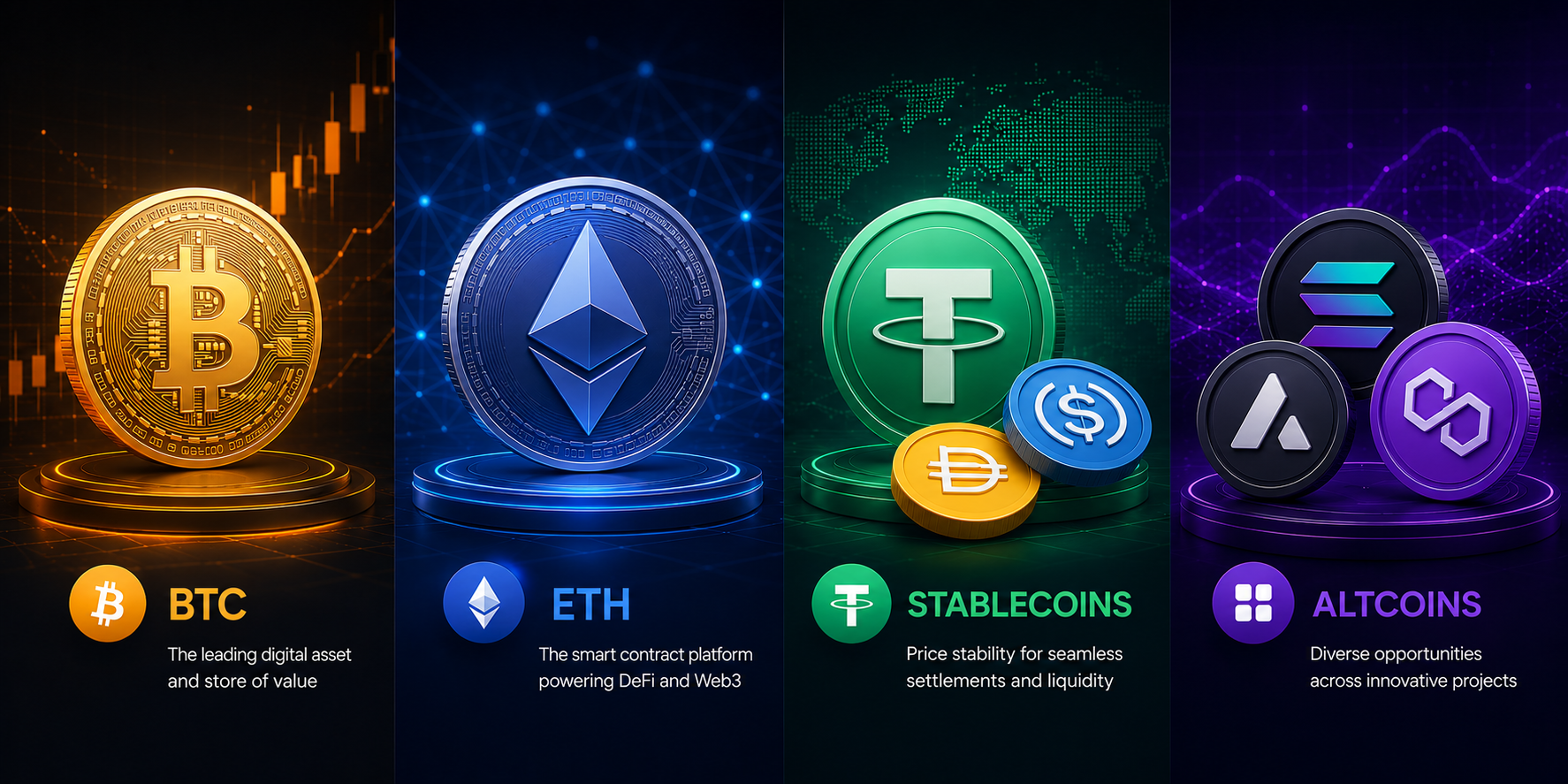
OTC trading is most commonly used for large transactions involving Bitcoin (BTC), Ethereum (ETH), stablecoins, and other highly liquid cryptocurrencies. These assets have deeper markets, making it easier to execute sizeable trades without significantly affecting prices.
Bitcoin and Ethereum are the most common OTC assets because they have strong institutional demand, mature custody infrastructure, and broad liquidity across major exchanges and trading venues. As a result, OTC desks are generally better positioned to source liquidity or find counterparties for large trades.
Stablecoins such as USDT and USDC are also widely used in OTC trading. Businesses often use them to convert between fiat and crypto, rebalance treasury holdings, settle transactions, or move funds between exchanges and custodians.
Altcoins can also be traded through OTC desks, provided they have sufficient liquidity and market demand. However, less liquid assets may result in wider spreads, smaller maximum trade sizes, or limited availability depending on the provider.
Keep in mind that supported assets vary between OTC providers. Availability often depends on the jurisdiction, account type, settlement method, and the size of the trade, so it's always worth confirming support before requesting a quote.
A crypto OTC (over-the-counter) desk is a private trading service that helps buyers and sellers execute large cryptocurrency transactions outside a public exchange order book.
Unlike a traditional exchange, where orders are matched publicly, an OTC desk provides a private quote for a specific asset and trade size. Once both parties agree on the price, the transaction is settled directly according to the agreed terms.
Most OTC desks operate in one of three ways. Some act as principal desks, buying from or selling directly to clients using their own inventory. Others operate as agency desks, sourcing liquidity from exchanges or other counterparties on the client's behalf. Many providers also offer request-for-quote (RFQ) platforms, where traders request a price before deciding whether to execute.
This approach is particularly useful for large trades. On a public exchange, placing a sizeable market order can move prices as it consumes available liquidity at multiple price levels. OTC trading helps reduce this market impact by allowing the entire trade to be negotiated privately before execution.
Just because a cryptocurrency is listed on an exchange doesn't mean it's a good candidate for OTC trading.
The success of an OTC trade depends on whether the desk can source enough liquidity, price the asset competitively, and settle the transaction efficiently. Some cryptocurrencies trade actively across many exchanges, while others have limited liquidity, making large OTC trades more expensive or difficult to execute.
When evaluating whether an asset is suitable for OTC trading, consider:
The goal isn't simply to trade through an OTC desk, it's to determine whether OTC provides better execution than trading directly on an exchange. For highly liquid assets, OTC often delivers greater price certainty and smoother execution. For thinly traded assets, however, a public exchange or an algorithmic execution strategy may sometimes be the better option.
Most institutional OTC trading is concentrated in a handful of well-established digital assets. Here's how the most common OTC assets compare and when each one makes sense.
Bitcoin is the most commonly traded asset on OTC desks and is often the first choice for large institutional transactions. Its deep liquidity, broad market participation, and mature trading infrastructure make it well suited for block trades that would otherwise move prices on a public exchange.
Businesses, investment funds, miners, and high-net-worth investors frequently use OTC desks to buy or sell large amounts of Bitcoin for treasury allocations, portfolio rebalancing, hedging, or liquidity management. Because Bitcoin trades across many major exchanges, OTC providers typically have access to multiple liquidity sources, helping them execute large orders with greater price certainty.
According to Finery Markets, Bitcoin accounted for 48% of institutional OTC trading volume during the first nine months of 2025. While figures vary across providers, Bitcoin remains the largest and most liquid asset in the institutional OTC market.
Ethereum is another popular asset for OTC trading, supported by strong institutional demand and deep liquidity. It is commonly used by investment funds, businesses, and crypto-native companies as a portfolio asset, treasury holding, or collateral for other financial activities.
Compared with Bitcoin, however, Ethereum requires a little more planning before settlement. Businesses should confirm which blockchain network will be used, whether the ETH is staked or freely transferable, and whether network fees are included in the quoted price. It's also important to distinguish native ETH from wrapped or network-specific versions of the asset, as settlement requirements can differ.
Before accepting an OTC quote, verify the wallet address, blockchain network, expected settlement time, and any applicable fees. These checks help avoid delays or settlement errors, particularly for large transactions.
Finery Markets reported that Ethereum represented 22% of institutional OTC trading volume during the first nine months of 2025 and recorded the strongest year-over-year growth among Bitcoin, Ethereum, and stablecoins in its dataset.
Stablecoins play a unique role in OTC trading. Rather than being purchased purely as investments, they're often used to settle trades, move funds between platforms, and manage corporate treasury operations.
For example, a business might convert fiat into USDC or USDT before purchasing Bitcoin, hold proceeds from a crypto sale in stablecoins, or transfer funds between custodians and exchanges without relying on traditional banking rails. Because of their price stability and fast settlement, stablecoins have become a core part of institutional OTC workflows.
Before requesting a quote, confirm which stablecoin will be used, which blockchain network supports settlement, and whether the transaction will settle in fiat, stablecoins, or another cryptocurrency. It's also worth checking whether network fees are included in the quoted price and understanding the issuer and redemption process for the stablecoin being used.
For example, Coinbase Prime allows eligible clients to use USDC balances to buy cryptocurrencies on USD-quoted order books and settle eligible trades in USDC, depending on account configuration and availability.
OTC trading isn't limited to Bitcoin and Ethereum. Many providers also support large-cap altcoins such as Solana (SOL), XRP, Cardano (ADA), Litecoin (LTC), Dogecoin (DOGE), and Chainlink (LINK).
Whether an altcoin is suitable for OTC trading depends largely on its liquidity. Well-established assets with active trading across multiple exchanges are generally easier to source and price competitively. Less liquid tokens, on the other hand, may have wider spreads, lower maximum trade sizes, or limited availability because OTC desks need to manage the additional risk of sourcing and hedging those assets.
Some providers may also support less common tokens through manual quote requests rather than automated trading platforms. In these cases, clients should expect additional compliance checks, longer quote times, and more operational review before a trade can proceed.
The key point is that OTC desks don't create liquidity where it doesn't already exist. They can aggregate liquidity from multiple sources and execute trades more efficiently, but thinly traded assets will generally remain more expensive and harder to trade than major cryptocurrencies.
Also read: Best USDT Networks for Pyaments
Before requesting an OTC quote, it's worth confirming that both the asset and the trade are a good fit for OTC execution. While every provider has its own requirements, a few key checks can help you avoid pricing surprises or settlement issues.
Consider the following before you trade:
As a general rule, the less liquid the asset, the more important it is to request an indicative quote before committing to a trade.
Although every OTC provider has its own workflow, most trades follow the same basic process.
1. Complete onboarding: Before trading, you'll typically need to complete identity verification (KYC or KYB), provide source-of-funds information, and ensure your account is approved for OTC trading.
2. Request a quote: Once onboarded, you specify whether you're buying or selling, the asset, trade size, settlement currency, preferred blockchain network, and any timing requirements.
3. Review and accept the quote: The OTC desk provides either an indicative or firm quote. If you agree to the price, you'll need to accept it within the quoted validity period, which may only last a few seconds.
4. Fund the trade: You transfer the required fiat currency, stablecoins, or cryptocurrencies according to the settlement instructions provided by the desk.
5. Trade execution and settlement: The OTC desk executes the transaction using its own inventory, external liquidity providers, or agency execution. Once completed, the purchased assets or sale proceeds are delivered to your designated wallet, custodian, or bank account.
6. Receive trade confirmations: After settlement, you'll receive trade confirmations and settlement records that can be used for accounting, reconciliation, and audit purposes.
While the overall process is similar across providers, details such as quote validity, settlement timelines, and supported funding methods vary. Always review the desk's trading and settlement procedures before executing a large transaction.
Read in detail: How an OTC Trade Works
Price is only one part of an OTC trade. Settlement terms, supported networks, reporting, and execution conditions can have just as much impact on the overall trading experience.
Before accepting a quote, ask the OTC desk:
These questions help you understand the full cost of the trade and reduce the risk of delays, unexpected fees, or settlement issues.
Not every OTC desk supports the same assets, settlement methods, or client types. The best provider depends on the assets you trade, the jurisdictions you operate in, and your operational requirements.
When comparing OTC desks, focus on factors such as:
For example, Coinbase Prime supports more than 275 digital assets and 340+ trading pairs, with availability varying by geography and legal entity. Crypto.com offers OTC trading across major cryptocurrencies, stablecoins, and multiple fiat currencies, while Kraken provides both relationship-managed OTC trading and RFQ-based execution for large orders.
Rather than choosing a desk based solely on pricing, look for one that matches your trading volume, settlement needs, compliance requirements, and preferred operating model.
Different assets serve different purposes in OTC trading.
Bitcoin is often the easiest asset to trade OTC because of its deep liquidity and broad institutional demand. Ethereum is another strong candidate but requires additional attention to settlement details, staking status, and supported blockchain networks.
Stablecoins are widely used for treasury management, cross-border settlements, and funding crypto trades, while altcoins require more careful evaluation because liquidity, spreads, and provider support can vary significantly.
Before requesting a quote, confirm that the OTC desk supports your chosen asset, trade size, settlement network, and jurisdiction. It's also worth comparing the OTC quote with public exchange pricing to determine which execution method offers the best outcome for your trade.
Executing large crypto trades requires more than competitive pricing. Businesses also need reliable liquidity, secure settlement, regulatory compliance, and dedicated support to ensure every transaction is completed efficiently and with confidence.
Fuze Finance provides a regulated, enterprise-grade crypto OTC trading solution built for businesses, fintechs, payment providers, exchanges, and institutional investors. Clients can buy and sell major cryptocurrencies and stablecoins through a dedicated OTC desk, benefiting from deep liquidity, competitive pricing, flexible settlement options, and personalized support throughout the trade lifecycle.
Beyond OTC execution, Fuze offers a broader suite of digital asset infrastructure, including wallets, stablecoin payments, treasury management, custody, and crypto APIs. This enables businesses to manage trading, settlements, and digital asset operations through a single trusted platform instead of integrating multiple providers.
Whether you're executing large trades, managing corporate treasury, or settling cross-border payments with stablecoins, Fuze helps simplify institutional crypto trading with secure, compliant, and scalable infrastructure.
Explore Fuze OTC Trading


%20(1)%20(1).png)