
Embedded trading is rapidly becoming a core capability for fintech apps. Rather than sending users to an external brokerage, businesses can now offer investing directly within their own products using API-first infrastructure and regulated partners.
This shift is being driven by three major trends: the growth of embedded finance, rising mobile-first investing, and brokerage infrastructure that's easier to integrate than ever before. At the same time, launching an embedded trading experience introduces new responsibilities around compliance, investor education, product design, and operational oversight.
This guide examines the latest embedded trading statistics for 2026, highlighting adoption trends, investor behaviour, infrastructure developments, and the metrics that matter most when evaluating embedded trading opportunities.
If you're new to the concept, you may also want to read our guide on What Is Embedded Trading?
If you're looking for the biggest trends at a glance, these are the embedded trading statistics that matter most for product teams, founders, and fintech leaders in 2026
Embedded trading isn't growing in isolation. It's being driven by broader changes in financial services, including the rise of embedded finance, increasing demand for mobile investing, and the availability of API-first brokerage infrastructure.
Research from Boston Consulting Group estimates that embedded finance across North America and Europe could grow into a $185 billion opportunity, while current market penetration remains relatively low at around $32 billion. That gap suggests there is still significant room for businesses to expand financial products within existing customer experiences.
At the same time, investing has become increasingly digital. Customers now expect to open accounts, fund portfolios, and place trades without leaving the apps they already use. Rather than building brokerage infrastructure from scratch, many fintechs are partnering with regulated providers to integrate trading through APIs and white-label platforms.
For businesses, the opportunity isn't simply to add another feature. Embedded trading works best when it complements an existing product, improves customer engagement, and creates long-term value rather than encouraging short-term trading activity.
Embedded trading is becoming easier to launch because infrastructure is improving, not because regulatory or operational responsibilities have disappeared.
Retail investors now represent a meaningful share of public market activity, creating a larger audience for businesses considering embedded trading products.
According to SIFMA, retail investors accounted for 17.9% of U.S. equity trading volume in 2024, while Vanda Research estimated that retail investors traded approximately $5.4 trillion in U.S. stocks and ETFs during 2025. Together, these figures suggest that retail participation has remained resilient even after the surge in investing during the pandemic years.
Growth is also reflected in account ownership. More consumers now expect investing to be available alongside payments, banking, or wealth management rather than through a standalone brokerage.
For fintechs, this doesn't automatically mean every customer wants to trade actively. Instead, it reinforces the importance of matching investment features to the product's existing audience and use case. A savings app, payroll platform, or banking application may benefit more from long-term investing tools than high-frequency trading capabilities.
Embedded trading has evolved alongside mobile investing. For many users, especially younger investors, a smartphone is now the primary way they research markets, monitor portfolios, and place trades.
Recent surveys show that 80% of investors under the age of 35 use mobile trading apps, highlighting how expectations around accessibility and user experience have changed. Investors increasingly expect instant onboarding, real-time portfolio updates, price alerts, and simple funding options without switching between multiple platforms.
For businesses, this raises the bar for product design. A successful embedded trading experience depends not only on market access but also on intuitive onboarding, transparent pricing, educational content, and responsive support.
Rather than replicating a professional trading terminal, many fintechs succeed by building simple, guided investing experiences that align with the needs of their existing customers.
While embedded trading can support a wide range of financial products, investor activity remains concentrated in a relatively small number of asset classes.
For most retail investors, equities and ETFs continue to dominate trading activity because they offer broad market exposure, liquidity, and familiar investment strategies. At the same time, demand for digital assets continues to grow as more regulated infrastructure becomes available and businesses expand beyond traditional brokerage products.
Interest is also increasing in fractional investing, recurring investment plans, and diversified portfolios that reduce the barrier to entry for first-time investors. Rather than focusing on speculative trading, many fintechs are using embedded trading to encourage long-term investing habits through automated contributions and portfolio-building tools.
Successful embedded trading products rarely succeed because they offer the largest selection of assets. Instead, they focus on offering the right assets for their target customers and investment goals.
The rapid growth of embedded trading has been made possible by infrastructure providers that abstract much of the operational complexity involved in offering investment products.
Instead of building brokerage systems from scratch, businesses can integrate APIs for account creation, identity verification, market data, order execution, custody, funding, reporting, and portfolio management. This significantly reduces development time while allowing companies to deliver a seamless investing experience within their own applications.
Several providers, like Fuze Finance, offer infrastructure that enables businesses to embed trading into fintech apps, wealth platforms, and financial services products. While these platforms simplify implementation, they differ considerably in areas such as regulatory coverage, supported assets, liquidity, custody arrangements, reporting capabilities, and geographic availability.
Choosing an embedded trading provider should therefore involve more than comparing API documentation. Businesses should evaluate whether a platform aligns with their regulatory requirements, customer base, operational workflows, and long-term product strategy.
As embedded trading becomes more accessible, investor education is becoming just as important as the trading experience itself.
Many first-time investors enter the market through mobile apps with limited investing experience. Press Release Services that clearly explain investment products, pricing, risks, and long-term investing principles can help users make better decisions while building greater confidence in the platform.
Educational features can also improve business outcomes. Investors who understand how products work are often more likely to complete onboarding, remain engaged over time, and use investment features responsibly.
Businesses can also create educational campaign visuals with an online banner maker, making complex investing concepts easier to communicate across websites, landing pages, and help centers.
Rather than encouraging frequent trading, many successful platforms focus on helping users develop consistent investing habits through educational content, portfolio insights, and transparent product design.
For businesses, education should be viewed as part of the product experience rather than a compliance requirement. Well-informed customers are more likely to trust the platform, stay engaged, and become long-term users.
Embedded trading products have become easier to use, but engagement should never come at the expense of responsible investing. Features such as watchlists, price alerts, recurring investments, and portfolio tracking can encourage regular participation without pushing users toward excessive trading.
Many regulators are also paying closer attention to product design, particularly where notifications, rewards, or interface elements could influence investment decisions. As a result, successful platforms increasingly focus on transparency, investor education, and long-term portfolio building rather than short-term trading activity.
For businesses, the goal should be to create products that help users invest confidently while maintaining clear disclosures, straightforward pricing, and appropriate risk communication.
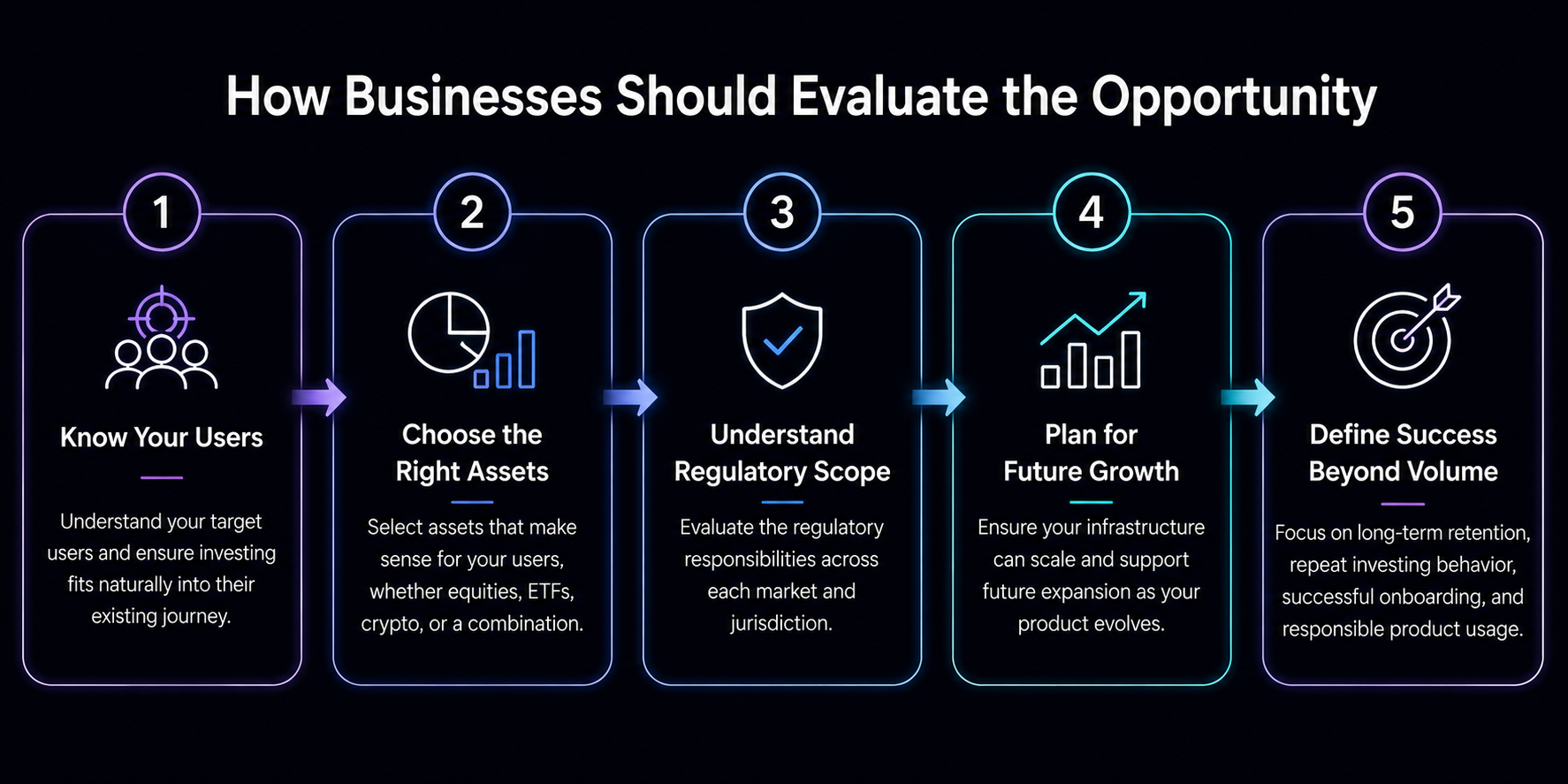
Growing investor participation does not automatically mean every business should launch embedded trading. The most successful products solve a clear customer need rather than adding investing simply because the technology is available.
Before committing to a provider or roadmap, businesses should evaluate:
Businesses should also define success beyond trading volume. Long-term customer retention, repeat investing behaviour, successful onboarding, and responsible product usage are often stronger indicators of product-market fit than the number of trades executed.
The statistics referenced throughout this guide come from publicly available regulatory reports, industry research, consumer surveys, exchange data, and provider publications. Where vendor-reported figures or forecasts are used, they are clearly attributed to their original sources.
Launching embedded trading requires more than integrating an API. Businesses also need regulated infrastructure, reliable liquidity, custody, compliance workflows, reporting, and developer tools that can scale as their product grows.
Fuze provides API-first embedded trading infrastructure that enables fintechs, banks, payment providers, and wealth platforms to integrate digital asset trading into their existing products. The platform combines institutional liquidity, regulated onboarding, custody integrations, and developer-friendly APIs, helping businesses launch trading experiences without building brokerage infrastructure from scratch.
Whether you're exploring embedded trading for the first time or expanding an existing financial product, Fuze provides the infrastructure needed to accelerate launch while supporting compliance, operational efficiency, and a seamless customer experience.


%20(1)%20(1).png)