
Not all embedded trading providers offer the same capabilities. While many let you integrate crypto trading through an API, the differences go far beyond the technology itself. Regulatory coverage, custody, liquidity, settlement, and operational support can vary significantly between providers, directly affecting how your product performs and scales.
That's why choosing a provider involves more than comparing APIs or implementation timelines. You need to understand who is responsible for regulated activities, how customer assets are protected, which markets and assets are supported, and whether the platform can grow alongside your business.
This guide explains the key factors to evaluate, the questions to ask during due diligence, and the criteria that matter most when comparing embedded trading providers.
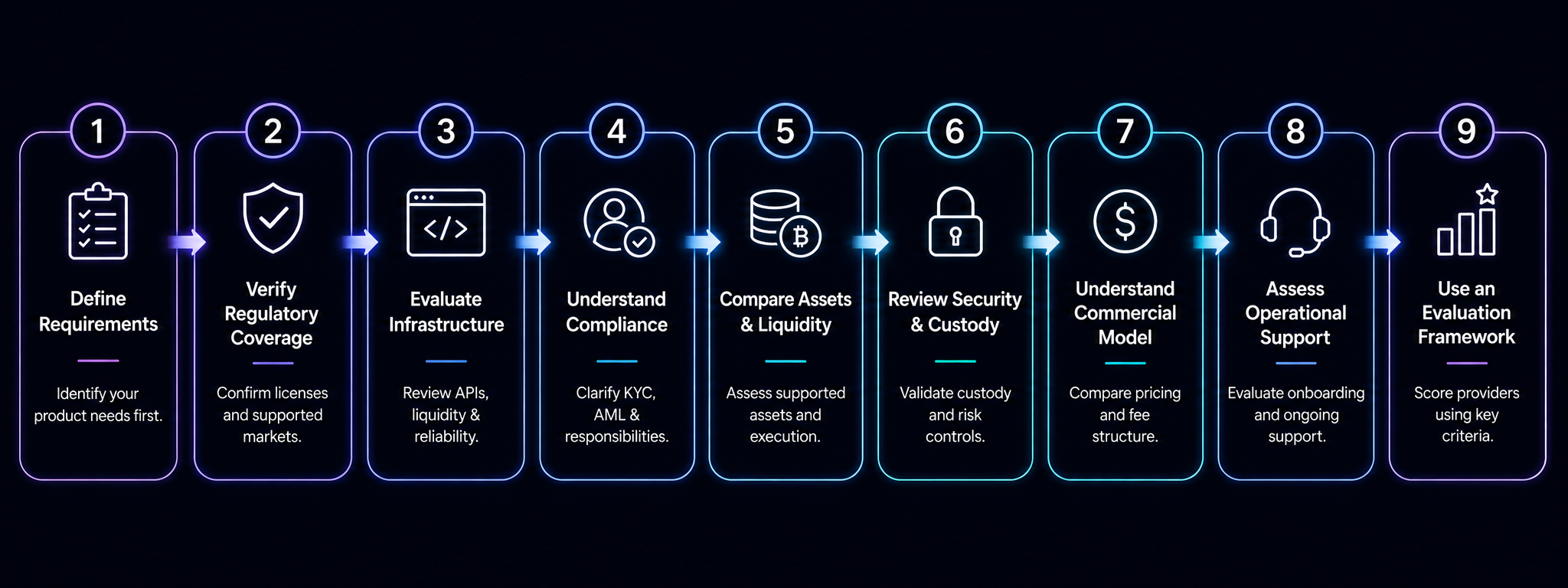
One of the biggest mistakes teams make is comparing providers before they've defined their own requirements.
The first question isn't "Which provider has the best API?" It's "What kind of infrastructure are we actually looking for?"
If you're still deciding whether embedded trading is the right approach for your business, read our guide on What Is Embedded Trading?
For some businesses, a simple trading widget may be enough to add basic buy-and-sell functionality. Others need a much deeper solution that supports custody, compliance, settlement, reporting, and trading infrastructure as part of a broader financial product.
The distinction matters because not all providers solve the same problem. Brokerage APIs, crypto liquidity providers, and embedded digital asset infrastructure serve different use cases and shouldn't be evaluated using the same criteria.
For example, if you're building a wealth app focused on equities and ETFs, your requirements will differ significantly from a fintech or payment platform launching crypto trading. Understanding your product goals first helps narrow the shortlist before technical comparisons begin.
Also read in detail: Embedded Trading Use Cases for Fintech Product Teams
A provider's feature set matters only if it can legally support your business.
Before reviewing APIs, supported assets, or implementation timelines, confirm that the provider is licensed, or otherwise authorized to operate in the jurisdictions where you plan to launch. Regulatory coverage determines who can use the product, how customers are onboarded, and which compliance responsibilities remain with your business.
During due diligence, ask providers to explain:
You should also request a responsibility matrix covering KYC, KYB, AML, sanctions screening, transaction monitoring, customer disclosures, complaints, and record retention.
Public registers and regulatory notices are equally valuable. Sales material should never be the only source of verification.
For example, Fuze Finance publicly states that Morpheus Software Technology FZE is licensed by Dubai's Virtual Assets Regulatory Authority (VARA) as a Broker-Dealer, while Niobe Payment Services LLC SPC is licensed by the Central Bank of the UAE as a Retail Payment Services provider.
These registrations provide a useful starting point during due diligence. However, businesses should also review any public regulatory notices, understand their context, and discuss the provider's current regulatory status, any operational limitations, and ongoing compliance obligations before signing an agreement.
A polished API is important, but it doesn't guarantee a reliable trading experience. Behind every integration sits a broader infrastructure that determines how trades are priced, executed, settled, and reported.
Instead of focusing only on documentation or SDKs, evaluate how the platform performs across the entire trading lifecycle. Understand how quotes are generated, where liquidity comes from, how orders are routed, and what happens when markets become volatile.
Key questions to ask include:
The quality of a trading platform is often revealed during periods of high market activity. Reliable infrastructure should continue processing orders, updating balances, and delivering trade confirmations even when trading volumes increase significantly.
Fuze Finance offers API-first embedded trading infrastructure designed for fintechs and financial institutions. The platform includes REST APIs, webhook support, institutional liquidity, custody integrations, and access to a broad range of digital assets.
As with any provider, businesses should validate implementation timelines, sandbox capabilities, operational support, reporting features, and uptime commitments against their own technical requirements.
Customer onboarding is one of the biggest operational differences between embedded trading providers. Some platforms manage identity verification and compliance almost entirely, while others expect your business to own a much larger portion of the process.
Before signing with a provider, understand exactly how customers move from registration to their first trade.
Ask providers to explain:
Clear ownership is essential. Customers should never be uncertain about which company is responsible for account verification, compliance reviews, or support requests.
A provider may advertise support for hundreds of digital assets, but that number alone rarely tells the full story.
The real question is whether the provider supports the assets, trading pairs, settlement currencies, and jurisdictions your customers actually need. A platform with fewer assets but stronger liquidity and better settlement capabilities may provide a better trading experience than one with a much larger catalogue.
When evaluating providers, look beyond asset count and consider:
Settlement deserves particular attention. Confirm whether trades can settle in fiat, stablecoins, or digital assets, which blockchain networks are supported, and whether settlement timelines meet your operational requirements.
Reliable liquidity and predictable settlement often have a greater impact on customer experience than the total number of supported assets.
Security is often reduced to a list of certifications or marketing badges, but those don't tell you how a provider protects customer assets or responds when something goes wrong.
Instead of asking whether a platform is "secure," understand how it manages custody, access controls, operational risk, and incident response. These areas have a much greater impact on day-to-day operations than a long list of compliance certifications.
When evaluating providers, ask about:
Security should extend beyond protecting infrastructure. It should also help your business meet internal governance, audit, and operational requirements as you scale.
Pricing is about far more than API costs.
Different providers generate revenue in different ways, including spreads, trading fees, subscription charges, revenue-sharing arrangements, custody fees, withdrawal charges, and implementation costs. Comparing only one number rarely provides an accurate picture of long-term economics.
Before making a decision, understand:
Request realistic pricing scenarios using your expected trading volumes rather than relying on headline rates. This provides a much clearer understanding of the total cost of ownership.
Fuze Finance offers embedded trading infrastructure for financial institutions, with commercial terms that vary depending on product scope and deployment. Businesses should discuss pricing, implementation costs, revenue opportunities, and service agreements directly during the evaluation process.
The quality of a provider becomes most visible after launch.
Trading platforms operate continuously, and issues such as failed deposits, delayed settlements, customer verification problems, or blockchain congestion require timely operational support. Strong documentation is valuable, but responsive operational teams are equally important.
Ask providers about:
It's also worth speaking with existing customers where possible. Their experience often provides valuable insight into how the provider performs once the platform is live.
After reviewing multiple providers, it's easy to focus on whichever platform delivers the best demo or the most polished sales presentation. A structured evaluation process helps keep the decision objective.
Create a scorecard using the criteria that matter most to your business. Common evaluation categories include:
No provider will score perfectly across every category. The objective is to find the platform that best aligns with your business model, target markets, and long-term product strategy.
Once you've shortlisted a provider, the next step is planning the implementation. Our guide on How to Launch Embedded Trading walks through the process, from defining your product and compliance responsibilities to integration, testing, and launch.
Choosing an embedded trading provider isn't just about adding crypto to your app. You're selecting a long-term infrastructure partner that will influence customer experience, compliance workflows, liquidity, custody, and day-to-day operations.
Fuze Finance is built for financial institutions that want to launch digital asset trading without building exchange infrastructure from scratch. Through a single integration, businesses can embed crypto trading into their existing products while relying on enterprise-grade infrastructure for execution, settlement, custody, and operational workflows.
Whether you're building a fintech app, wealth platform, payment solution, or treasury product, Fuze helps reduce implementation complexity while giving teams the flexibility to launch and scale faster.
Rather than stitching together multiple providers for custody, execution, liquidity, and settlement, businesses can manage their trading infrastructure through a unified platform designed for financial institutions.


%20(1)%20(1).png)