
Embedded trading allows businesses to offer crypto trading directly within their own apps without building exchange infrastructure from scratch. Instead of managing custody, execution, compliance, and settlement internally, many companies integrate with regulated infrastructure providers that handle these functions behind the scenes.
This guide explains how embedded crypto trading works, whether you need to become a broker-dealer, and the practical steps involved in choosing the right operating model, infrastructure, and launch strategy.
Disclaimer:
This guide is for educational purposes only and should not be considered legal advice. Licensing, custody, securities, money transmission, and consumer protection requirements vary by jurisdiction and product design.
Embedded trading allows users to buy, sell, and hold digital assets directly within an application they already use. Instead of redirecting customers to a separate exchange, businesses integrate trading into their own product experience while relying on specialized infrastructure providers to power the regulated backend.
From the user's perspective, the experience feels seamless. They can complete identity verification, fund their account, place trades, and monitor their portfolio without leaving the app. Behind the scenes, however, licensed partners may be responsible for regulated functions such as trade execution, custody, settlement, compliance, and reporting.
This model enables businesses to expand their financial offering without building exchange infrastructure from scratch, making embedded trading an increasingly popular choice for fintechs, payment providers, wealth platforms, and enterprise treasury products.
Read in detail: What is Embedded Trading?
One of the most common questions businesses ask is whether offering embedded crypto trading requires them to become a broker-dealer or obtain similar financial licenses.
The answer depends on several factors, including the assets being offered, the countries where customers are located, how orders are handled, and which party performs regulated activities. There isn't a single answer that applies to every business.
In practice, most companies choose one of three operating models.
This is the most common approach for businesses launching embedded trading.
Your application owns the customer experience, while a regulated partner provides the underlying trading infrastructure. Depending on the provider and jurisdiction, this may include customer onboarding, KYC and AML processes, trade execution, custody, settlement, reporting, and other regulated services.
For many businesses, this offers the fastest route to market while avoiding the cost and complexity of building regulated trading infrastructure internally.
Some organizations choose to obtain the necessary licenses and build their own trading infrastructure.
This approach provides greater control over execution, custody, and compliance, but also requires significantly more engineering resources, regulatory expertise, operational staff, and ongoing oversight. It's generally suitable only for businesses with the scale and resources to operate financial infrastructure directly.
Some businesses adopt a hybrid approach, managing certain parts of the customer journey while outsourcing specific regulated functions to infrastructure partners.
For example, a company may own the user interface, customer support, and product experience while relying on a licensed provider for custody, execution, and settlement.
Regardless of the model, responsibilities should be clearly documented between all parties. Customers should understand who provides the trading service, who holds their assets, and who is responsible for regulated activities behind the scenes.
“Without becoming a broker-dealer” does not mean “without compliance.” It means your app should avoid activities that look like effecting securities transactions, taking or routing orders, executing trades, handling customer funds or securities, making investment recommendations, or negotiating transaction terms unless properly registered, exempt, or advised by counsel.
Your app can usually own the experience layer. Regulated intermediation should be deliberately assigned and contractually documented
Once you've decided to offer embedded crypto trading, the next step is choosing how you'll bring it to market. The right operating model depends on how much control you want, how quickly you need to launch, your engineering resources, and the level of regulatory responsibility you're prepared to manage.
Most businesses follow one of the following approaches.
A hosted widget is the quickest way to launch embedded trading. Most of the onboarding and trading experience is provided by the infrastructure partner, allowing businesses to add crypto trading with minimal development effort. While customization is limited, this model is often ideal for validating customer demand or launching an MVP.
With an API-first approach, the trading experience is built directly into your application while the provider supplies the underlying infrastructure. Your team controls the user interface and customer journey, while the partner manages services such as account creation, trade execution, custody, settlement, and compliance.
This model offers greater flexibility and branding while avoiding the complexity of building regulated trading infrastructure yourself.
White-label solutions provide a branded trading experience that's largely managed by the infrastructure provider. They typically require less engineering than a fully custom API integration while offering more control than a hosted widget.
This approach is popular with fintechs, neobanks, wealth platforms, and payment providers that want crypto trading to feel like a native part of their product.
Some organizations choose to build and operate their own trading platform by obtaining the required licenses, integrating liquidity providers, managing custody, and running compliance operations internally.
While this provides the highest level of control, it also requires substantial investment in engineering, legal, compliance, and operations. For most businesses, partnering with an established infrastructure provider is significantly faster and more practical.
Once you've decided to integrate embedded trading instead of building your own exchange or brokerage infrastructure, the next step is implementation. While every business has different regulatory and operational requirements, most successful launches follow a similar process—from defining the product scope to selecting an infrastructure provider, integrating the technology, and preparing for launch.
The steps below provide a practical framework for planning and deploying embedded crypto trading.
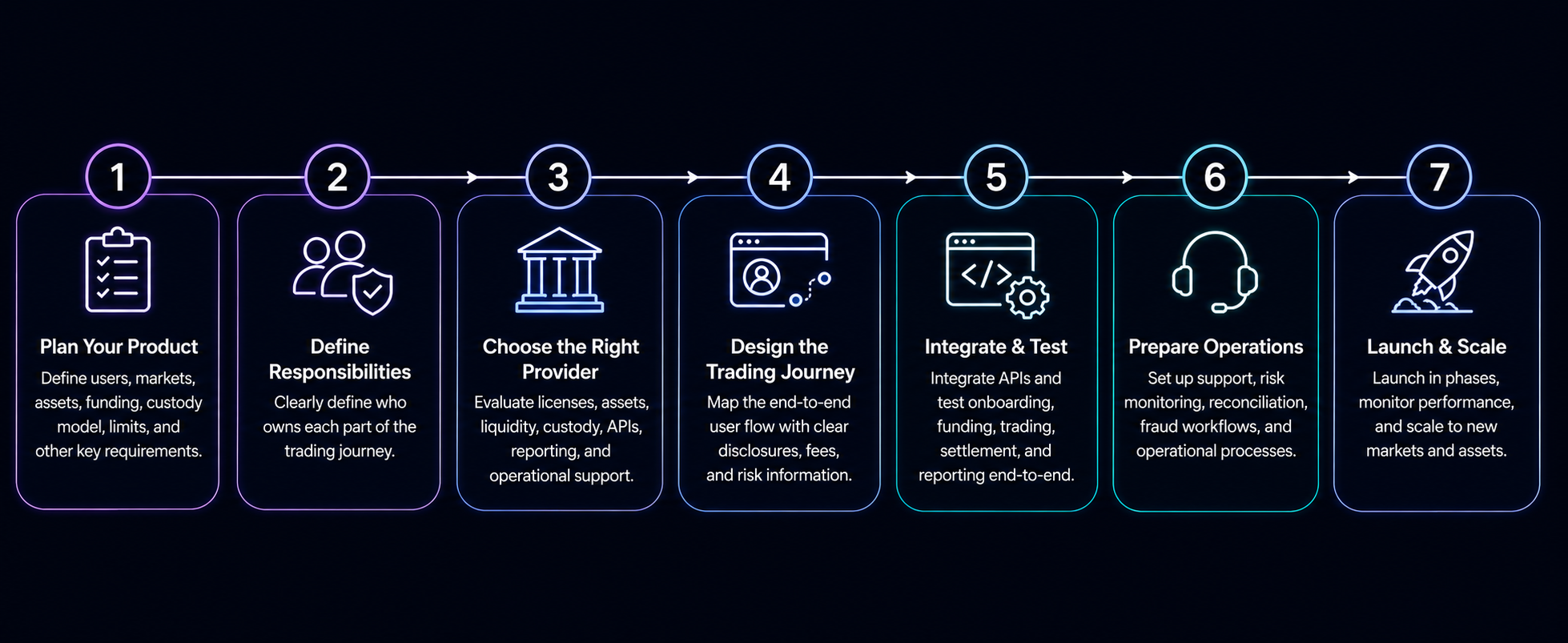
Before comparing providers or evaluating APIs, define what you're trying to build.
Businesses often start vendor conversations too early, only to discover later that a provider doesn't support their target markets, preferred custody model, or funding methods. Having a clear product scope makes provider selection much easier.
Start by answering a few practical questions:
These decisions influence almost every technical and regulatory requirement later in the project. They also make it much easier to evaluate whether a provider's licenses, custody model, liquidity, and APIs align with your business.
One of the biggest mistakes businesses make is assuming their infrastructure provider "handles everything."
In reality, embedded trading is a shared responsibility. While a licensed partner may manage regulated activities such as KYC, trade execution, custody, settlement, and transaction monitoring, your business still owns much of the customer experience.
Before engineering begins, create a responsibility matrix that clearly defines who owns each part of the trading journey.
Typically, the infrastructure provider is responsible for regulated functions such as identity verification, AML screening, trade execution, custody, settlement, and regulatory reporting. Your business, meanwhile, usually owns the application interface, customer communications, onboarding experience, first-line support, product analytics, and ongoing customer engagement.
Some responsibilities, such as disclosures, fraud monitoring, funding workflows, complaints, and reconciliation, are often shared between both parties and should be clearly documented.
Clarifying ownership early helps avoid operational confusion and ensures customers always know who is providing each part of the service.
Choosing an embedded trading provider involves much more than comparing APIs.
The provider you select will influence regulatory coverage, customer experience, liquidity, operational processes, and the markets you can support. A strong integration cannot compensate for weak custody, limited jurisdictional coverage, or poor reporting.
When evaluating providers, look beyond marketing claims and assess:
Some providers offer fully managed embedded trading infrastructure, while others only provide APIs or software. Understanding exactly which services are included helps avoid implementation surprises later.
Also read in detail: Embedded Trading Use Cases for Fintech Product Teams
Launching embedded trading is as much an operational project as it is a technical one.
Users should understand what they're buying, who holds their assets, how fees work, and what happens after a trade is completed. A well-designed customer journey reduces support requests while making compliance obligations easier to satisfy.
A typical trading journey includes:
Throughout this process, disclosures should be presented at the right moment rather than buried inside lengthy terms and conditions. Customers should clearly understand fees, custody arrangements, trading risks, and which company provides each service.
Good embedded trading feels simple to the user because the complexity has already been addressed behind the scenes.
Once you've selected an infrastructure partner, the focus shifts to implementation. While the exact integration process varies by provider, the objective is the same: create a trading experience that feels native to your application while ensuring the underlying infrastructure is reliable, secure, and compliant.
Most implementations begin in a sandbox environment. Your team should validate the complete trading workflow, from customer onboarding and funding to order execution, settlement, and reporting—before enabling live transactions.
Key areas to test include:
Don't treat API integration as a purely technical exercise. Product, engineering, operations, compliance, and customer support teams should all participate in testing to ensure the entire trading lifecycle works as expected.
A successful launch depends as much on operational readiness as it does on technology. Once users begin trading, your team must be prepared to handle identity verification issues, payment failures, delayed settlements, customer enquiries, and compliance reviews.
Before going live, document how common operational scenarios will be handled and who is responsible for resolving them.
Your launch checklist should include:
Establishing clear ownership across product, operations, finance, compliance, and customer support helps reduce response times and ensures customers receive consistent communication when issues arise.
Rather than making embedded trading available to every customer on day one, start with a controlled rollout. A phased launch allows you to validate operational processes, monitor customer behaviour, and identify issues before expanding the product.
Many businesses begin with a limited beta, support only a small number of assets, and apply conservative trading limits. As operational confidence grows, they gradually increase transaction limits, expand into additional markets, and introduce more assets and features.
Alongside technical monitoring, track business metrics such as:
These metrics provide a clearer picture of product adoption and operational health than trading volume alone.
Before making embedded trading available to all users, review the fundamentals one last time.
Confirm that:
A structured launch process reduces operational risk and creates a stronger foundation for scaling your trading offering over time.
Building embedded trading requires more than connecting to a trading API. Businesses also need secure custody, liquidity, trade execution, compliance, settlement, reporting, and operational infrastructure that can scale with their growth.
Fuze Finance brings these capabilities together through a single embedded trading platform, enabling fintechs, payment providers, wealth platforms, treasury platforms, and other financial businesses to launch crypto trading without building exchange infrastructure from scratch.
With Fuze, businesses can:
Whether you're adding crypto trading to a fintech app, payment platform, wealth product, or treasury solution, Fuze provides the infrastructure needed to bring digital asset trading to market faster while reducing operational complexity.


%20(1)%20(1).png)