
Remittance operators sit at the intersection of consumer payments, regulated financial services, FX, treasury, and local payout infrastructure. Customers expect a simple outcome: money sent in one country arrives safely in another. Delivering that outcome requires MTOs to manage fraud, AML controls, sanctions screening, liquidity, FX pricing, settlement, payout reliability, and customer support at the same time.
This guide covers the main operational challenges facing modern MTOs and the controls teams should consider before launching or scaling a corridor.
A remittance is typically a cross-border transfer sent by an individual to a recipient in another country. An MTO, or money transfer operator, facilitates that movement through banks, wallets, cards, cash networks, or other payment partners.
A corridor refers to a specific send-and-receive market pair, such as U.S. to Mexico or UAE to India. A payout partner is the local institution or network that delivers funds to the beneficiary, such as a bank, wallet provider, cash agent, or payment aggregator.
Unlike many B2B cross-border payments, remittances are generally lower-value, higher-frequency, and consumer-facing. That makes speed, pricing transparency, customer support, and error resolution particularly important.
Most operational challenges fall into four connected areas:
The challenge is that these areas cannot be managed independently. A fraud alert can delay settlement, a liquidity shortage can prevent an approved payout, and a partner outage can turn a successful sender-side transaction into a customer complaint.
International policy work continues to identify cost, speed, access, and transparency as core cross-border payment challenges. The BIS and other standard setters have made clear that payment improvement requires both infrastructure upgrades and trusted operating practices.
For MTOs, the objective is therefore broader than initiating a transfer. The transaction must be completed, monitored, reconciled, and explainable from beginning to end.
A typical remittance journey includes customer acquisition, onboarding, KYC, sanctions screening, funding, fraud checks, FX quoting, treasury funding, settlement, payout, reconciliation, and post-transaction support.
Risk can enter at almost any point. A compromised card can create funding fraud. A sanctions alert can stop a transaction after onboarding. A liquidity shortfall can delay payout even when the customer passes every compliance check. A local payout outage can create a failed customer experience despite successful sender-side processing.
This makes remittance operations highly interconnected. Product, compliance, fraud, treasury, partner operations, finance, and customer support may all handle different parts of the same transaction.
A stronger operating question is not simply “Did the transfer initiate?” but “Can we complete, evidence, reconcile, and explain the transfer?”
Fraud creates direct financial losses while also increasing chargebacks, customer complaints, compliance exposure, and partner disputes.
Common risks include:
Remittance fraud is particularly challenging because transactions are cross-border and often time-sensitive. Once funds are paid through cash or credited to a wallet, recovery can become difficult.
Fraud controls should account for corridor and customer context rather than applying identical rules everywhere. Important signals include transaction velocity, funding method, beneficiary relationships, device behavior, customer tenure, payout method, and agent location.
Automation can handle routine decisions, but fraud teams also need clear escalation paths into compliance and customer support. A declined transaction should be identifiable as a fraud event, compliance issue, or customer-service problem so the right team can respond.
Compliance is core infrastructure for an MTO, not a back-office function.
A typical program includes customer due diligence, enhanced due diligence, sanctions and PEP screening, transaction monitoring, suspicious activity reporting, recordkeeping, licensing, and consumer protection controls.
The FATF risk-based approach means controls should reflect the actual risk associated with customers, corridors, products, channels, and agents.
In the U.S., FinCEN identifies money transmitters as money services businesses subject to applicable Bank Secrecy Act requirements. The CFPB's remittance transfer rule also covers areas such as disclosures, error resolution, cancellation, refunds, and certain agent activities.
These requirements directly influence product design. They determine what information must be collected, when transactions can proceed, how alerts are handled, and how errors are resolved.
Compliance also affects corridor economics. Manual reviews, monitoring tools, licensing, audits, and recordkeeping all contribute to the cost of operating a remittance program.
Corridor liquidity is the ability to fund payouts in the right currency, market, and time window without holding excessive idle capital.
MTOs may rely on prefunded partner accounts, correspondent banking relationships, local bank balances, stablecoin liquidity, or other treasury arrangements to support payouts.
Key challenges include:
A customer may fund a transfer today while the payout partner settles tomorrow. If FX moves during that period, the operator may absorb the difference unless its pricing and treasury model accounts for the exposure.
Each corridor should therefore be evaluated based on its expected float requirement, demand volatility, settlement cycle, fallback funding cost, currency availability, and cutoff calendar.
Liquidity is not simply a finance concern. If the operator cannot fund the payout when required, an otherwise approved and compliant transaction can still fail.
Last-mile delivery is where the beneficiary actually receives the money. It may happen through a bank account, instant payment system, mobile wallet, cash pickup, card payout, or agent network.
Local conditions vary significantly between markets. Common failure points include account mismatches, payment-rail downtime, cash shortages, wallet limits, agent liquidity constraints, local ID requirements, and market-specific holidays or cutoffs.
MTOs should track payout performance by partner, rail, geography, transaction size, and customer segment. A portfolio-wide success rate can hide serious problems in individual corridors.
Customers judge the service by the final outcome. If the sender's payment succeeds but the beneficiary cannot access the funds, the transaction has effectively failed from the customer's perspective.
Remittance pricing usually combines a visible transfer fee with an FX margin. The customer's actual cost may also include receiving-side or other partner fees.
Pricing varies by corridor because of differences in liquidity, payout costs, settlement speed, compliance requirements, cash handling, and competition.
A low advertised fee does not necessarily mean a low-cost transfer if the FX spread is wide. Similarly, unclear delivery estimates or poor refund handling can damage customer trust even when the transfer eventually succeeds.
MTOs should monitor total customer cost across:
Transparent pricing, accurate delivery estimates, and reliable error handling should be treated as part of the product experience, not simply as support functions.
Modern remittance infrastructure can reduce manual work and improve routing, monitoring, and reconciliation, but it does not eliminate operational responsibility.
Useful components include identity orchestration, transaction-risk scoring, sanctions screening, payment orchestration, payout aggregators, virtual accounts, treasury automation, reconciliation tools, and partner-monitoring dashboards.
The goal should not simply be faster execution. Infrastructure should improve decisioning, routing resilience, evidence capture, and reconciliation.
For example, smart routing can move transactions to another payout provider during an outage, but the MTO still needs rules for customer communication, settlement impact, partner liability, and reconciliation.
Newer rails such as instant payments, stablecoin settlement, tokenized deposits, and other digital payment infrastructure can improve specific parts of the transaction lifecycle. They do not remove licensing, compliance, liquidity, consumer protection, or local payout requirements.
Before launching or scaling a corridor, MTO teams should validate:
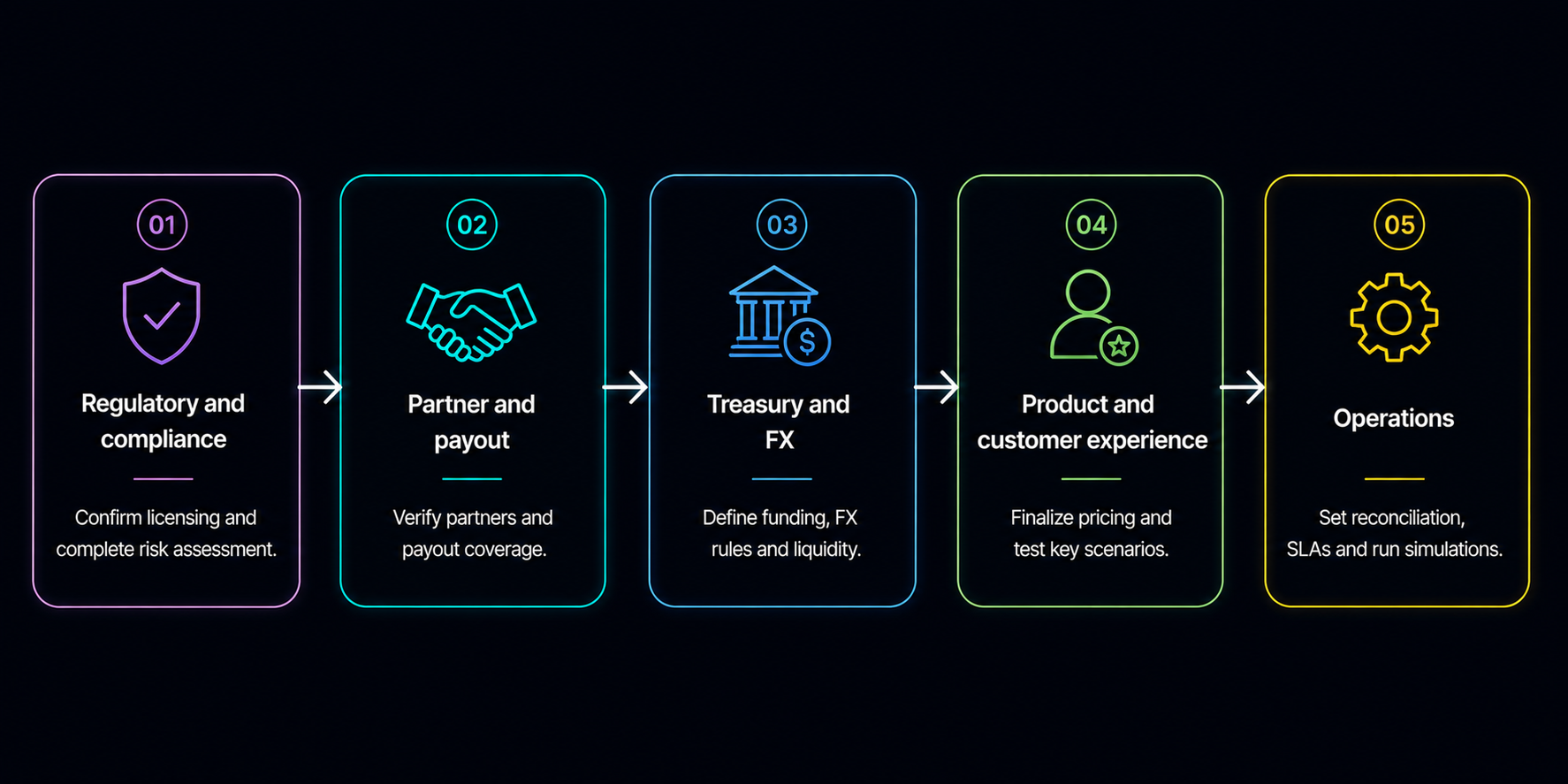
The key launch question is simple: Can the team operate the corridor reliably under stress?
MTOs should track both performance metrics and risk indicators across each corridor.
Fraud and risk: Fraud loss rate, chargebacks, false positives, manual-review backlog, and review aging.
Compliance: KYC pass rate, sanctions alerts, false positives, EDD volume, case cycle time, and monitoring findings.
Payout and customer: Payout success rate, delivery time, SLA breaches, partner downtime, complaints, refunds, and repeat contacts.
Treasury and FX: Prefunding utilization, idle balances, settlement failures, FX slippage, partner exposure, and trapped liquidity.
These metrics should be segmented by corridor, partner, payout method, funding method, transfer size, and customer risk tier. Portfolio averages can hide a deteriorating corridor until customers and liquidity are already affected.
Fuze Finance helps remittance businesses build and operate cross-border payment flows with infrastructure designed for modern settlement, liquidity, and payout requirements. Its remittance infrastructure can support cross-border money movement while helping businesses manage FX, settlement, and operational complexity across supported corridors.
For MTOs evaluating new corridors or improving existing ones, the focus should remain on reliable settlement, competitive FX, liquidity management, and operational visibility. Explore Fuze Finance remittance infrastructure to see how it can support your cross-border payment strategy.


%201.jpg)