
Remittances are one of the largest segments of cross-border payments, enabling migrants, freelancers, businesses, and families to move money internationally. While sending money appears simple from a customer's perspective, every transaction relies on licensing, compliance, FX management, liquidity, settlement, and local payout networks working together.
This guide explains how the remittance industry works, where operators generate margins, the infrastructure required to support international transfers, and where stablecoins fit within modern remittance operations.
A remittance is a cross-border transfer sent by individuals or businesses through Money Transfer Operators (MTOs), banks, or regulated fintechs.
The industry remains critical, with global remittance flows reaching $856 billion in 2024, including $653 billion to low- and middle-income countries. Beyond supporting families, remittances fund education, healthcare, housing, and small businesses while contributing significantly to local economies.
Despite digital innovation, operators still rely on strong compliance, competitive FX, reliable payout networks, liquidity, and treasury management. Success depends on building profitable, well-managed corridors rather than chasing overall market size.
Practical checkpoint: Evaluate each corridor based on demand, payout coverage, compliance requirements, liquidity, and unit economics before expanding.
A remittance appears simple to customers, but behind every transfer is a regulated workflow involving compliance, funding, settlement, payout, and reconciliation across multiple financial institutions.
A typical transaction follows this path: Sender → MTO or fintech → KYC/AML screening → Funding rail (bank, card, wallet, or cash) → Settlement and treasury → Payout partner (bank, wallet, or cash agent) → Recipient. Depending on the corridor, additional layers such as FX providers, liquidity partners, sanctions screening, fraud monitoring, or stablecoin settlement may also be involved.
The process typically includes customer onboarding, identity verification, funding, quote generation, compliance screening, settlement, payout, customer notifications, and post-transaction reconciliation. Every stage must be accurately recorded to support regulatory reporting, customer support, and financial controls.
Although customers see a single transaction, operators must coordinate multiple partners while managing compliance, liquidity, treasury, settlement risk, exceptions, refunds, and reconciliation.
Practical checkpoint: Map every step from customer onboarding to payout, identify the owner of each process, and document where compliance checks, settlement, and reconciliation occur before launching a new corridor.
The remittance market continues to grow, but performance varies by corridor. Migration trends, employment, exchange rates, inflation, and local regulations all influence transaction volumes and profitability.
According to the World Bank, remittances to low- and middle-income countries were expected to reach $685 billion in 2024, exceeding both foreign direct investment and official development assistance. Major recipient markets include India, Mexico, China, the Philippines, and Pakistan, reflecting strong migration corridors.
While digital onboarding, wallets, and faster payment systems have improved accessibility, local infrastructure, cash demand, partner reliability, and regulatory requirements still differ significantly across markets. As a result, corridor-level economics, not global market size, drive pricing, margins, and operational success.
Practical checkpoint: Assess every corridor individually by evaluating customer demand, funding methods, payout options, compliance requirements, FX liquidity, and expected margins before expanding.
Remittance operators generate revenue and incur costs across multiple layers, making the visible transfer fee only one part of the overall economics.
Key cost and revenue components include customer fees, FX spreads, funding costs, payout fees, liquidity and prefunding, fraud losses, compliance expenses, and reconciliation overhead. Together, these determine whether a corridor is profitable.
According to the World Bank's Remittance Prices Worldwide database, the global average cost of sending remittances was 6.36%, well above the UN Sustainable Development Goal target of 3%. While digital models reduce some operating costs, they do not eliminate payout fees, compliance obligations, fraud risk, or liquidity requirements.
Operators should model profitability by corridor rather than relying on global averages. Even if stablecoin settlement lowers treasury costs, overall margins remain dependent on customer acquisition, compliance, payout expenses, and FX economics.
Practical checkpoint: Build a corridor-level profit model that includes fees, FX spread, funding costs, payout costs, compliance, fraud, liquidity, and reconciliation before launching or pricing a new corridor.
Compliance is the foundation of every remittance business. Operators must verify customers, monitor transactions, screen against sanctions lists, detect suspicious activity, maintain records, and meet licensing and consumer protection requirements across every corridor.
Core obligations include KYC and customer due diligence, sanctions screening, transaction monitoring, suspicious activity reporting, licensing, recordkeeping, consumer protection, and oversight of agents and payment partners. These controls protect both customers and financial institutions while helping businesses meet regulatory expectations.
In the U.S., FinCEN requires money services businesses (MSBs) to maintain AML programs, customer identification, recordkeeping, and suspicious activity reporting. The CFPB Remittance Transfer Rule also governs disclosures, cancellation rights, error resolution, and consumer protections for remittance transfers.
Strong compliance programs do more than satisfy regulators, they improve access to banking partners, expand corridor coverage, and reduce operational risk. For most operators, compliance is a competitive advantage rather than simply a regulatory requirement.
Practical Checkpoint: Document every compliance requirement for each corridor, including licensing, KYC, AML, sanctions screening, reporting, consumer protection, and partner oversight before launching services.
No single payment rail works for every remittance corridor. Most operators rely on a mix of banking networks, cards, wallets, cash agents, and stablecoins to balance speed, cost, coverage, and resilience.
Traditional rails such as correspondent banking, ACH, wires, fast payment systems, cards, mobile wallets, and cash networks each serve different customer needs. Bank transfers offer broad reach, fast payment systems improve speed, wallets simplify digital payouts, and cash networks remain essential where banking access is limited. Many operators also use payout aggregators to expand market coverage more quickly.
Stablecoins can improve treasury management, liquidity movement, and 24/7 settlement between regulated entities, but they are only one part of the payment stack. They still require compliant on/off ramps, wallet controls, sanctions screening, local payout infrastructure, and regulatory oversight.
Rather than relying on a single rail, operators should build a resilient payment strategy that matches customer behavior, corridor requirements, liquidity needs, and regulatory obligations.
Practical Checkpoint: Evaluate every corridor based on settlement speed, payout coverage, liquidity, costs, compliance requirements, and fallback options before selecting payment rails.
Stablecoins can improve remittance infrastructure, but they are not a complete remittance solution. Most operators use them as a settlement, treasury, or liquidity layer between regulated entities rather than exposing them directly to customers.
They can enable 24/7 settlement, faster treasury movement, improved dollar liquidity, and greater transaction transparency. However, operators still need compliant onboarding, licensing, wallet controls, sanctions screening, local payout partners, consumer protection, and reliable fiat on/off ramps.
Stablecoins also introduce new considerations, including issuer risk, custody, blockchain reliability, Travel Rule compliance, and evolving regulation. Their effectiveness depends on the corridor, regulatory environment, and availability of local payout infrastructure.
Fuze Finance integrates stablecoin rails into regulated payment infrastructure, allowing businesses to benefit from faster settlement while maintaining compliance and operational controls.
Practical Checkpoint: Before adopting stablecoins, assess licensing, issuer risk, custody, compliance requirements, fiat on/off ramps, local payout coverage, reconciliation processes, and fallback payment rails for every corridor.
Yes, this section should stay because it's actionable. Here's a tighter, more scannable version.
Adding stablecoin rails is an operational and compliance decision, not just a technology integration. Before launching, validate the following:
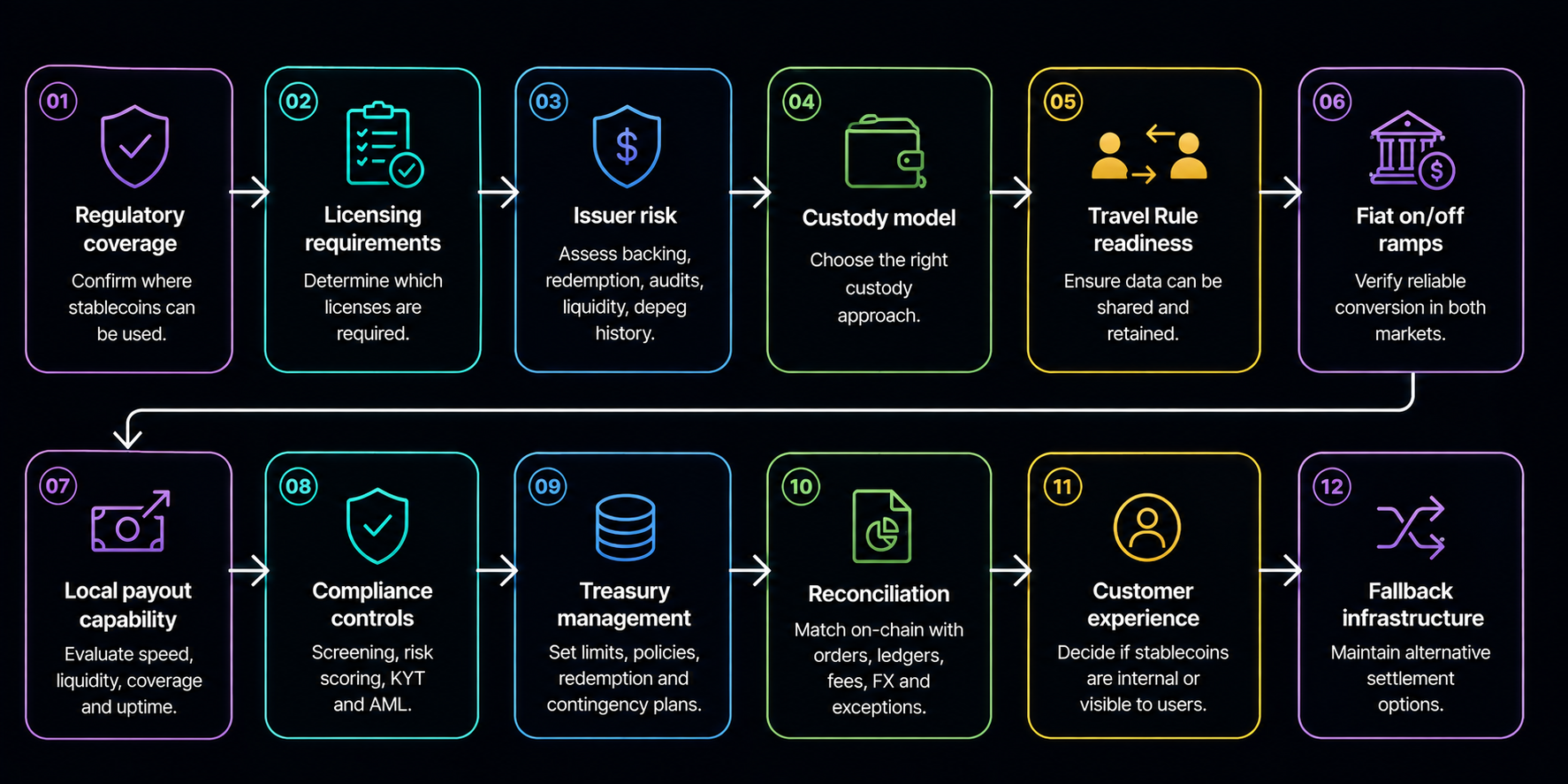
The FATF 2025 Virtual Assets Update noted continued gaps in licensing, offshore VASP supervision, and uneven Travel Rule implementation, while reporting that 99 jurisdictions had passed or were implementing Travel Rule legislation. For any remittance business using digital assets, regulatory readiness should be validated alongside technical implementation.
Practical checkpoint: Before enabling stablecoin settlement, verify that every target corridor is legally supported, operationally resilient, fully compliant, and backed by tested fallback payment rails.
Remittance businesses can build infrastructure internally, partner with regulated providers, use payout aggregators, or adopt a hybrid model. The right approach depends on licensing, corridor strategy, operational capacity, and growth objectives.
Building an independent MTO offers the greatest control over pricing, compliance, and customer experience but requires significant investment in licensing, banking relationships, treasury, and operations. Partner-led or aggregator models enable faster market entry but reduce control over pricing, coverage, and partner performance. Many operators also combine traditional payment rails with stablecoin-based settlement to improve treasury efficiency while keeping customer funding and payouts in fiat.
Before selecting an operating model, evaluate each corridor for transaction volume, competition, licensing requirements, payout coverage, compliance risk, FX liquidity, funding needs, and customer trust. These factors have a greater impact on long-term success than the technology itself.
The most effective operating model aligns infrastructure with corridor economics, regulatory obligations, and customer expectations rather than relying on a single payment rail or provider.
Practical Checkpoint: Build a corridor readiness scorecard covering demand, licensing, payout options, compliance, liquidity, costs, and customer trust before choosing your operating model.
Fuze Finance provides regulated remittance infrastructure that enables MTOs, fintechs, and payment providers to simplify cross-border money movement. Through a single API, businesses can collect funds in fiat, convert them into stablecoins, settle across blockchain networks, and pay out in local currencies through a global network of regulated partners. This helps reduce settlement times, improve capital efficiency, and support payouts across more than 65 countries.
Beyond settlement, Fuze offers the infrastructure needed to scale remittance operations, including FX conversion, collections, payouts, wallet infrastructure, real-time APIs, sandbox environments, and compliance tooling. By combining traditional payment rails with stablecoin-based settlement, businesses can expand into new corridors faster while maintaining the regulatory, operational, and reporting standards required for modern cross-border payments.


%201.jpg)