
The cryptocurrency market has grown far beyond retail investing. Today, businesses, financial institutions, and payment providers rely on crypto trading data to understand market trends, evaluate liquidity, and identify new opportunities.
High trading volumes don't necessarily mean higher adoption, and rising ownership doesn't always translate into active trading.
In this guide, we'll break down the latest crypto trading statistics, from global adoption and trading volume to stablecoins, exchange market share, and institutional participation. Whether you're evaluating crypto for treasury management, payments, or trading infrastructure, these benchmarks provide a clearer picture of where the market stands today.
Crypto trading has become larger, more liquid, and increasingly institutional, but activity remains concentrated.
High trading volumes don't necessarily mean more people are using crypto. Market making, automated trading, arbitrage, and derivatives can all inflate trading activity. That's why businesses should evaluate multiple indicators instead of relying on trading volume alone.
When people talk about crypto trading statistics, they're often referring to very different types of data. Looking at one metric in isolation can create a misleading picture of the market.
Broadly speaking, crypto market statistics fall into five categories:
Each metric tells a different story. A market may have millions of crypto owners but relatively low trading activity, while another may generate enormous trading volumes through institutional trading or derivatives.
That's why businesses should avoid treating trading volume as a direct measure of adoption. Looking at adoption, liquidity, stablecoin supply, derivatives activity, and exchange concentration together provides a much clearer picture of the market.
Also read: How to Start Crypto Trading?
Global crypto ownership continued to expand throughout 2025.
According to Crypto.com, an estimated 741 million people owned cryptocurrency in 2025, up from 659 million in 2024. The report also estimated 365 million Bitcoin holders and 175 million Ethereum holders worldwide.
These figures show growing interest in digital assets, but ownership doesn't necessarily translate into active trading. Someone who bought Bitcoin several years ago may still count as an owner without making regular trades.
The same distinction applies when comparing different surveys.
For example, Pew Research Center reported that 19% of U.S. adults had invested in, traded, or used cryptocurrency in its January 2026 survey. Meanwhile, the National Cryptocurrency Association found that one in four U.S. adults owned crypto, while Security.org reported 30% current ownership.
These numbers differ because each survey measures something different. Some count people who have ever used cryptocurrency, while others measure current ownership or investment exposure.
For businesses, separating these categories is important. Crypto owners, active traders, ETF investors, DeFi users, and businesses using stablecoins all represent different audiences with different infrastructure needs.
Crypto adoption is growing worldwide, but the reasons behind that growth vary from region to region.
According to Chainalysis' 2025 Global Crypto Adoption Index, India ranked first, followed by the United States, Pakistan, Vietnam, and Brazil.
At the same time, North America and Europe generated the highest overall transaction values, with more than $2.2 trillion and $2.6 trillion, respectively, during the reporting period.
These rankings highlight an important distinction: countries with the highest adoption don't always generate the highest trading volumes.
In North America, growth has been driven largely by institutional participation, Bitcoin ETFs, and improving regulatory clarity. Europe has benefited from expanding regulatory frameworks and growing institutional activity.
Meanwhile, countries such as India, Pakistan, Vietnam, Brazil, and Nigeria continue to see strong grassroots adoption, supported by mobile-first financial services, remittances, retail investing, and increasing demand for alternatives to traditional financial systems.
These regional trends are particularly relevant for businesses operating in the Middle East.
Several of the world's fastest-growing crypto markets, including India, Pakistan, and Vietnam, are closely connected to the Gulf through trade and remittance corridors. At the same time, the UAE has emerged as one of the region's leading regulated digital asset hubs.
This combination creates strong demand for stablecoin-powered cross-border payments, institutional custody, OTC trading, and compliant digital asset infrastructure. As adoption continues to grow across South Asia while regulatory clarity improves in the UAE, businesses operating between these markets are well positioned to benefit from faster and more efficient cross-border settlement.
Not all crypto trading volume measures the same type of activity. To understand the market, it's helpful to separate trading into four broad categories: spot trading, derivatives, stablecoin trading, and over-the-counter (OTC) transactions.
Spot trading is the most familiar type of crypto trading. It involves buying and selling digital assets for immediate settlement. According to CoinGecko, the top 10 centralized exchanges recorded $2.7 trillion in spot trading volume during Q1 2026, down from $4.5 trillion in Q4 2025. This highlights how trading activity can fluctuate with market cycles.
Derivatives trading is significantly larger. CoinGecko estimates that perpetual futures exchanges processed approximately $85.3 trillion in trading volume during 2025. These markets allow traders to hedge risk or trade with leverage, making them a major driver of overall market activity.
Stablecoin trading also plays a central role in crypto markets. Stablecoins such as USDT and USDC serve as the primary trading pairs for many cryptocurrencies, allowing traders to move between assets without converting back into fiat currency.
Finally, there's OTC (over-the-counter) trading, where large transactions are executed privately rather than through public exchanges. OTC trading is commonly used by institutions because it helps minimize price impact when buying or selling large amounts of cryptocurrency.
Each of these markets serves a different purpose. Spot markets reflect immediate buying and selling activity, derivatives indicate leverage and institutional participation, stablecoins provide liquidity, and OTC markets facilitate large institutional trades.
Although thousands of exchanges operate globally, trading activity remains concentrated among a relatively small group of platforms.
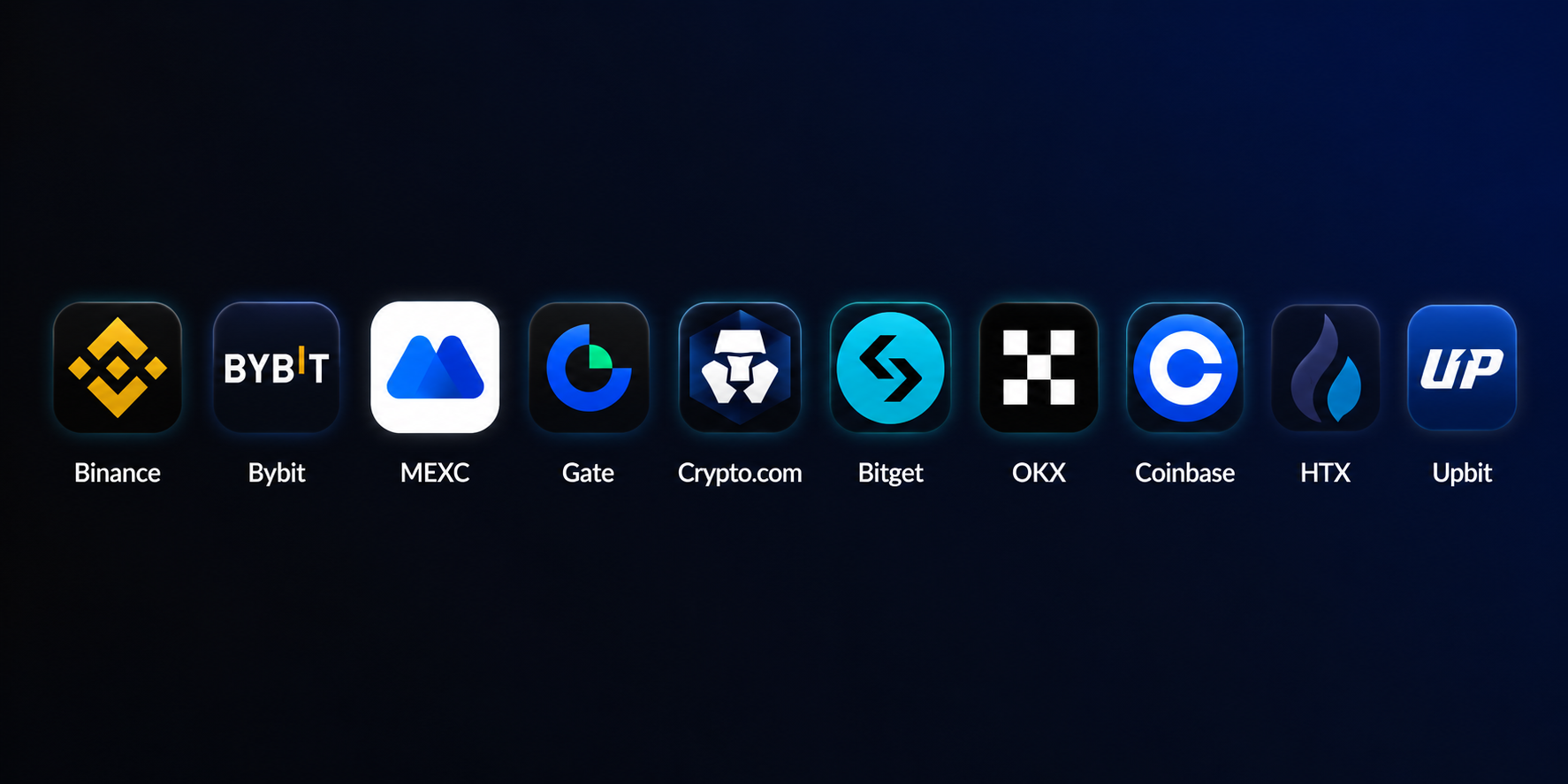
Market share alone doesn't tell the full story.
Some exchanges specialize in derivatives, while others focus on fiat on-ramps, institutional custody, or regional markets. Businesses evaluating an exchange should also consider factors such as liquidity, regulatory compliance, security, custody solutions, API reliability, reporting capabilities, and supported trading pairs, not just trading volume.
Crypto trading takes place on both centralized exchanges (CEXs) and decentralized exchanges (DEXs), but they serve different users and use cases
The biggest difference is custody.
With a centralized exchange, users deposit their assets with the platform, which manages custody and executes trades on their behalf.
With a decentralized exchange, users keep control of their own wallets and trade directly through blockchain-based smart contracts.
Centralized exchanges continue to dominate global trading volume because they generally offer deeper liquidity, easier fiat access, and institutional services. However, decentralized exchanges have grown rapidly in recent years, particularly for new token launches, on-chain trading, and decentralized finance (DeFi).
Rather than replacing one another, CEXs and DEXs increasingly serve different parts of the crypto ecosystem.
Stablecoins have become one of the most important pieces of crypto market infrastructure.
Unlike cryptocurrencies whose prices fluctuate significantly, stablecoins are designed to maintain a stable value, typically by being pegged to a fiat currency such as the U.S. dollar.
Today, they support much more than trading.
Stablecoins are widely used as the primary quote currency for crypto trading pairs, collateral for derivatives markets, a way to move liquidity between exchanges, and increasingly, as a settlement asset for businesses making cross-border payments.
Institutional participation has become one of the biggest drivers of crypto market growth.
The approval of spot Bitcoin ETFs in the U.S. opened a regulated way for investors to gain exposure to Bitcoin without managing private keys or self-custody. Since then, institutional demand for digital assets has continued to expand.
Trading activity reflects this shift. CME Group reported nearly $3 trillion in notional cryptocurrency futures and options trading in 2025. Average daily trading volume more than doubled to 280,000 contracts, while average daily open interest reached 313,000 contracts.
Beyond cryptocurrencies themselves, tokenized assets are also gaining momentum. CoinDesk reported that the tokenized asset market reached $26.7 billion in April 2026, led by tokenized U.S. Treasuries. CoinGecko also reported $524.79 billion in RWA perpetual trading volume during Q1 2026, highlighting growing interest in real-world asset (RWA) markets.
Together, these trends show that crypto is evolving beyond retail trading. Financial institutions are increasingly investing in regulated products, digital asset infrastructure, and tokenized financial markets.
Crypto statistics are most valuable when viewed together rather than in isolation.
For example, high trading volume doesn't always mean strong market demand. Activity may be driven by market makers, automated trading, derivatives, or arbitrage rather than new investors.
Similarly, strong adoption doesn't always translate into high trading activity. Some markets have millions of crypto holders who rarely trade, while others generate enormous trading volumes through institutional participants.
When evaluating the market, businesses should look beyond trading volume and consider factors such as:
It's also important to understand the limitations of crypto data. Reported trading volume may vary between exchanges, some activity comes from automated trading rather than individual investors, and private OTC transactions are often not visible in public market data.
Rather than relying on a single metric, businesses should compare multiple data sources, including exchange data, on-chain activity, institutional products, and market research, to build a more accurate picture of the market.
Also read: Benefits of Crypto Trading
Understanding crypto trading statistics is only the first step. Businesses also need secure, regulated infrastructure to turn market opportunities into real products and services.
Fuze provides enterprise-grade digital asset infrastructure that enables banks, fintechs, exchanges, payment providers, and enterprises to build crypto products with confidence. Through a single integration, businesses can access crypto trading, OTC services, stablecoin payments, wallets, custody solutions, and yield infrastructure while meeting regulatory and operational requirements.
Fuze helps you launch faster without building the underlying infrastructure from scratch.


%20(1)%20(1).png)