
Crypto trading has become one of the most accessible ways to participate in digital asset markets, with thousands of cryptocurrencies available to buy and sell through online trading platforms. But accessibility doesn't guarantee success. Many beginners make their first trade without understanding how the market works, how to manage risk, or how to build a consistent trading process.
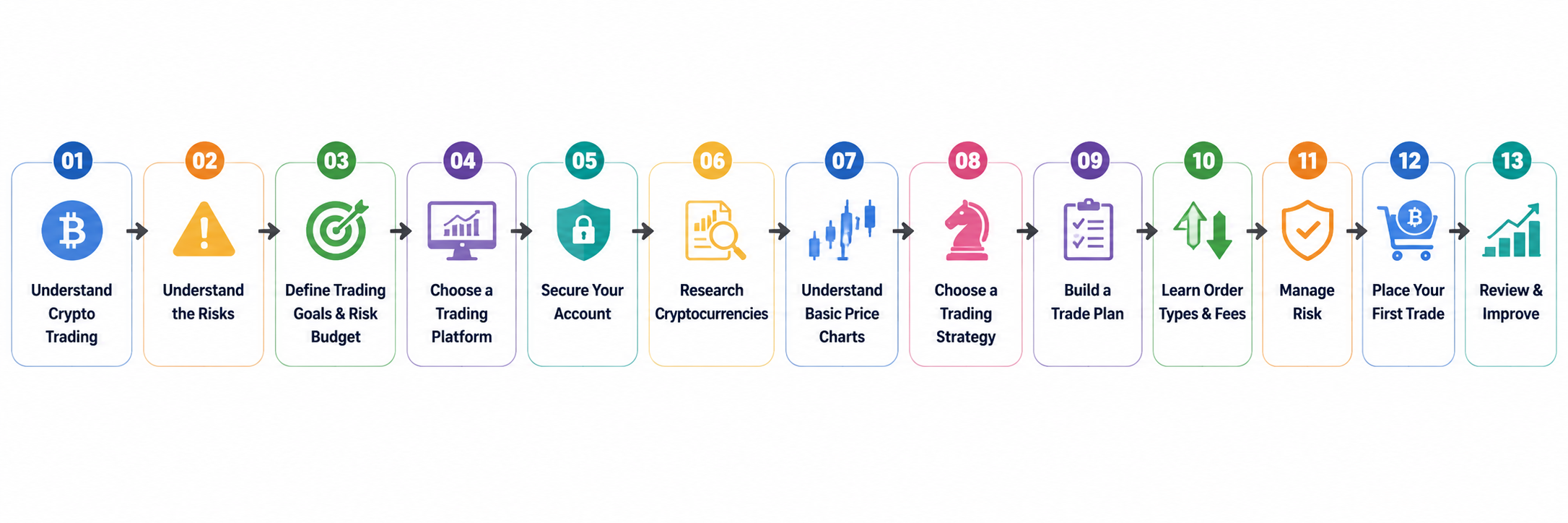
This guide explains how to start crypto trading through a practical beginner workflow. You'll learn how to set clear goals, choose a trading platform, research assets, place your first trade, and manage risk. Rather than chasing short-term price movements, the focus is on building habits that help you trade with greater confidence over time.
Crypto trading is the process of buying and selling digital assets, such as Bitcoin, Ether, and stablecoins, with the goal of taking advantage of price movements. Unlike long-term investing, trading requires a defined strategy for when to enter a position, when to exit, and how much risk to take on each trade.
Beginners are likely to come across several trading approaches. Spot trading involves buying and selling the actual digital asset and is the most common starting point. Dollar-cost averaging (DCA) means investing a fixed amount at regular intervals to reduce the impact of market volatility. More advanced approaches, such as swing trading, day trading, and derivatives trading, require greater market knowledge and carry higher levels of risk.
For most beginners, spot trading provides the simplest way to understand how the market works before exploring more complex strategies. This guide focuses on building that foundation through a step-by-step workflow rather than chasing short-term market opportunities.
Read in detail here: What is Crypto Trading?
Before making your first trade, it's important to understand the risks involved. Crypto markets are highly volatile, and prices can change rapidly. While the potential for returns exists, so does the possibility of losing part or all of your investment.
Some of the most common risks include:
As a beginner, focus on developing good trading habits rather than chasing quick profits. A disciplined process, supported by research, risk management, and patience, is far more valuable than the outcome of any single trade.
Before making your first trade, decide why you want to trade crypto. Your objective will influence the assets you choose, how often you trade, and how much risk you're willing to take.
For example, you might want to:
Next, set a budget that you're comfortable risking. Only trade with money you can afford to lose, and keep your trading capital separate from funds needed for everyday expenses or emergency savings.
If you're just starting out, consider one of these beginner-friendly approaches:
Before moving on, make sure you have a clear objective, a realistic budget, and a maximum loss you're willing to accept.
Not all crypto trading platforms are the same. Before opening an account, compare exchanges based on factors such as regulatory compliance, supported assets, trading fees, liquidity, deposit and withdrawal options, and available order types.
Once you've selected a platform, take a few simple steps to protect your account:
If you plan to hold crypto for the long term, you may also consider moving your assets to a self-custody wallet. While this gives you greater control, it also means you're responsible for securely storing your private keys.
Avoid choosing a cryptocurrency simply because it's trending or being discussed on social media. Before making a trade, spend a few minutes understanding what you're buying.
Focus on these fundamentals:
A cryptocurrency becomes a trading opportunity only when you have a clear reason to buy, a target for selling, and a plan for managing risk.
You don't need advanced technical analysis to place your first trade. Learning a few basic concepts is enough to understand market direction and identify potential entry points.
Pay attention to:
Charts should help you make informed decisions—not replace your trading plan. Always combine chart analysis with research, position sizing, and a predefined exit strategy.
Start with one simple strategy and stick with it. Changing methods after every market move makes it difficult to learn what works.
Good beginner options include:
Avoid high-risk strategies such as leveraged futures, high-frequency trading, copy trading, or meme-coin speculation until you have more experience.
Checkpoint: Use the same approach for your first 10–20 trades before trying a new strategy.
A trade is not an idea until entry, exit, and risk are defined. Write the plan before you click buy.
Use this template:
This table can live in a notebook, spreadsheet, or trading journal. The format matters less than consistency. Your goal is to make every decision reviewable.
Before placing your first trade, understand how orders work and what you'll pay.
The most common order types are:
Be aware of these trading costs:
Checkpoint: Before clicking Buy, double-check the asset, trading pair, order type, position size, fees, and wallet address (if withdrawing).
The goal of risk management is simple: make sure one bad trade doesn't end your trading journey.
Follow these basic rules:
Remember that stop-loss orders help reduce risk but cannot guarantee your exact exit price during highly volatile markets.
A simple trading journal should record:
Your first live trade is practice—not a test of how much money you can make.
A simple process looks like this:
A small, planned loss is often more valuable than a lucky, unplanned profit because it builds the discipline needed for long-term success.
Long-term success in crypto trading comes from building a disciplined process rather than trying to predict every market move. The traders who improve consistently are usually the ones who treat each trade as an opportunity to refine their decision-making.
1. Review every trade objectively: After closing a trade, take a few minutes to evaluate it. Ask whether you followed your original plan, whether your entry and exit made sense, and what you would do differently next time. Over time, these reviews help identify recurring strengths and weaknesses.
2. Measure process before profits: A profitable trade isn't always a good trade, just as a losing trade isn't always a bad one. If you followed your strategy and managed risk correctly, you've achieved your objective regardless of the outcome. Consistently following a sound process is more valuable than occasional lucky wins.
3. Monitor your portfolio as a whole: It's easy to focus on individual positions while overlooking your overall exposure. Keep an eye on how much capital is invested, how concentrated your holdings are, and whether you're taking on more risk than intended across multiple trades.
4. Separate research from execution: Learning about new projects is important, but research shouldn't automatically lead to a trade. Maintain a watchlist for ideas and only enter positions after they meet your predefined trading criteria. This simple habit reduces impulsive decisions driven by hype.
5. Keep a trading journal: Document your watchlist, trade plans, entries, exits, and key observations. A journal creates a record of your decision-making and makes it easier to spot patterns that can improve your performance over time.
Also read: Benefits of Crypto Trading
Most beginner trading mistakes aren't caused by a lack of market knowledge—they come from poor discipline and risk management. Recognizing these pitfalls early can help you avoid costly lessons.
1. Trading without a clear plan: Entering a position without predefined entry, exit, and risk levels often leads to emotional decisions once the market starts moving.
2. Chasing momentum: Buying after a sharp price rally because of fear of missing out frequently results in entering trades after much of the move has already occurred.
3. Taking on too much risk too soon: Using leverage, allocating too much capital to a single trade, or concentrating your portfolio in one asset can magnify losses before you've developed a consistent strategy.
4. Ignoring trading costs: Fees, spreads, and slippage can significantly reduce returns, especially for active traders. Factoring these costs into every trade leads to more realistic expectations.
5. Following hype instead of research: Influencers, social media posts, and online communities can generate ideas, but they shouldn't replace independent research. Understanding why you're entering a trade is essential.
6. Skipping security and trade reviews: Weak account security, poor wallet management, and failing to review past trades can be just as damaging as making bad investment decisions. Protecting your assets and learning from previous trades should be part of every trader's routine.
Avoiding these common mistakes won't guarantee profits, but it will help you build the discipline and risk management habits that separate successful traders from those who struggle over the long term.
Learning how to trade crypto is only the first step. For businesses looking to offer crypto trading to their customers, building a secure, compliant, and scalable trading experience requires far more than connecting to an exchange. It involves regulated infrastructure, liquidity, custody, compliance, and reliable execution.
Fuze provides an end-to-end embedded crypto trading platform that enables banks, fintechs, wealth platforms, and enterprises to launch regulated digital asset trading through a single integration. With institutional-grade liquidity, custody orchestration, and enterprise APIs, Fuze helps businesses deliver a seamless trading experience while reducing the complexity of building and managing the underlying infrastructure.
To learn how you can embed regulated crypto trading into your platform, explore Fuze's Embedded Trading solution.


%20(1)%20(1).png)