
Blockchain technology has evolved significantly over the past few years, but many networks still struggle with high transaction fees, slow confirmation times, and limited scalability during periods of heavy demand.
Solana was built to solve this problem. As a high-performance Layer-1 blockchain, it focuses on delivering fast transaction speeds, low fees, and the ability to support large-scale decentralized applications. Its architecture enables developers to build everything from payment platforms and decentralized exchanges to NFT marketplaces, blockchain games, and tokenized asset platforms on a single network.
Whether you're sending SOL, trading tokens, interacting with DeFi protocols, or exploring Web3 applications, understanding how Solana transactions work can help you make faster, cheaper, and more reliable transactions.
In this guide, we'll explain how Solana calculates transaction fees, how quickly transactions are processed, what affects network performance, and how Solana compares with other leading blockchains.
Solana is an open-source Layer-1 blockchain designed to deliver high throughput without relying on secondary scaling solutions. Instead of processing transactions one at a time, Solana uses several performance-focused technologies that allow validators to execute many transactions simultaneously.
One of Solana's biggest innovations is Proof of History (PoH)—a cryptographic clock that timestamps transactions before they enter the consensus process. Combined with Proof of Stake (PoS), this allows validators to verify and order transactions more efficiently, reducing delays and improving network performance.
The result is a blockchain capable of handling significantly more activity than many earlier Layer-1 networks while maintaining low transaction costs.
Every transaction on Solana follows a straightforward process, even though complex technology operates behind the scenes.
When a user initiates a transaction, their wallet signs it using their private key and broadcasts it to the Solana network through a Remote Procedure Call (RPC) node. Validators then verify the transaction, execute the required instructions, and include it in a block. Once enough validators reach consensus, the transaction is confirmed and permanently recorded on the blockchain.
The process can be simplified as follows:
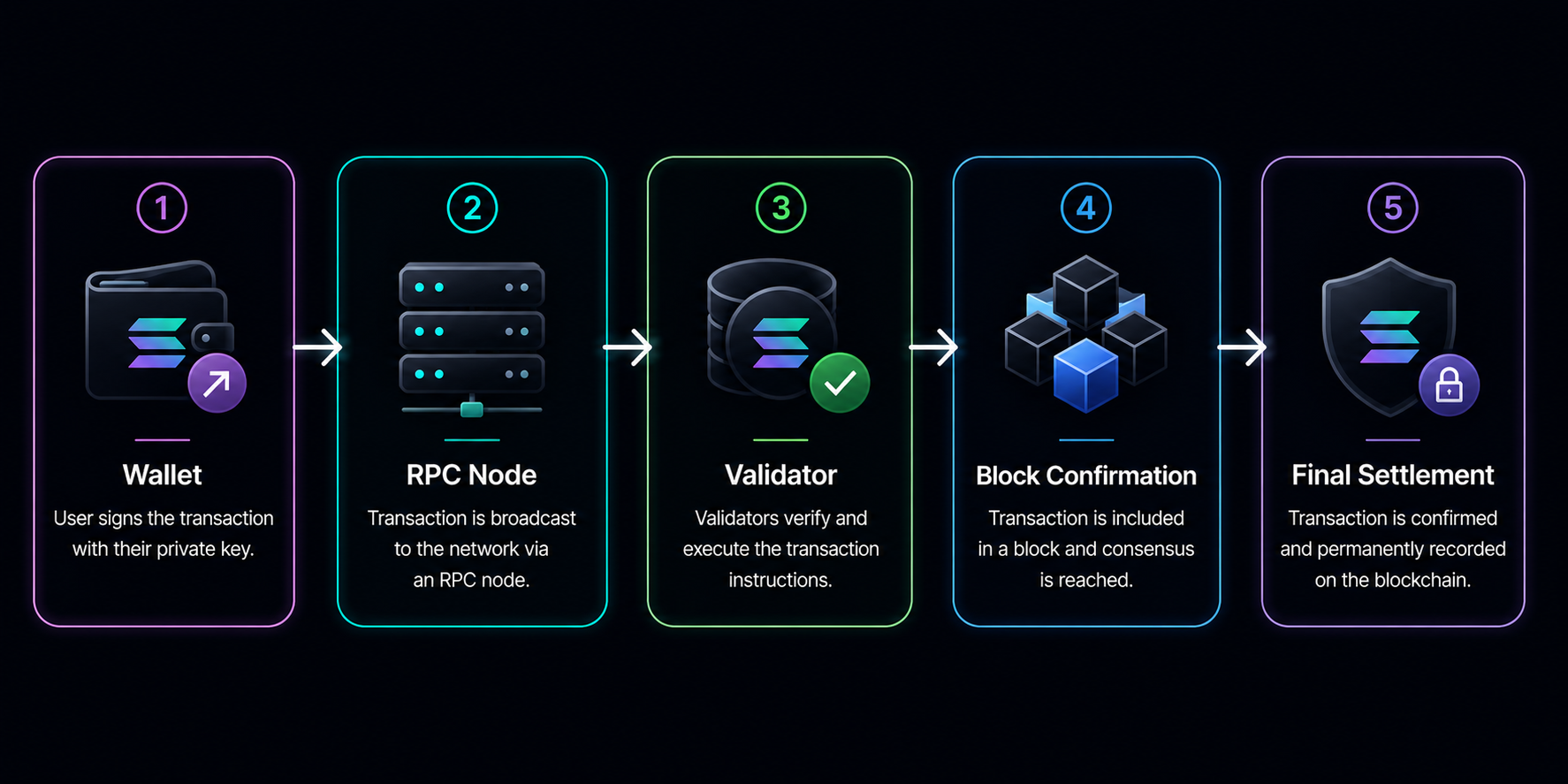
Wallet → RPC Node → Validator → Block Confirmation → Final Settlement
Unlike many blockchain networks where transactions compete heavily for block space, Solana's architecture allows validators to process many independent transactions in parallel. This significantly improves throughput while keeping confirmation times short.
One of Solana's biggest advantages is its extremely low transaction fees. Unlike networks where fees can increase dramatically during periods of congestion, Solana is designed to keep transaction costs predictable and affordable.
For most users, transferring SOL or sending SPL tokens costs only a tiny fraction of a dollar. Even interacting with decentralized applications generally remains inexpensive compared to many other Layer-1 blockchains.
Every transaction includes a base fee, which covers the cost of processing the transaction and helps protect the network from spam.
In addition to the base fee, users can choose to pay an optional priority fee. This allows validators to prioritize a transaction during periods of high network demand. While most everyday transfers don't require a priority fee, traders executing time-sensitive transactions or users participating in popular NFT launches may choose to pay one for faster confirmation.
The total fee depends on several factors, including:
Simple wallet transfers consume very few resources, while smart contract interactions, token swaps, or NFT minting generally require more compute units and may incur slightly higher fees.
Solana's low fees are the result of its high-performance architecture rather than artificially subsidized transactions.
Several design choices contribute to its affordability:
Together, these innovations enable Solana to process large volumes of transactions while keeping costs consistently low for users.
Transaction speed is one of Solana's biggest competitive advantages. The network is designed to process transactions in seconds, making it suitable for applications that require near real-time settlement, such as payments, decentralized finance (DeFi), gaming, and digital asset trading.
However, it's important to understand that block time, confirmation time, and finality are different metrics, and each measures a different stage of the transaction lifecycle.
Block time refers to how frequently new blocks are produced on the network. Solana's average block time is around 400 milliseconds, allowing validators to add transactions to the blockchain quickly.
Faster block production means users spend less time waiting for their transactions to be included in a block.
A transaction is considered confirmed once validators have processed it and reached network consensus. Under normal network conditions, most Solana transactions are confirmed within a few seconds.
The exact confirmation time depends on several factors, including network activity, transaction complexity, validator performance, and whether a priority fee has been included.
Finality means a transaction is permanently recorded on the blockchain and cannot be reversed. Solana's architecture allows transactions to achieve finality much faster than many traditional blockchain networks, making it well suited for payment applications and time-sensitive financial services..
Unlike traditional payment networks that often impose strict transaction limits, Solana's restrictions are primarily based on technical resources rather than transaction value.
The Solana protocol itself does not impose a fixed limit on how much SOL can be transferred in a single transaction. However, wallets, exchanges, or custodians may apply their own withdrawal or transfer limits for operational or security reasons.
Each transaction has a maximum size, which limits the amount of data that can be included in a single request. Simple SOL transfers require very little space, while transactions involving multiple accounts or complex smart contracts consume more of the available capacity.
Every transaction is allocated a compute budget that determines how much processing it can consume. If a transaction exceeds this limit, it may fail unless additional compute resources are requested.
Although Solana is built for high throughput, periods of intense activity—such as popular NFT launches or major token events—can temporarily increase competition for network resources. During these periods, users may choose to add a priority fee to improve confirmation speed.
Both Solana and Ethereum support smart contracts and decentralized applications, but they differ significantly in transaction costs and network performance:
Ethereum has one of the largest developer ecosystems in blockchain, while Solana focuses on delivering a fast, low-cost user experience. The right choice depends on your application's priorities, whether that's ecosystem maturity, transaction costs, scalability, or speed.
Although Solana is known for its performance, transactions can occasionally fail. In most cases, this is caused by network conditions or transaction configuration rather than a problem with the blockchain itself.
Common reasons include:
Understanding these common issues can help users troubleshoot failed transactions more effectively.
Although Solana is already one of the most affordable blockchain networks, following a few best practices can help ensure faster confirmations and lower costs.
Following these practices can improve your overall experience while minimizing failed transactions and unnecessary fees.
Solana has established itself as one of the leading Layer-1 blockchains by combining fast transaction speeds, low fees, and a scalable architecture. Whether you're transferring SOL, trading tokens, interacting with DeFi protocols, or building decentralized applications, the network offers an efficient alternative to many traditional blockchain platforms.
Its combination of Proof of History and Proof of Stake enables rapid transaction processing while keeping costs predictable for users. Features such as optional priority fees and parallel transaction execution further enhance network performance, making Solana suitable for everything from everyday payments to enterprise-scale blockchain applications.


.jpg)