
Large crypto blocks are not just an execution problem. They are also a liquidity, counterparty, settlement, custody, and reporting decision. The right OTC desk should help you move size with fewer market-impact surprises, but it should also fit your internal controls, funding rails, jurisdiction, and post-trade process.
This listicle is designed for institutions, crypto businesses, family offices, and high-net-worth traders comparing leading OTC desks by practical workflow fit rather than generic brand recognition. Fuze Finance approaches this decision from a risk-aware, operational perspective: before moving size, buyers should validate RFQ quality, settlement terms, custody controls, reporting outputs, and whether the desk can actually support the trade pattern they intend to execute.
The best desk depends less on a universal ranking and more on the trade pattern: regulated custody, lower minimum access, API liquidity, derivatives, stablecoin flows, or jurisdictional availability.
We compared desks using factors that affect live execution, not just marketing claims or minimum trade size.
Ranking pages often over-focus on minimums and “low slippage.” In practice, settlement, counterparty structure, and operational risk often create the real implementation friction.
Choosing the right OTC desk depends on your trading volume, geographic location, supported assets, and operational requirements. Below, we've compared some of the leading crypto OTC providers, highlighting their strengths, ideal use cases, and key features to help you find the best fit for your business.
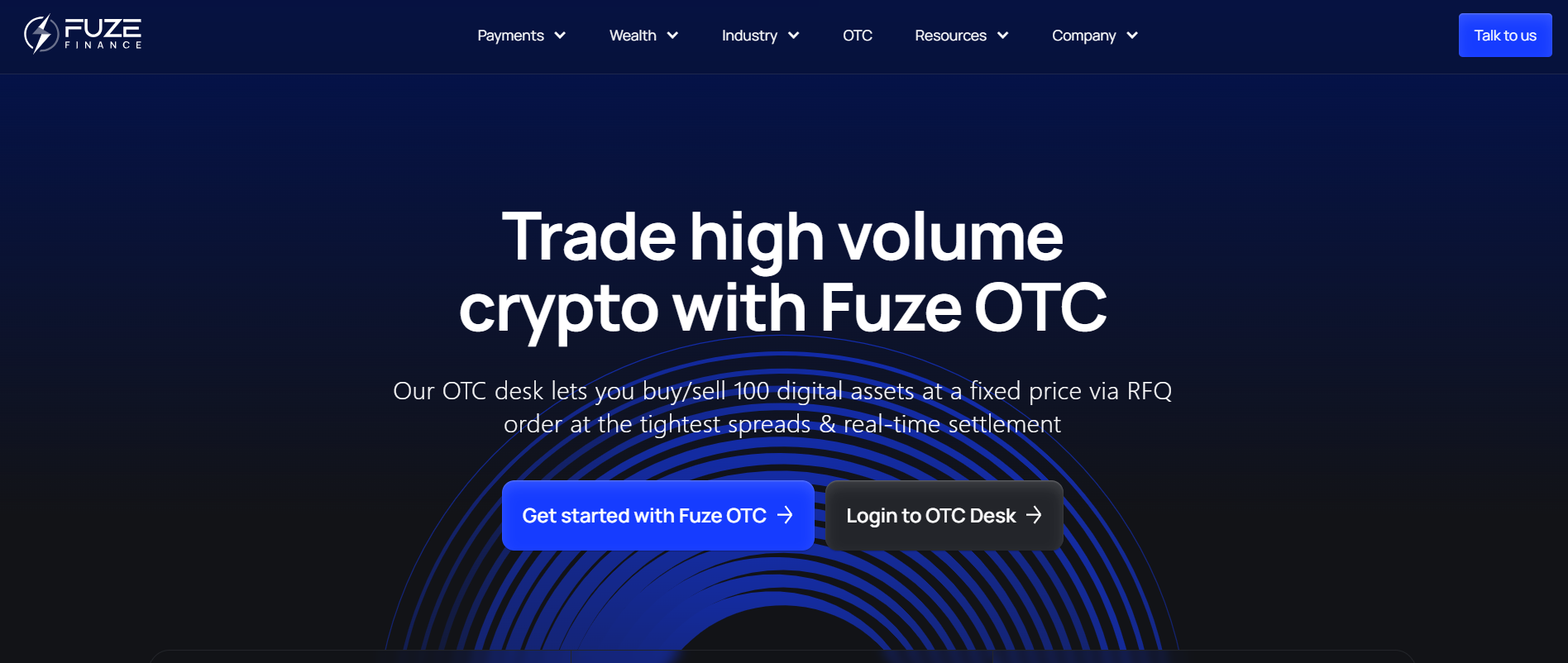
Fuze OTC desk is best suited for institutions, HNIs, corporate treasuries, and crypto businesses that need to execute large-volume digital asset trades outside public exchanges.
Fuze Finance runs a VARA- and CBUAE-licensed OTC desk out of Dubai, offering fixed RFQ pricing, tight spreads, and T+0 settlement on 100+ tokens including USDT and USDC. Every quote is locked for 10 seconds and is all-inclusive, so the price you see is the final price, no slippage, re-quotes, or hidden fees on block trades.
The desk handles both fiat-to-crypto and crypto-to-fiat across AED, USD, EUR, GBP, and TRY, wiring fiat proceeds directly to your verified bank account once a trade settles. Every OTC client gets a dedicated relationship manager reachable by chat and phone, 24/7/365.
Onboarding completes in under 24 hours, with KYC and wallet whitelisting required before trading begins. Trades start from a $250,000 USD-equivalent minimum.
The main caveat is that Fuze Finance is a VARA- and CBUAE-licensed desk, so full KYC is mandatory before trading, alongside a $250,000 minimum trade size and wallet whitelisting that can take up to 7 working days, plus current limits on third-party wallets, all worth clearing before a time-sensitive trade.
Best fit: Choose Fuze Finance when the buyer needs a regulated, high-touch OTC desk for large fixed-price crypto/stablecoin blocks with fast fiat settlement and dedicated coverage.
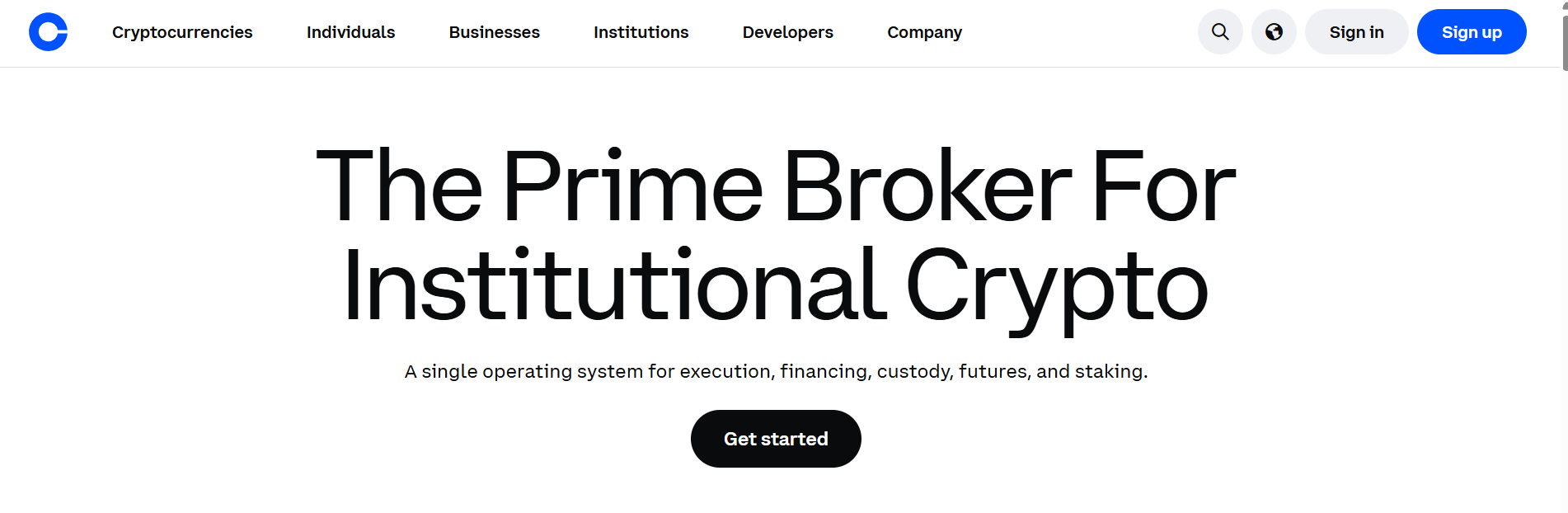
Coinbase Prime is strongest when the buyer wants execution, custody, financing, and reporting under one institutional platform.
Coinbase Prime is a strong fit for asset managers, corporates, crypto funds, ETFs, foundations, and institutions that want fewer handoffs between trading and custody. The platform combines execution, financing, custody, futures, staking, and reporting in one institutional environment.
Its custody proposition is central. Coinbase states that Coinbase Custody Trust Company is a New York State Department of Financial Services limited purpose trust company and qualified custodian, which can matter for boards, auditors, and regulated allocators.
The RFQ workflow is also relatively transparent. A client requests a quote, liquidity providers compete briefly, the winning quote is returned with a limited hold, and the client chooses whether to accept. RFQ is available through the Prime UI, REST API, and FIX API. Coinbase says quoted prices are inclusive of fees, RFQ orders are fill-or-kill, and settlement occurs instantly once the winning quote is accepted. Its RFQ help page states UI quote holds are 3 seconds and refreshable up to 20 times, while API quote holds are 1 second.
Coinbase also notes USDC can be used across Prime UI, REST API, and FIX API for supported order types including RFQ, with post-trade reports showing settlement currency details. Buyers should still confirm supported pairs, order limits, financing availability, and jurisdictional terms with their Coinbase account manager or Prime Operations team.
Best fit: Choose Coinbase Prime when custody, compliance review, transparent RFQ pricing, and integrated reporting matter as much as raw OTC liquidity.
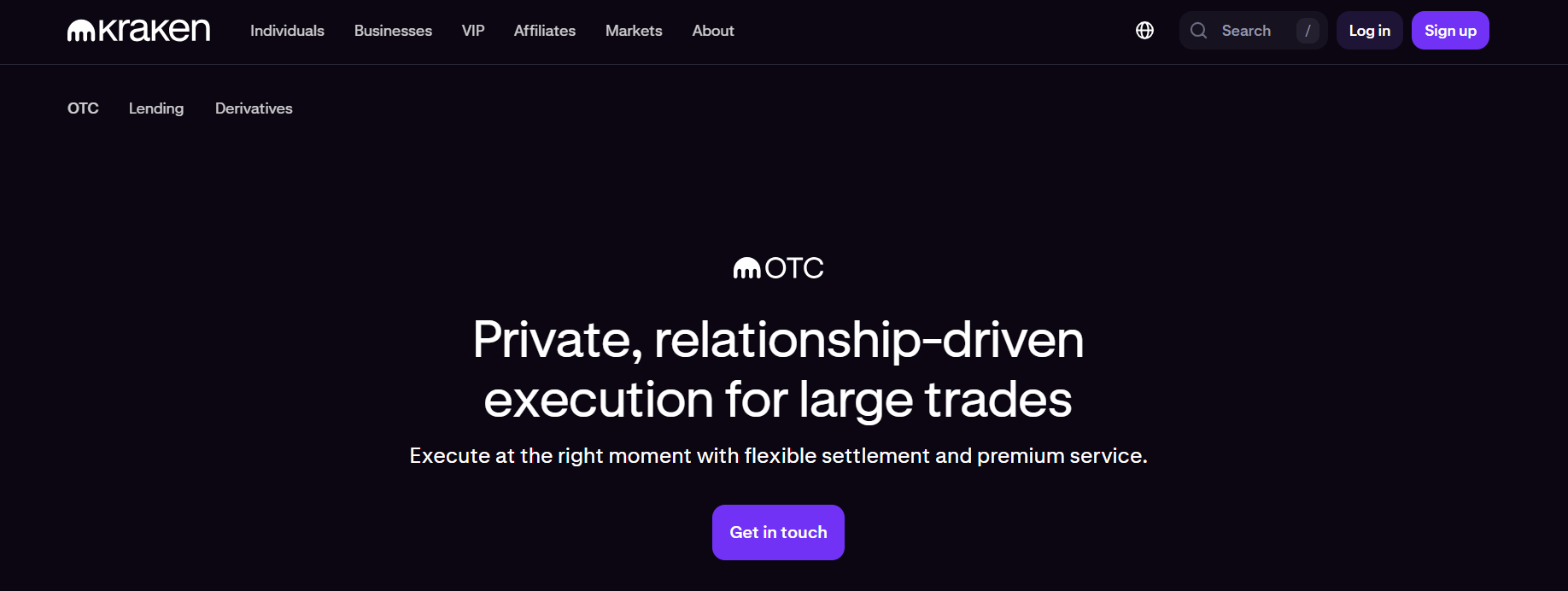
Kraken OTC is a strong fit for HNWIs, crypto businesses, and institutions that want a dedicated desk, deep liquidity, 24/7/365 execution, and flexible settlement without needing a very high entry threshold.
Kraken publishes a relatively accessible OTC threshold, stating that OTC supports spot and derivatives trades over $50,000, subject to jurisdiction. That makes it relevant for family offices, active traders, crypto businesses, and smaller institutions that want desk support without an institution-only onboarding path.
Kraken offers two workflows: clients can use the self-service OTC portal for executable RFQs, or they can chat securely with Kraken’s trade desk for desk-assisted execution. Kraken also describes dedicated 24/7/365 support and dedicated relationship managers for institutional clients.
Coverage is broad. Kraken says clients can access all asset pairs listed on Kraken or trade 150+ pairs through the OTC portal. On settlement, Kraken states OTC trades can settle within 24 hours using a Kraken account, bank, and/or external wallet.
The main caveat is jurisdiction. Products, derivatives access, and OTC features vary by location, so buyers should confirm availability before assuming the full feature set applies.
Best fit: Choose Kraken OTC when the buyer wants a recognizable exchange brand, human coverage, and a published entry point lower than many institution-only desks.
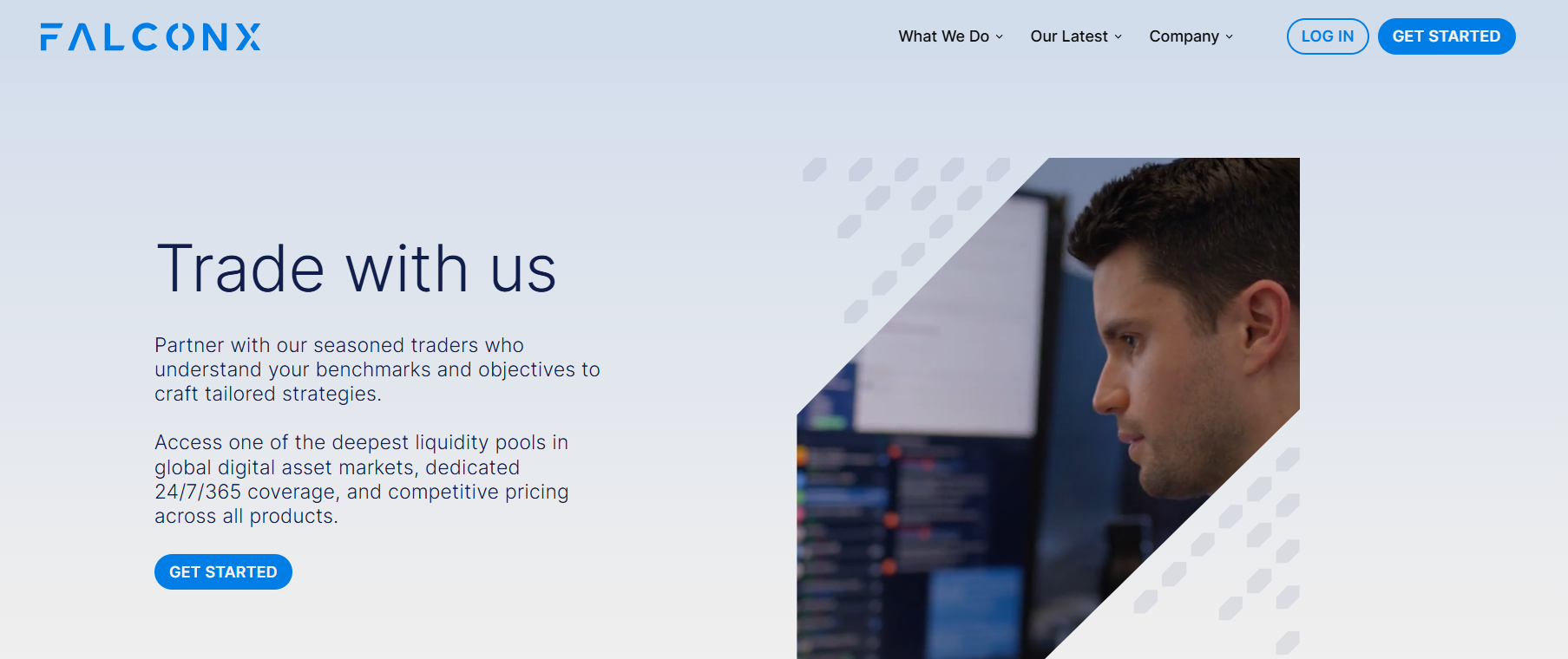
FalconX is best positioned for hedge funds, market makers, and trading firms that care about electronic execution, broad liquidity access, derivatives, and reduced pre-funding burden.
FalconX is better understood as an institutional trading and prime-brokerage-style platform than a simple exchange OTC desk. It describes electronic and OTC spot trading, RFQ/streaming execution across crypto and FX markets, and UI/API access.
For systematic and high-frequency institutional users, connectivity is a major advantage. FalconX lists WebSocket, FIX, and REST API connectivity, and says OTC trading covers 400+ tokens, subject to restrictions. Its principal-liquidity materials reference post-trade settlement and reduced counterparty risk, while its trading materials emphasize portfolio-level margining for derivatives.
FalconX also offers bespoke derivatives across options, forwards, swaps, and structured products. In the U.S., options and forwards are offered through FalconX Bravo, Inc., a CFTC-registered swap dealer. Support is positioned as dedicated 24/7/365 coverage with tailored strategies.
Buyers should verify entity, product availability, derivatives eligibility, and client classification before onboarding.
Best fit: Choose FalconX when API connectivity, liquidity aggregation, derivatives, and capital efficiency matter more than a one-off voice-brokered block trade.
B2C2 is a strong choice for institutions that want an ongoing liquidity-provider relationship rather than only a one-off block desk.
B2C2 is an institutional liquidity provider focused on streaming prices and electronic execution. Its client base includes asset managers, fund managers, banks, retail brokers, crypto exchanges, payment companies, fintechs, miners, crypto projects, and foundations. It also states clearly that it does not serve retail clients.
The desk provides 24/7/365 liquidity, seamless execution and settlement, and electronic prices in major crypto and fiat with no per-transaction execution or settlement fees. B2C2 supports GUI access, WebSocket/REST/FIX API connectivity, and RFQ through GUI and API.
A key operational feature is post-trade settlement. B2C2 says clients can access two-way streaming prices and execute without needing to pre-fund an account. It also supports flexible trade sizes and has traded from small tickets to multimillion-dollar blocks; its FAQ references trades from 0.0005 BTC to multimillion-dollar blocks, with maximum size negotiated individually.
Settlement restrictions, maximum size, supported jurisdictions, and onboarding terms should be confirmed with a sales manager.
Best fit: Choose B2C2 when the buyer wants continuous institutional liquidity, streaming prices, API/FIX connectivity, and flexible settlement terms.
Cumberland is best framed as a large institutional liquidity provider for funds, brokers, market makers, and crypto-native firms that need access to sizable OTC liquidity across major assets and stablecoins.
Cumberland is an institutional cryptoasset liquidity provider backed by DRW. Public materials highlight spot cryptocurrency liquidity across dozens of cryptocurrencies, including numerous stablecoins, as well as listed options and futures, bilateral crypto options, and non-deliverable forwards.
It is a strong candidate for large funds, brokers, foundations, market makers, and crypto-native firms that value depth and relationship-led coverage. However, compared with more portal-oriented desks, public details are lighter on RFQ surfaces, APIs, published minimums, fees, settlement rails, and onboarding requirements.
Before routing major flow, buyers should ask: Which assets and stablecoins are supported today? Is the trade principal or agency? What are quote hold times? Are post-trade settlement or netting available? What fiat and stablecoin rails are supported? Which legal entity faces the client?
Best fit: Choose Cumberland when the priority is deep institutional liquidity and a relationship-led desk, but verify operational terms directly before placing it on a final execution roster.
Galaxy fits institutions that want a broader digital-asset markets relationship, not just spot OTC execution.
Galaxy Global Markets is an institutional digital-asset markets platform with trading and capital-solutions breadth. Galaxy positions its offering around high-touch OTC and electronic trading coverage, one of the largest OTC crypto derivatives trading desks, bespoke lending solutions, and execution through investment banking.
The product set includes spot trading, derivatives trading, lending, and structured products. That makes Galaxy relevant for hedge funds, asset managers, miners, projects, corporates, and institutions that may need financing, hedging, structured exposure, or derivatives alongside spot OTC execution.
Because Galaxy spans multiple businesses and product types, buyers should confirm the relevant entity, documentation, margin framework, collateral terms, and settlement process for the specific transaction.
Best fit: choose Galaxy when OTC execution is part of a larger institutional relationship involving derivatives, lending, structured products, or capital markets work.
Binance-related OTC options can be useful for traders who value exchange-native liquidity and fast account-based settlement, but the article must separate global Binance availability from Binance US availability.
Binance global and Binance.US are different user experiences, regulatory contexts, asset sets, and eligibility paths. Buyers should not assume that features, assets, or policies transfer between the two.
For Binance US, public OTC portal materials describe a live RFQ platform where users can place and confirm orders and receive quick settlement directly into Binance.US accounts. Binance US states users need a KYC-verified Level 1 account and that the portal has a $10,000 equivalent minimum trade size. Its launch page said 12 coins and tokens were initially supported; a separate tutorial said OTC was website-only and crypto-to-crypto when that article was published.
Before trading, confirm USD availability, supported assets, maximum order limits, state availability, and account features. For global Binance, non-U.S. users should verify local availability, products, RFQ/block-trading workflow, minimums, settlement methods, and compliance requirements directly through their account or institutional contact.
Best fit: choose Binance US or Binance global OTC only where jurisdiction, policy, account status, asset support, and compliance review clearly fit the trade.
Before onboarding or routing a major block, use a practical checklist:
The fastest RFQ portal is not always the best support model, and the most senior voice desk is not always necessary. For repeatable BTC, ETH, or stablecoin clips, a self-serve RFQ portal with clear quote holds, fill-or-kill behavior, and predictable settlement may be most efficient.
For complex altcoin blocks, derivatives, structured trades, multi-leg hedges, token unlocks, or treasury conversions, senior coverage can reduce execution and operational surprises. API-first firms should prioritize uptime, quote quality, FIX/WebSocket/REST documentation, error handling, and reconciliation. Operations-led buyers should prioritize settlement workflows, reporting, withdrawal controls, banking/stablecoin rails, and named support contacts.
Fuze Finance recommends building an execution roster rather than choosing a single desk blindly. Many institutional teams benefit from one primary desk, one backup desk, and a tested settlement path for urgent market windows.
Choosing an OTC partner isn't just about price. It's about finding a desk that fits how your business actually operates, settles, and stays compliant.
Fuze Finance is a VARA- and CBUAE-licensed OTC desk built for banks, fintechs, payment providers, exchanges, and institutions moving large volumes off-exchange. You get fixed-price RFQ quotes locked for 10 seconds, deep liquidity and tight spreads across 100+ tokens including USDT and USDC, and T+0 settlement wired straight to your verified bank account.
Every client is backed by a dedicated relationship manager, available 24/7/365. Whether you're managing treasury, funding cross-border flows, or converting between crypto and fiat at scale, Fuze pairs institutional-grade execution with regulated infrastructure, so you can trade large blocks with price certainty and minimal operational overhead.


%20(1)%20(1).png)