
Crypto payments can appear instant on a wallet screen, but that doesn't mean they're ready for real-world payment infrastructure. For businesses moving money across borders, speed is more than how quickly a transaction appears, it also depends on confirmation time, settlement finality, and network reliability.
The real question isn't which blockchain is the fastest, it's which network enables funds to settle quickly, securely, cost-effectively, and with minimal operational complexity.
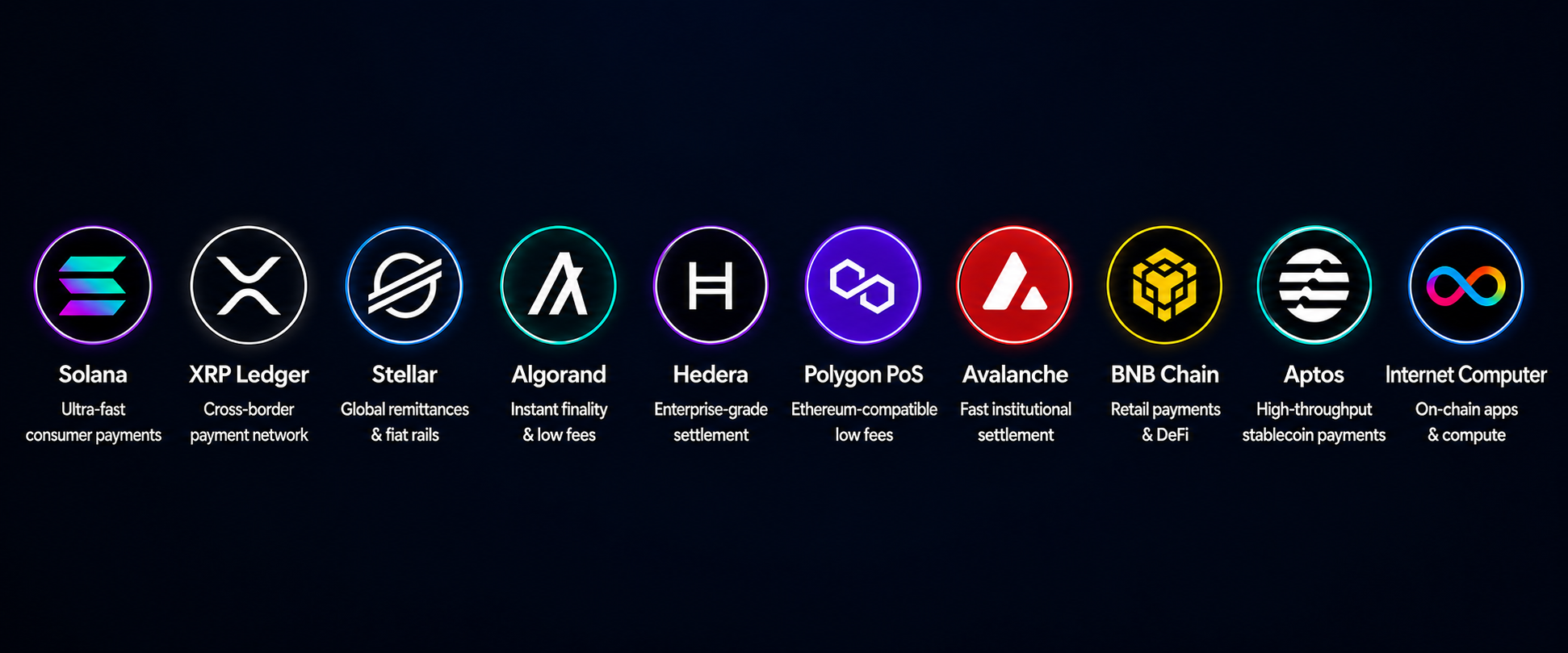
This list compares 10 fast networks through a payments-infrastructure lens. It covers stablecoin support, fee profiles, ecosystem fit, and operational tradeoffs. The goal is not to crown one winner. It is to help teams shortlist the right crypto rail for a specific corridor, product, and risk model.
Speed in crypto payments usually means three different things. A network can look fast by one measure and less attractive by another.
For payment infrastructure, headline TPS is only one part of the equation. A remittance company, crypto exchange, neobank, or corporate treasury team needs to know when recipients can safely use the funds, whether settlement is truly final, and whether transaction fees remain predictable during periods of high network activity. They also need confidence that the network provides the stablecoin liquidity, custody support, reconciliation capabilities, and compliance tooling required for the payment corridor.
Some networks provide quick user confirmation but require longer for full finality. Others offer deterministic finality but have less payment ecosystem depth.
Current ranking tools separate real-time TPS, max TPS, block time, and finality. That is because “speed” is a bundle of metrics, not one universal number.
Figures should be treated as directional. They vary by network conditions, measurement source, transaction type, exchange confirmation policy, and whether the source reports theoretical, peak, or observed throughput.
The fastest chain is not automatically the best payment rail. The best fit depends on finality model, stablecoin liquidity, exchange support, custody, fiat ramps, and compliance tooling.
Solana is a strong fit when volume, low fees, and consumer-grade UX matter. Its payment materials emphasize high throughput and low fees for merchant and stablecoin payments.
Solana Pay documentation describes a protocol and SDK for accepting decentralized payments in apps and services. This matters for payment teams that need checkout flows, QR-based payments, or app-native transfers.
Solana typically confirms transactions in under a second while maintaining very low transaction fees, making it attractive for high-frequency stablecoin payments and consumer use cases. However, payment teams should distinguish between confirmation and finality. A transaction may be confirmed quickly, but finalized blocks generally trail confirmed blocks by at least 32 slots, meaning additional time is required before settlement is considered irreversible.
Payment takeaway: Solana is compelling for stablecoin payments, merchant checkout, exchange flows, and consumer apps. Teams should decide whether they can act on fast confirmation or must wait for full finality.
They should also evaluate RPC reliability, custody support, monitoring, and incident response.
XRP Ledger (XRPL) is purpose-built for payments and deterministic ledger validation rather than broad smart contract composability.
Most transactions are accepted into the next ledger after submission, with final outcomes typically achieved within 4–7 seconds under normal network conditions. Like any blockchain, transaction times may increase during periods of network congestion or connectivity issues.
Transaction costs are also minimal. Standard transactions require burning a very small amount of XRP, with a reference minimum fee of 0.00001 XRP.
For payment infrastructure, finality is the key consideration. Transactions should only be treated as settled once they are included in a validated ledger, rather than relying on tentative submission results.
Payment takeaway: XRPL is well suited for payment providers that prioritize fast, low-cost, payment-native settlement and has an established track record in cross-border payments. It is less suitable for applications that require extensive EVM-compatible smart contract functionality.
Stellar is a payments-focused blockchain that combines fast settlement with strong fiat connectivity. It is designed to support cross-border payments, remittances, and asset transfers between traditional financial systems and digital assets.
The network typically reaches consensus in under six seconds using the Federated Byzantine Agreement (FBA) consensus mechanism, which differs from both proof-of-work and traditional proof-of-stake models.
A key differentiator is Stellar's anchor model. Anchors are regulated entities—such as banks, fintech companies, and money transfer operators—that connect the Stellar network to local financial systems. They enable users to move between fiat currencies and digital assets by issuing or redeeming tokenized assets and facilitating on- and off-ramp services.
Payment takeaway: Stellar's speed is valuable because it is backed by an ecosystem built for payments. Its anchor network, asset issuance capabilities, and remittance-focused infrastructure make it well suited for cross-border payment flows that require seamless movement between fiat and digital assets.
Algorand stands out for its deterministic finality, not just its transaction throughput. This makes it particularly attractive for payment products that require clear and predictable settlement.
Built on a Pure Proof-of-Stake (PPoS) consensus mechanism, Algorand provides instant block finality, meaning transactions are considered final as soon as they are included in a block. Because the network is designed to avoid forks, payment teams can build workflows around straightforward transaction completion without waiting for additional confirmations.
Following the go-algorand 3.16 upgrade, average transaction completion times are around 3.3 seconds. The network also has a minimum transaction fee of 0.001 ALGO and has demonstrated sustained high throughput in stress tests.
Payment takeaway: Algorand is a strong choice for payment infrastructure where predictable settlement and deterministic finality matter more than achieving the highest theoretical TPS. Its straightforward transaction lifecycle also simplifies messaging for users and operational teams.
Hedera is a public distributed ledger that uses the Hashgraph consensus algorithm rather than traditional blockchain block production, giving it a distinct infrastructure profile.
The network provides deterministic consensus finality within seconds, making it well suited for payment applications that require fast and predictable settlement. Its fee model is also designed with enterprises in mind. Transaction fees are priced in USD-denominated tinycents and automatically converted to HBAR using the current network exchange rate, helping businesses forecast costs more consistently.
Hedera uses a base-fee-plus-variable-cost pricing model, allowing transaction costs to scale based on the resources consumed. Businesses can also estimate fees in advance to support budgeting and volume planning.
Payment takeaway: Hedera is well suited for treasury operations, B2B payments, and enterprise payment infrastructure that value predictable fees, deterministic finality, and structured network governance. The tradeoff is that its governance model and ecosystem are more enterprise-oriented than many permissionless, crypto-native networks.
Polygon PoS is a practical choice for payments because it combines fast settlement with EVM compatibility. For many fintechs, exchanges, and payment providers, operational familiarity can be just as important as transaction speed.
The network offers cryptographic finality in around five seconds while supporting low-cost stablecoin transfers and high transaction throughput. Its close alignment with the Ethereum ecosystem also makes it a popular choice for global stablecoin payments and cross-border settlement.
A key advantage is ecosystem maturity. Polygon benefits from broad support across Ethereum-compatible wallets, custodians, developer tools, analytics platforms, tax solutions, and compliance providers, making it easier to integrate into existing payment infrastructure.
Payment takeaway: Polygon PoS is a strong option for businesses seeking low-fee stablecoin transfers without leaving the Ethereum ecosystem. Its combination of fast settlement, low costs, and mature EVM tooling makes it well suited for payment providers that want to leverage existing operational workflows.
Avalanche is well suited for payment infrastructure that requires both fast settlement and configurable network architecture. Rather than operating as a single blockchain, the ecosystem includes the C-Chain, X-Chain, P-Chain, and custom Avalanche L1s (formerly Subnets), each designed for different use cases.
Avalanche's consensus mechanism delivers transaction finality in around one second, making it attractive for payment applications that require low-latency settlement. Custom Avalanche L1s also allow organizations to define their own validator, staking, and governance rules, providing greater flexibility for institutional and application-specific deployments.
This flexibility means teams should evaluate the specific Avalanche environment they plan to use, as transaction performance, fee models, validator requirements, and network assumptions can vary across chains and custom L1s.
Payment takeaway: Avalanche is a strong option for institutional payment pilots, controlled payment environments, app-specific settlement networks, and EVM-compatible payment applications.
Its combination of fast finality and customizable infrastructure offers greater deployment flexibility, but teams should clearly define the target chain, validator model, fee structure, and settlement assumptions before implementation.
BNB Chain is widely used for payments because of its broad ecosystem, low transaction costs, extensive wallet support, and strong exchange connectivity. These characteristics make it particularly suitable for retail-oriented payment flows and stablecoin transfers.
The network supports payment use cases such as gasless stablecoin transfers, QR code payments, crypto cards, cross-border transactions, and fiat on- and off-ramp integrations. It also offers fast transaction processing, with block times of around 450 milliseconds and payment finality of approximately 650 milliseconds.
BNB Chain uses a dual-layer finality model that combines economic and probabilistic finality. Its EVM compatibility and large user base also make it a popular choice for exchange deposits and withdrawals, as well as peer-to-peer stablecoin payments.
Payment takeaway: BNB Chain is a strong option when ecosystem reach, retail adoption, and low-cost transfers are priorities. Before integrating, payment teams should evaluate network congestion, validator decentralization, stablecoin liquidity, exchange support, custody integrations, and compliance tooling to ensure the network meets their operational requirements.
Aptos is a high-performance Layer 1 blockchain designed for low-latency applications. It uses the Move programming language and a parallel execution architecture to improve transaction throughput and scalability.
Its Block-STM execution engine processes transactions in parallel rather than sequentially, enabling higher throughput under heavy network demand. The network has also expanded its stablecoin ecosystem with native support for USDC and USDT, making it increasingly relevant for peer-to-peer payments, cross-border transfers, digital commerce, and other stablecoin-based payment flows.
As a newer blockchain, Aptos has a less mature payments ecosystem than networks such as Stellar, XRPL, Polygon, or Solana. Before deployment, regulated payment providers should evaluate custody availability, exchange support, liquidity across payment corridors, risk monitoring, compliance tooling, and operational runbooks.
Payment takeaway: Aptos is a promising option for fintechs building new payment infrastructure that prioritizes low latency and high throughput. It is particularly attractive where native stablecoin support is available, but infrastructure readiness should be assessed on a corridor-by-corridor basis.
Internet Computer (ICP) highlights an important distinction in payment infrastructure: the fastest blockchain by performance metrics is not always the best payment rail. Rather than focusing solely on transactions per second (TPS), the network measures performance using requests per second, latency, and Million Instructions Executed Per Second (MIEPS).
The network's update calls typically reach consensus finality in around one to two seconds under normal conditions, although latency can vary across larger subnets. Its architecture is designed around sovereign compute and canister smart contracts, making it fundamentally different from blockchains primarily optimized for stablecoin-based payments and settlement.
While ICP ranks highly on certain throughput and performance benchmarks, payment infrastructure decisions depend on much more than raw speed. Stablecoin liquidity, wallet support, exchange connectivity, custody services, fiat on- and off-ramps, and compliance integrations are often more important factors when evaluating a production payment network.
Payment takeaway: Internet Computer demonstrates why benchmark performance alone should not determine payment rail selection. It is best viewed as an example of how blockchain performance metrics differ from real-world payment readiness, rather than as a default choice for cross-border payments or stablecoin settlement.
Choosing a fast crypto rail starts with technical speed, but it cannot end there. Use this checklist before selecting a network for production payments.
The core lesson is simple: the blockchain leg of a payment may settle in seconds, but the end-to-end cross-border payment often takes longer.
Fiat funding, FX conversion, compliance reviews, liquidity management, and local payout execution can still introduce delays. In practice, on- and off-ramps, liquidity, and regulatory workflows are often the biggest determinants of overall payment speed.
Transaction speed is only one part of delivering a great crypto payment experience. Businesses also need access to the right blockchain networks, reliable settlement, secure infrastructure, and compliance tools to support real-world payment flows. Choosing the fastest network means little without an enterprise-grade platform to integrate and manage it.
Fuze provides regulated digital asset infrastructure that enables banks, fintechs, payment service providers, and enterprises to build crypto payment and digital asset solutions through a single integration. By supporting leading blockchain networks and enterprise-grade APIs, Fuze helps businesses deliver faster, more reliable crypto transactions while reducing the complexity of managing blockchain infrastructure.
Learn how Fuze's crypto payment infrastructure can help your business build faster, secure, and scalable digital asset experiences.


